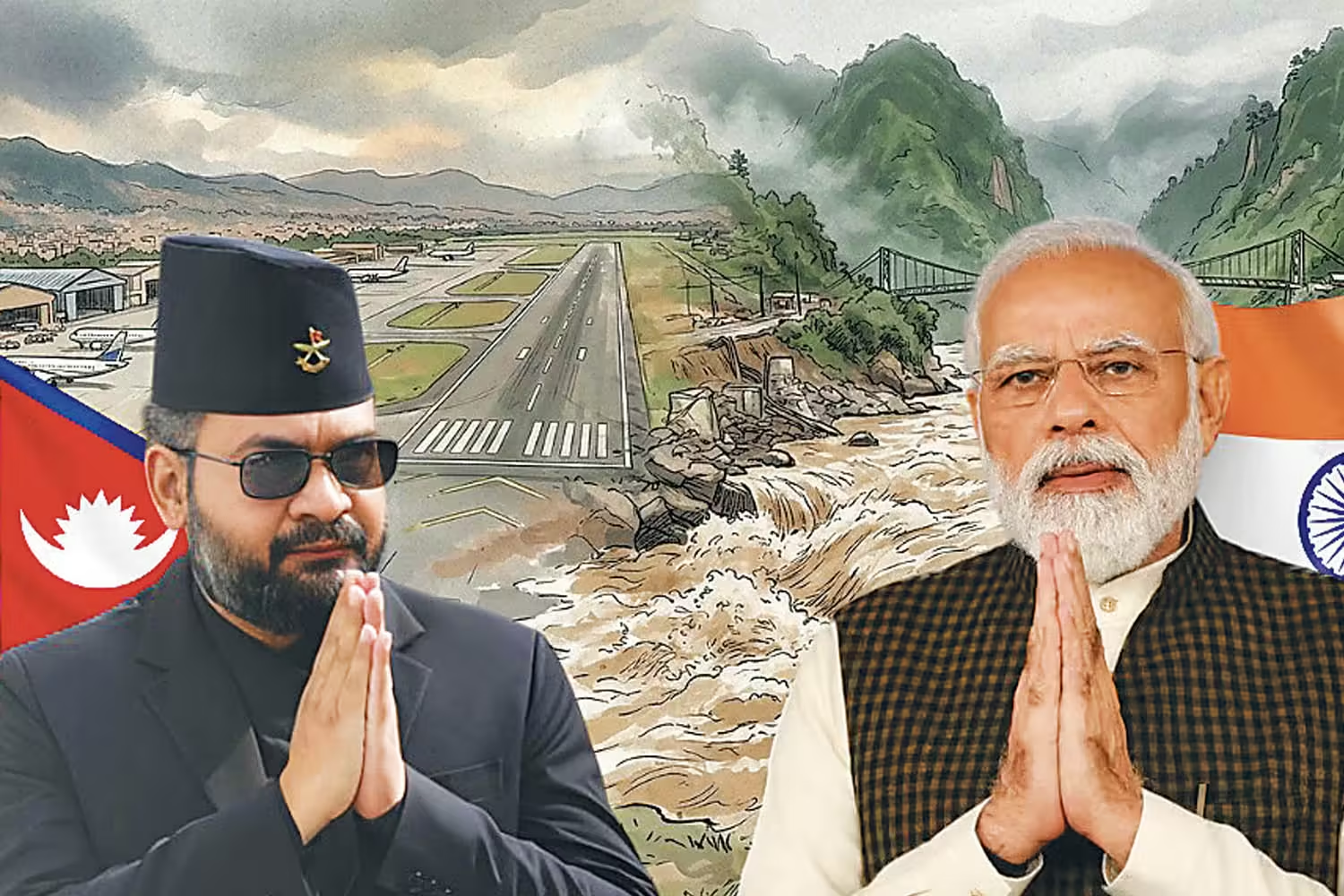

As preparations ramp up for Prime Minister Balendra Shah’s India visit, observers have cautioned Kathmandu against approaching New Delhi with an extensive wish list, arguing that Nepal should instead focus on restoring the political trust and confidence with its southern neighbour.
“Ask no favour and take no wish list along. Talk to the other side eye to eye as an equal counterpart,” former foreign secretary Madhu Raman Acharya advises the Nepali prime minister. “Concentrate on issues that need to be resolved at the highest political level. Focus on building trust and confidence. Let the mechanisms work on the issues; the rest will follow.”
India’s Foreign Secretary Vikram Misri returned to Delhi on Thursday after two days of engagements in Kathmandu. In a trip focussed on Prime Minister Shah’s visit to Kathmandu, Misri discussed a range of proposals and agendas put forward by the Nepali side.
Misri paid courtesy calls on the prime minister, Finance Minister Swarnim Wagle, Foreign Minister Shisir Khanal, Energy Minister Biraj Bhakta Shrestha and Infrastructure Development Minister Sunil Lamsal. In these meetings and others with senior officials, potential agendas for the prime minister’s visit were discussed. Both sides have tentatively agreed November 22-25 for Prime Minister Shah’s first official bilateral visit since taking office in March.
Misri focussed largely on government-to-government engagement as the visiting secretary held fewer political meetings in Kathmandu. The reading of the Indian establishment is that there is less fragmentation in Nepali politics this time. According to a Nepal observer in New Delhi, this is the reason why Misri did not have many political meetings and parleys in Kathmandu, in a break from past visits from India that saw meetings with Nepali leaders across the political spectrum.
The two neighbours need to restore confidence in order to normalise their relations, Acharya stressed. “There must be a solid understanding between the top leadership [on both sides].”
Once confidence and trust are restored, things will move faster, Acharya said about Nepal-India cooperation.
Besides infrastructure projects, Nepal is seeking an early review of the Nepal-India Trade Treaty, which is currently scheduled for renewal in 2030. The proposed revision aims to address non-tariff barriers and difficulties faced by Nepali exporters.
Nepal has also requested access to two additional Indian ports in Gujarat and Odisha to facilitate trade with third countries.
Although preliminary discussions have taken place on several proposals, no agreements have yet been finalised. India’s response will be particularly important on the proposed financial assistance package, rupee-denominated loans, additional air-entry routes, railway expansion and revision of the trade treaty, government officials said.
“If we do not have good relations at the top level, nothing will happen at the bottom. So building confidence is very important. The prime minister should focus on building trust and confidence with the Indian leadership,” former secretary Acharya told the Post.
In New Delhi, the mood is positive, said Ranjit Rae, former Indian ambassador to Nepal. He said a series of back-to-back visits by officials and political leaders from both countries had helped prepare the ground for the current engagement.
“Misri’s visit has added positive vibes to the relationship. The overall attitude in New Delhi is positive and problem-solving. There is a growing sense that we should take a pragmatic approach towards resolving differences,” Rae told the Post from New Delhi.
Several ministers of the Rastriya Swatantra Party government have visited India in recent months. They include Finance Minister Wagle, Foreign Minister Khanal and Home Minister Sudan Gurung.
Before returning to Delhi, Misri met only two political leaders—RSP President Rabi Lamichhane and Nepali Congress President Gagan Thapa.
During previous high-level visits, Indian leaders and officials would typically meet representatives of the Madhesh-based parties and other political forces. But Misri did not meet any Madheshi leader in Kathmandu this time.
“But they are in communication with us,” said Surendra Kumar Jha, a Madheshi leader close to Mahantha Thakur. “We heard that meetings with Madheshi leaders were not on the itinerary,” he said.
Nepal–India relations must be guided by the well-being and prosperity of the people of both countries, said former Nepali Army general Binoj Basnyat. The objective, he said, should be to advance economic statecraft through development-oriented diplomacy, transforming geographical proximity and historical ties into tangible opportunities for shared growth.
“Today’s national mandate is not about ideological alignment or political competence defined by ideology. It’s about delivering reforms, strengthening institutional capacity and pursuing an opportunity-driven foreign policy,” Basnyat said.
“Diplomacy must increasingly serve economic interests—mobilising investment, expanding trade, strengthening connectivity, creating employment and unlocking shared development opportunities.”
The priority is to move from political rhetoric to tangible results, from traditional diplomacy to development diplomacy, and from managing differences to building mutual prosperity, Basnyat suggested.
In Kathmandu, Misri and Nepali officials discussed Nepal’s proposal for a $2 billion economic assistance package from India, alongside major infrastructure, trade, energy and connectivity initiatives.
Nepal has sought $1 billion in grants and another $1 billion in concessional loans to finance various development projects.
Of the proposed grant assistance, $500 million would be allocated for the construction of the Butwal–Pokhara Expressway, while the remaining $500 million would support the reconstruction of infrastructure damaged by the Bhotekoshi flash flood. The concessional loans would primarily finance hydropower projects and electricity transmission lines.
Nepal has also proposed receiving loans in Indian rupees instead of US dollars to minimise foreign exchange risks and make future debt repayments more predictable.
In the water resources sector, the two sides have agreed to convene a meeting on the Pancheshwar Multipurpose Project to address outstanding water-sharing issues. Other proposals include constructing an LPG pipeline from Motihari in India to Sarlahi, extending the existing Raxaul-Amalekhgunj petroleum pipeline to Bhandara in Chitwan, and building another petroleum pipeline from Siliguri towards Jhapa.
Beyond infrastructure, Kathmandu has proposed establishing branches of India’s prestigious Indian Institutes of Technology (IITs) and Indian Institutes of Management (IIMs) in Nepal. It has also sought cooperation in areas such as artificial intelligence and technical assistance for cricket development through training, capacity building and knowledge exchange.
Meanwhile, preparations are under way for the joint inauguration of several Indian-assisted projects, including the Bhairahawa Integrated Check Post, the Police Training Centre in Panauti and a bridge in Darchula.
The Butwal-Pokhara Expressway is among Nepal’s major infrastructure priorities. Estimated to cost around $750 million, the project aims to reduce travel time between the Indian border and Pokhara to about two hours while promoting tourism, trade and transportation. The Asian Infrastructure Investment Bank has already conducted a feasibility study for the project.
During Misri’s visit, a trial run was also conducted on the Janakpur-Ayodhya rail route to promote religious tourism.
“The trial run of the Ayodhya-Janakpur rail service is a good step forward,” outgoing Indian Ambassador to Nepal Naveen Srivastava wrote on social media platform X. He said the commencement of regular train services between the two historic cities would reinforce the strong cultural and traditional bonds between India and Nepal and boost bilateral tourism.
Nepal has also proposed extending railway lines from Janakpur through Bardibas to Nijgadh, as well as connecting Raxaul in India with Birgunj and Pathlaiya.
In the aviation sector, Nepal is seeking additional international air-entry routes through its western borders, particularly Mahendranagar and Nepalgunj, to improve access to Pokhara and Bhairahawa international airports. It has also proposed direct flights between Bhairahawa and Kushinagar, Pokhara and Varanasi, and Nepalgunj and Delhi. Both sides are planning to hold a technical-level meeting soon to discuss the proposals.
Source: kathmandupost.com