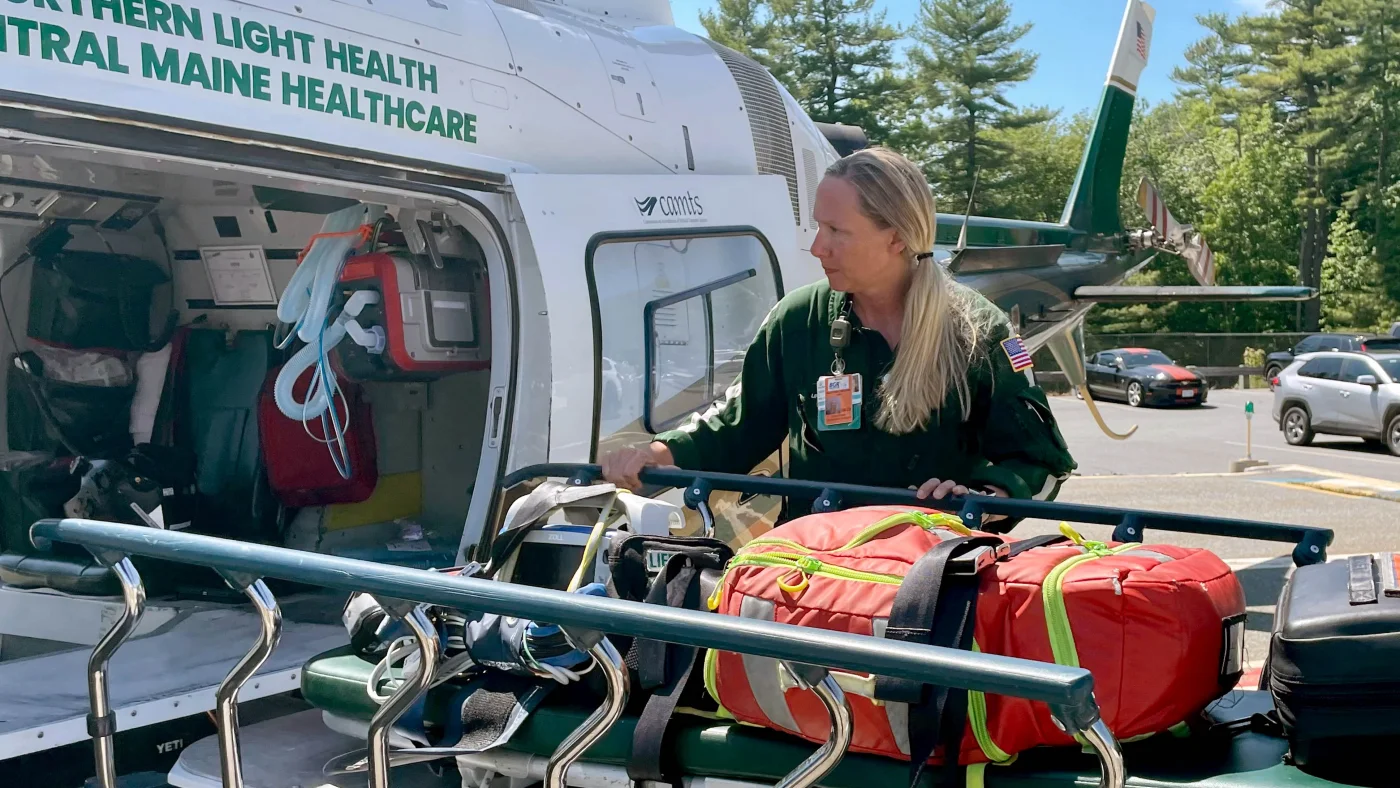

Flight nurse Denise Saucier begins loading a stretcher and equipment into a helicopter on the tarmac at LifeFlight of Maine’s Bangor headquarters. It takes only a few minutes for the crew to prepare for takeoff.
Elaine Appleton Grant for NPR
hide caption
Elaine Appleton Grant for NPR
Clipboard in hand, pilot Will Bradbury stands near a helicopter at LifeFlight of Maine’s Bangor headquarters. He’s running down emergency landing tips with his crew.
“If we need to get out quickly because of smoke or fire, just watch the terrain so that you’re not walking uphill into the rotors,” he reminds flight nurse Denise Saucier and paramedic Brian Merklin.

The team is getting ready to take off on a medical transport flight. Saucier folds herself into the compact helicopter. She’s worked for the air ambulance service for seven years and still calls it a dream job.
Dream job or not, the life of a flight clinician is hard and, given the headwinds slamming rural healthcare, getting harder.
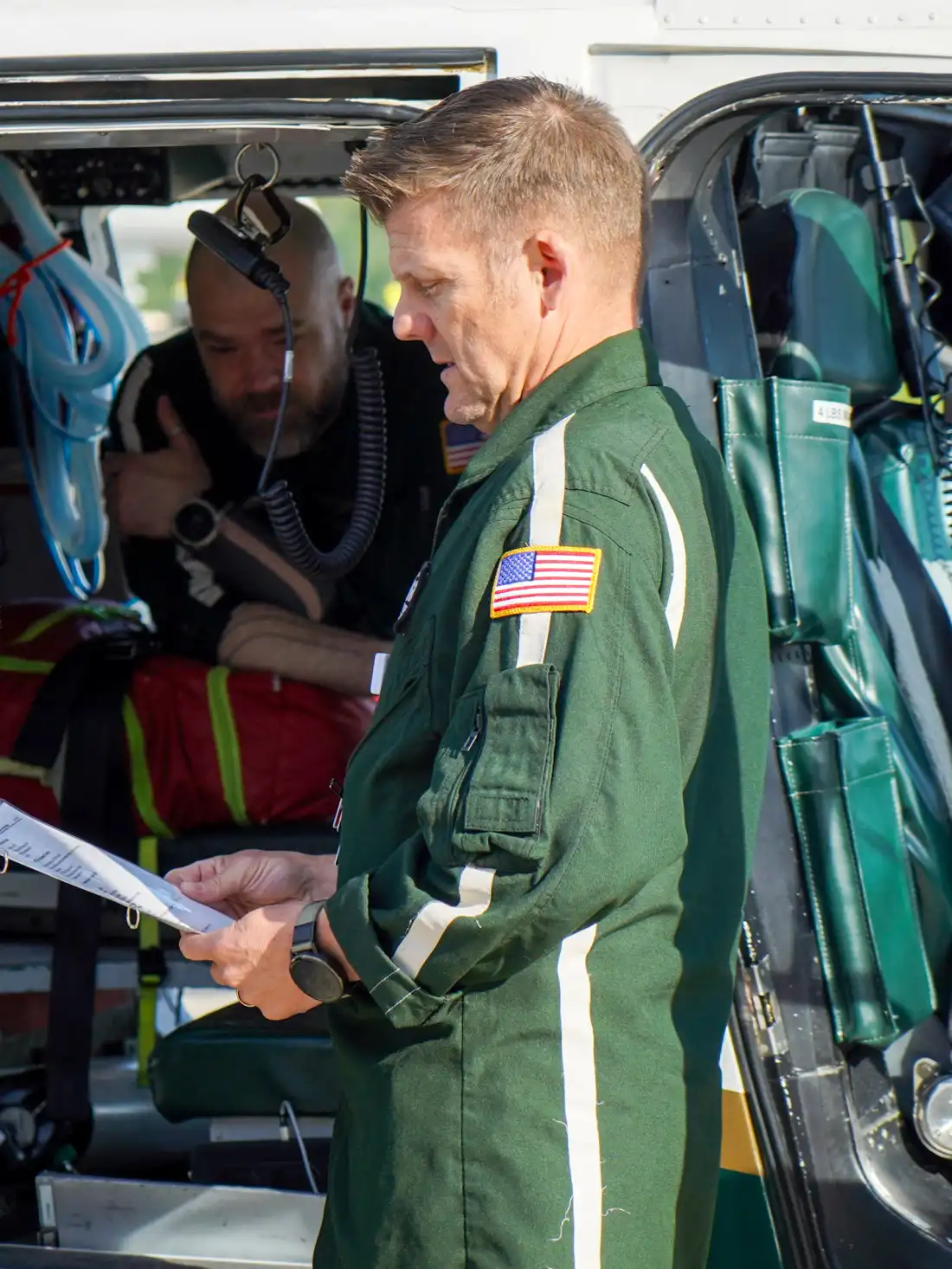
Pilot Will Bradbury runs down emergency landing tips with his crew ahead of a flight from LifeFlight of Maine’s Bangor headquarters.
Henry Frank/LifeFlight
hide caption
Henry Frank/LifeFlight
Since 2015, demand for medical flights in Maine has doubled. In 2025, LifeFlight crews flew 3,031 flights, more than one every three hours. This year, demand is up another 10%.
Nationwide, air medical services are filling the gaps left behind as rural hospitals close, convert to outpatient-only rural emergency hospitals, or stop offering unprofitable services like labor and delivery.
And, as Medicaid cuts estimated by the Congressional Budget Office at $911 billion over ten years take effect, it’s going to get worse. Hundreds more rural hospitals or maternity departments are at immediate risk of closing. With every closure, medical care gets further away.

And, increasingly, ground ambulance stations, many of which are also struggling to keep their doors open, can’t meet the need. That leaves flight clinicians like Saucier and Merklin seeing more patients every day.
“We’re seeing this across the board. The need for air medical services is increasing year over year,” says Nicholas George. He runs the ETHOS Database, a national tracking system for air medical programs.
When the rural health care system breaks, EMS — on the ground and, increasingly, in the air — is the backstop.
For stories on the science of healthy living, subscribe to NPR’s Health newsletter.
Healthcare of last resort
Every week or two, Saucier finds herself on a flight to one of Maine’s thousands of islands. Occasionally, crews even land in the state’s vast forests and mountains, then take snowmobiles to reach patients.
But “scene calls” to roadside — or trailside — accidents are less than 10% of LifeFlight’s transports. (They’re a higher percentage in urban areas.)
Most are interfacility transports, like today’s. They’ll stabilize a patient at a small, local hospital and fly them to a larger, better resourced one.
Saucier glances out the window for hazards. The view still reminds her of the role the organization plays in Maine, one of the country’s most rural states.
“You go so long of a distance without seeing any houses, any roads,” Saucier says. “It really hits home how rural Maine is and how necessary EMS is in the state.”
And the pressure is on air ambulances as ground services in Maine are increasingly strained. The system is so fragmented that patients can fall through the cracks. Last year, a woman in a small northern Maine town died while the county dispatch center called 10 ambulance services. None responded.

Pilot Will Bradbury guides the helicopter during a flight over rural Maine (right). The view out the window includes some of the many lakes near Bangor (left).
Elaine and Frank
hide caption
Elaine and Frank
Air ambulance services, though, come with unique challenges, particularly since the COVID-19 pandemic. It’s been difficult to retain staff with the medical expertise to treat everything from heart attacks to injuries to fragile newborns, and who can stick with the demanding job without burning out.
Almost a quarter of ground-based EMS workers leaves the field every year. While there’s no comprehensive staffing data for air medical services, flight clinicians face a slew of unique stresses, including dangerous conditions; long shifts and unpredictable hours; ever-increasing training and certification requirements; and significant mental health burdens. And then there’s the pay, which is low throughout emergency medical services.
For years, LifeFlight retained only 60% to 70% of its workers, says CEO Joe Kellner.
“This is a really hard job,” Kellner says. “By their job description, they are seeing people on their worst day, over and over again.”
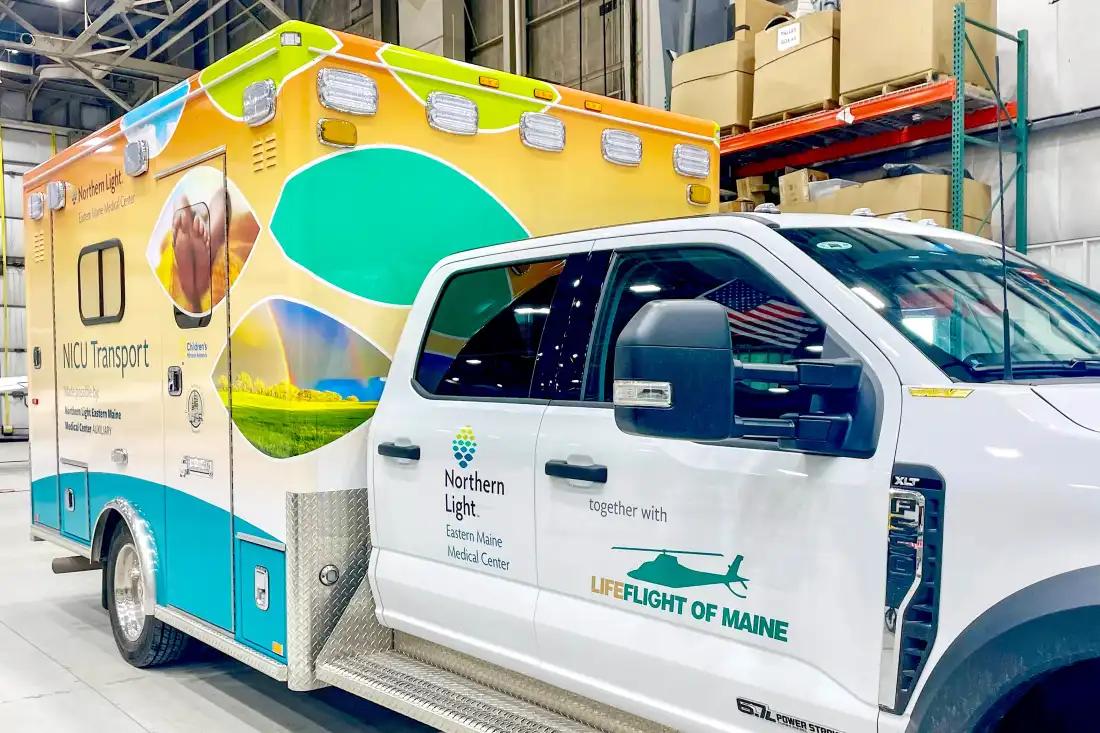
A specialty ambulance designed to transport newborns who need critical care. Northern Light is one of Maine’s large hospital systems; it works in partnership with LifeFlight of Maine. By the end of the year, Maine will have lost 12 of its labor and delivery departments, causing a statewide shortage of birthing centers.
Elaine Appleton Grant for NPR
hide caption
Elaine Appleton Grant for NPR
Training elite clinicians
This year, for the first time in nine years, LifeFlight is nearly fully staffed. One of the nation’s handful of independent nonprofit air medical companies, LifeFlight has taken an innovative approach to the problems that plague the industry, including a combination of better training, higher pay and in-house mental health support.

Mike Abernethy, an EMS expert and retired emergency medicine professor at the University of Wisconsin, considers the company one of a handful of model programs for the industry. LifeFlight of Maine is a nonprofit, unlike much of the industry, which is dominated by for-profit businesses with reputations for charging exorbitant prices.
“There’s just absolutely no comparison in the aviation and medical quality of these programs” versus an average for-profit air medical business, Abernethy argues.
When Kellner, a paramedic himself, became CEO in 2023, he began addressing the recruitment and retention problems. What LifeFlight calls the “Critical Care Academy,” a six- to eight-month orientation program, is intended to address both issues.
Emergency critical care advances quickly. So most clinicians need regular education, both to remain successful on the job and to get hired in the first place.
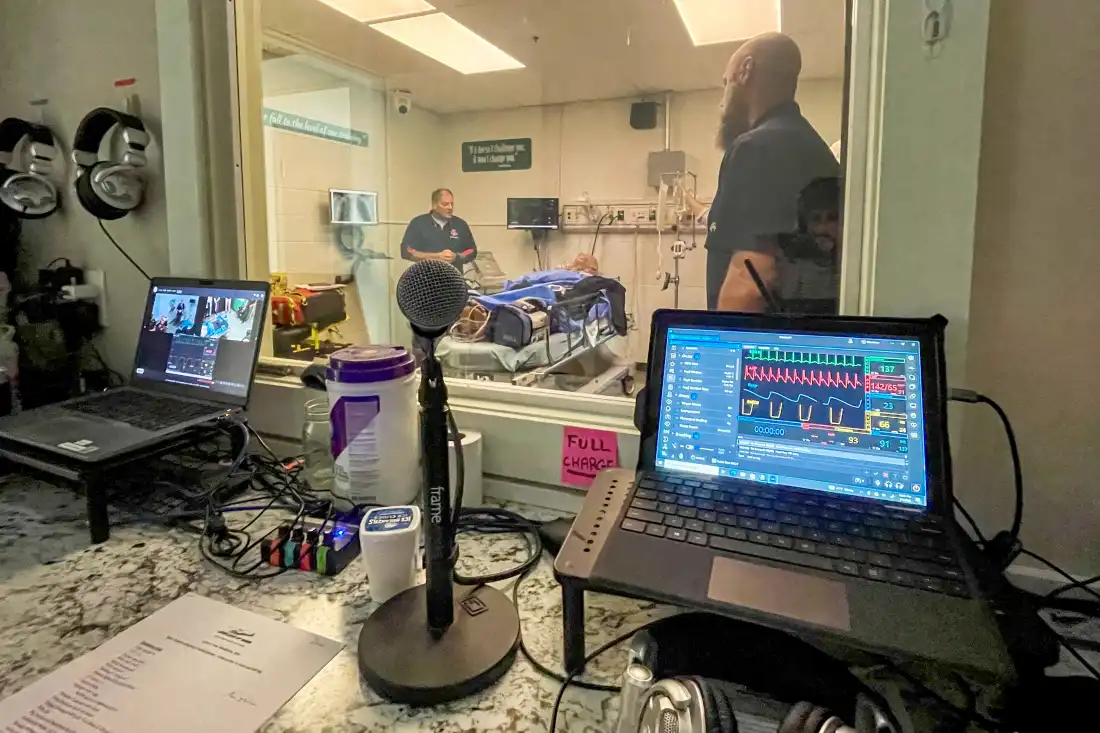
Seen through the window of a control room, Chuck Hogan, LifeFlight of Maine’s chief clinical officer, (left) stands next to a “breathing, bleeding” dummy in a fake hospital room. He’s preparing for a simulation of an emergency, designed to test clinicians’ skills.
Elaine Appleton Grant
hide caption
Elaine Appleton Grant
On another day at headquarters, four instructors sit in a claustrophobic control room. Through a window looking into what appears to be a hospital room, paramedics Daniel Horne and Brad Alleger are undergoing an annual skills assessment, a simulation of a real-life medical crisis.
Dr. Dave Saquet turns on a mic and coughs. “It’s hard to breathe,” he whispers urgently. “It hurts everywhere.”
His voice seems to be coming from the patient — a breathing, bleeding mannequin lying on a hospital bed.
“What happened to you?” Horne asks.
“My house was on fire,” Saquet chokes out.
A wall monitor displays the patient’s vital signs — which Saquet is manipulating on his laptop.
Medics and nurses here do simulations often, both to pass the Critical Care Academy, and also to stay up to date on occasional but critical events, like emergency births, newborn resuscitation, and burns. Before the assessment ends, the paramedics will have tried and failed to intubate the patient. After that “failure,” they performed an emergency procedure to enable breathing, switching from the mannequin to a pig trachea.
Because it’s hard to find recruits qualified enough for the rigorous training, the company also started a mentorship program for people considering applying. Some even attend the academy, gaining skills even if they’ll never work for LifeFlight.
Success comes slowly: Recently, LifeFlight hired one of last year’s mentees.

Experiments
Kellner instituted an unusual change that he says even nurses endorse: LifeFlight raised paramedics’ pay to match flight nurses’ compensation. Industrywide, paramedics make less. That keeps costs down, which is why pay equity is rare. Kellner believes the change has helped with recruitment.
Another experiment: LifeFlight hired a full-time mental-health counselor.
EMS workers’ rates of post-traumatic stress injury, anxiety and depression are more thanfive times higher than the average American’s.
“That has led people to leave this profession,” Kellner says.
That was true for paramedic Brian Merklin, who was working for a different service in Nevada during the pandemic.
“We got hit really hard,” he says. “The crews were just flying nonstop. We did four-day shifts, so for 96 hours we were just going, going, going.”
About a third of the staff quit, he says. “They were getting air medical service plus COVID, right in the teeth.”
Eventually, Merklin too needed a break. He left the profession for a few years. Then, when he felt the urge to fly again, he found LifeFlight.
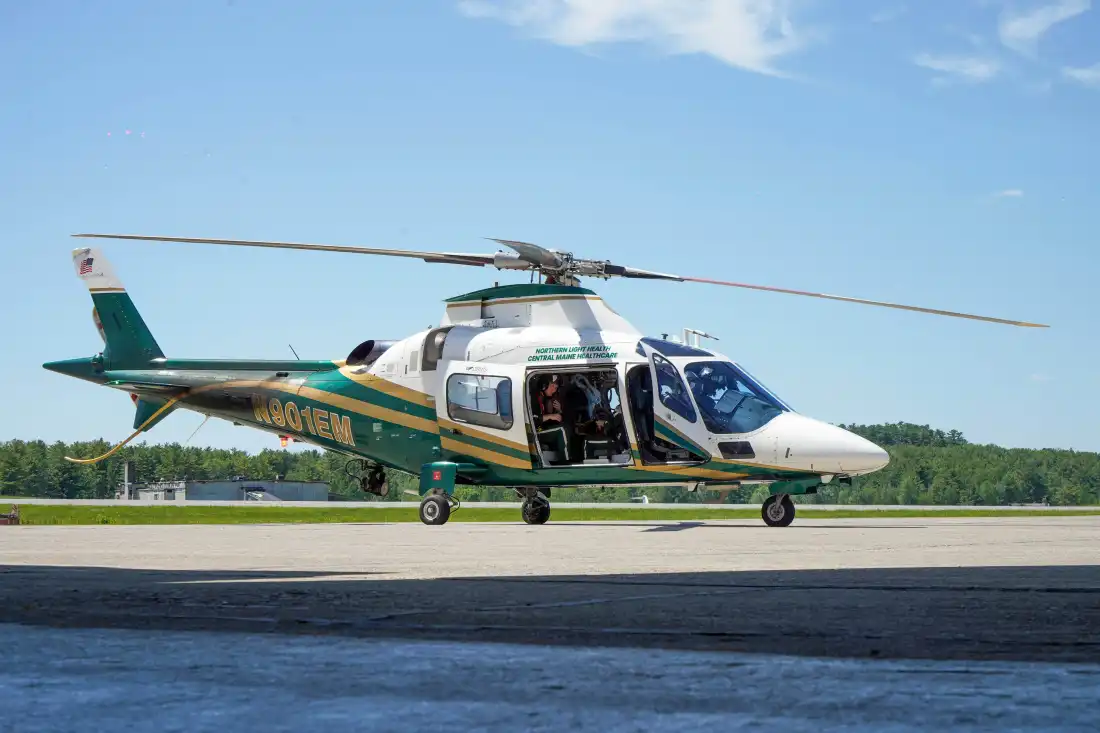
A LifeFlight of Maine helicopter and crew at the company’s base at Bangor International Airport in Maine.
Henry Frank/LifeFlight
hide caption
Henry Frank/LifeFlight
Today’s trip
The helicopter, which took off from Bangor, lands on a community hospital’s rooftop helipad. Merklin and Saucier hurry to the patient’s side. Most LifeFlight patients are unconscious or too ill to consent to share their stories, so the details are private. The injuries are shocking. If this patient doesn’t get to a trauma center quickly, they might die.
Merklin and Saucier are unfazed.
But it’s this kind of incessant trauma exposure that makes mental health support for first responders so invaluable.
Merklin serves on a peer support team.
“There’s a lot of lip service paid … to the cost to your mental health in this profession. But this is the only place I have ever worked that actually provided support,” he says. “I would love to see it take hold in other areas.”
If counseling keeps two or three people from leaving, it’s a wise investment, Kellner argues: “The cost of training somebody new into our organization is about $100,000.”
As both air and ground EMS become even more essential, the task is to recruit and keep more people like Merklin and Saucier.
Because, if hundreds more hospitals do close, highly trained EMS workers may be the only people standing between patients dying and getting the care they need.
Elaine Appleton Grant’s reporting was supported by the National Institute for Health Care Management.
Source: www.npr.org