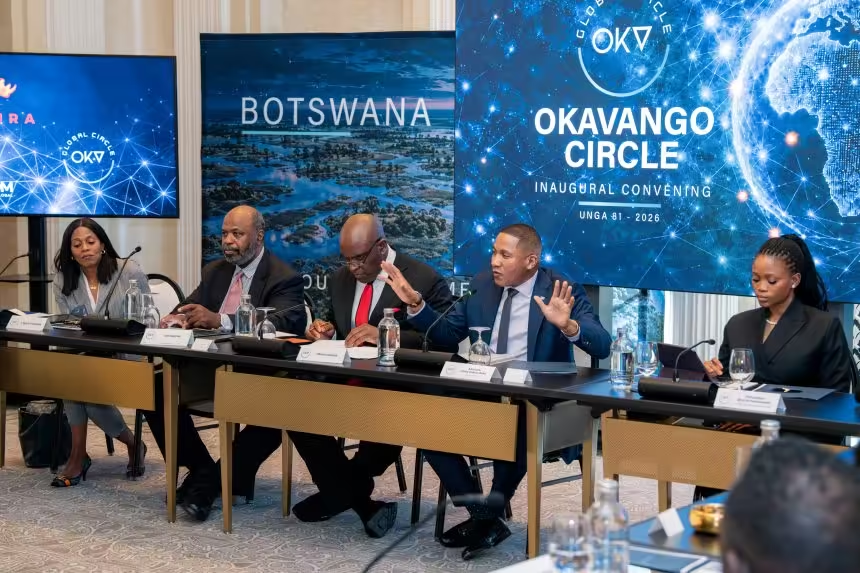

Backed by Botswana President Duma Boko and guided by Co-Chairs Ufo Eric-Atuanya, Jude Kearney and Ijeoma D. Agboti-Obatoyinbo, the Okavango Circle seeks to give Africa a stronger voice in global decisions on critical minerals, technology, finance and industrial development.
By Ajong Mbapndah L *
For generations, Africa has supplied the minerals that power industries, sustain economies and drive technological advancement around the world. From copper and cobalt to the resources underpinning the global energy transition, the continent remains indispensable to international economic development. Yet much of the wealth, technology and industrial capacity generated from these resources has accumulated elsewhere. The question confronting African leaders is how to turn the continent’s enormous natural wealth into greater economic influence, industrial growth and lasting prosperity.
For Botswana President Duma Gideon Boko, the answer begins with challenging economic arrangements that have historically confined Africa to the lower end of global value chains. His backing of the newly launched Okavango Circle reflects a determination to place African governments, industries and institutions at the centre of discussions about critical minerals, artificial intelligence, emerging technologies and finance.
Officially launched on September 22, 2026, on the sidelines of the 81st United Nations General Assembly in New York, the Okavango Circle brings together governments, investors, technology leaders, researchers and industry representatives to examine the growing connections between these sectors. Its central argument is that Africa must move beyond supplying raw materials to participate more fully in the industries, technologies and financial systems shaping the global economy.

The launch at the Waldorf Astoria attracted senior government officials and international stakeholders, including Botswana’s Minister of Minerals and Energy, Bogolo Kenewendo, and Eswatini’s Minister of Information, Communications and Technology, Senator Savannah Maziya. Their participation highlighted growing African interest in linking mineral development with technological advancement, investment and industrial transformation.
President Boko set the tone with a frank assessment of Africa’s historical relationship with international investors and mineral markets.
“Current mineral trade with Africa was structured to merely extract ore and cart it away raw to places outside Africa. And the bulk of Foreign Direct Investment that has come to Africa has been resource seeking Foreign Direct Investment which simply came to cart away the ore,” he declared.
His remarks captured a longstanding development challenge. Despite decades of mineral production and foreign investment, many African economies continue to struggle with limited processing capacity, inadequate infrastructure and insufficient participation in the higher-value activities associated with their natural resources.
For Boko, reversing that trend requires stronger institutions, productive investment and partnerships that allow African economies to retain more value from their resources. It also requires greater African participation in international economic decision-making.
“Often conversations about Africa take place away from Africa outside of Africa,” he observed.
The President expressed hope that the initiative would help ensure that Africa’s story is shaped and communicated from the continent itself. He also welcomed the possibility of hosting influential international gatherings in Botswana, bringing discussions traditionally held in established global financial and political capitals closer to the countries most directly affected by their outcomes.
Inspired by Botswana’s world-renowned Okavango Delta, the Circle carries a distinctly African identity while pursuing an international mandate. Its ambition is to strengthen Africa’s position within global economic systems through informed engagement, stronger partnerships and greater participation in decisions affecting the continent’s future.
Boko also acknowledged the limitations of governments acting alone and the importance of drawing on expertise from the private sector, research institutions and international partners.
“The assumption always when government takes a position is that government has the knowledge, the skill, and the expertise. That is not always correct,” he acknowledged.
His assessment underscored the importance of cooperation between governments and institutions capable of mobilizing investment, developing technologies and supporting industrial growth.

Three Co-Chairs, One Vision
Providing strategic direction to the initiative is a Steering Committee co-chaired by Ufo Eric-Atuanya, Jude Kearney and Ijeoma D. Agboti-Obatoyinbo. Together, they bring extensive experience in international investment, energy development, infrastructure finance, corporate governance and global economic engagement. Their professional backgrounds provide the Circle with expertise across several of the sectors central to its mission.
Eric-Atuanya, President of Rimsom Global, has played a prominent role in advancing the initiative’s vision and international engagement. His firm organized the New York launch, helping convene government officials, investors, industry representatives and technology specialists around the Circle’s objectives.
Jude Kearney brings more than 25 years of experience in African energy development, international commercial law and infrastructure finance. A seasoned legal and investment adviser, he has worked extensively with governments, corporations and investors on complex petroleum, electric power and infrastructure projects across the continent. His career includes six years in Johannesburg as Managing Partner of an international law firm specializing in energy projects, as well as an earlier professional assignment in Nigeria. Kearney also served as a senior official in the U.S. Department of Commerce during the Clinton administration, working closely with the late Commerce Secretary Ron Brown and helping advance American international trade and market access initiatives, particularly in Africa and Asia. A graduate of Harvard University and Stanford Law School, he brings to the Circle a combination of legal expertise, international policy experience and longstanding engagement with Africa’s investment and development landscape.
Ijeoma Agboti-Obatoyinbo adds considerable depth to the Circle’s investment and financial leadership. A global institutional investment executive and board director with more than 25 years of experience across four continents, she has built a distinguished career spanning private equity, venture capital, alternative investments, asset allocation and investment governance in developed and emerging markets. She most recently served as Chief Executive Officer of FBNQuest Funds, the alternative investments business of FBN Holdings Plc, where she led a regulated investment management platform and served on the executive leadership team. She also held non-executive directorships at FBNQuest Capital and FBNQuest Asset Management. Earlier in her career, she spent 13 years at JPMorgan Chase & Co., including 11 years with JPMorgan Asset Management’s Private Equity Group in New York and London. Founder of OAI Alternative Investments, she has advised institutional and private investors on investment strategy and capital allocation. She holds degrees and qualifications from the University of Lagos, Harvard University and INSEAD, where she earned her MBA.
Their combined experience could prove valuable as the Circle seeks to engage governments, international investors, technology companies and development institutions. Eric-Atuanya’s strategic engagement, Kearney’s understanding of energy investment and international trade, and Agboti-Obatoyinbo’s institutional investment expertise offer complementary strengths for building partnerships and advancing the initiative’s priorities.
For Eric-Atuanya, what distinguishes the Okavango Circle is its recognition that the world’s most important economic systems can no longer be understood in isolation.
“What makes the Okavango Circle novel is that it is not looking at critical minerals, artificial intelligence, emerging technologies and finance as separate conversations. It is focused on the governance of their convergence: the interconnectedness between these systems and the implications that this convergence has for economies, societies and institutions,” he explained.
His argument reflects the changing relationship between natural resources, technological innovation and economic power. Critical minerals are essential to advanced technologies, while those technologies increasingly influence how resources are discovered, extracted and processed. Finance determines which projects attract investment and where new industries take root.
“The question is no longer simply how we govern critical minerals, or how we govern artificial intelligence, or how we govern finance. The question is how we govern the points at which these systems intersect, influence one another and create new opportunities and risks,” Eric-Atuanya said.
The Circle intends to examine these connections and encourage governments, investors and industry leaders to develop more coordinated approaches to the opportunities and challenges they present.

Beyond Minerals: Africa’s Place in the New Global Economy
The Okavango Circle has emerged as international competition for critical minerals intensifies. Countries are seeking secure supplies of resources needed for electric vehicles, renewable energy technologies, electronics, digital infrastructure and advanced manufacturing. At the same time, artificial intelligence and other emerging technologies are transforming industries and influencing investment decisions.
Africa occupies an important position in these developments because of its mineral endowment and potential for industrial expansion. However, resource ownership alone does not guarantee economic influence. Many countries still lack the processing facilities, reliable energy supplies, transport networks, financing and technical capabilities needed to participate fully in global value chains.
The Circle seeks to encourage discussions that address these constraints while identifying opportunities for African economies to strengthen manufacturing, improve technology access and attract investment into productive industries. Its agenda extends beyond mining to the broader question of how resource-producing countries can develop the skills, infrastructure and institutions needed to compete internationally.
The relationship between minerals, technology and finance also raises difficult questions about ownership, regulation, economic security and the distribution of benefits from technological progress. Decisions made today about mineral supply chains, artificial intelligence and industrial investment could influence the economic prospects of African countries for decades.
For governments seeking to diversify their economies, greater participation in mineral processing, manufacturing, research and technology development offers opportunities to create skilled employment and expand domestic industries. Achieving those objectives will require sustained investment, effective policies and cooperation between public institutions and businesses.
The issues are not exclusively African. Supply-chain security, access to strategic resources, technological competitiveness and responsible investment are increasingly important concerns for governments and industries worldwide. The Circle hopes to provide a platform where African priorities can be considered alongside those of international partners.
Botswana’s Leadership and a Continental Ambition
Botswana’s prominent role in the launch has given the Okavango Circle an important political platform, although the initiative is intended to operate as a global forum rather than exclusively as a government programme. President Boko has expressed support for its objectives, while the Government of Botswana is engaging with the initiative as its institutional and implementation arrangements are developed.
The participation of Minerals and Energy Minister Bogolo Kenewendo reinforced Botswana’s interest in linking natural resources with industrial development and investment. For a country whose economic history has been closely associated with mineral production, the discussion is particularly relevant as African economies seek to diversify and strengthen local value addition.
Eswatini’s Senator Savannah Maziya brought a complementary perspective from the technology sector, emphasizing the connection between Africa’s mineral resources and the technological systems transforming the world.
“As Minister of Information, Communication and Technology for the Kingdom of Eswatini, this is a highlight of my meetings in New York. My presence here reflects an understanding of the indelible link between our minerals and global technology,” she stated.
Her participation reflected the wider African interest generated by the initiative, although it did not constitute a formal institutional endorsement by the Government of Eswatini.
The involvement of senior African officials also demonstrated the relevance of discussions that bring together resource development, technological advancement and international investment. For countries seeking to strengthen their industrial competitiveness, these issues are increasingly interconnected.
President Boko’s support reflects a broader aspiration to make Africa a more influential participant in international economic discussions. Hosting future engagements on the continent could also provide opportunities for African policymakers, businesses and researchers to contribute more directly to debates affecting their economies.
Turning Ambition Into Action
Following its New York launch, the Okavango Circle faces the challenge of establishing the institutions, partnerships and programmes needed to advance its objectives. The attention generated by the initiative’s debut provides an opening, but its long-term relevance will depend on what follows.
The Steering Committee is expected to prepare a Tactical Plan within 60 days of the September 22 launch, outlining proposed next steps for submission to the Government of Botswana. The plan is intended to establish priorities for stakeholder engagement, institutional development, partnerships and future international activities.
An important component of the proposed framework is the Technology Convergence Governance Institute (TCGI), envisioned as the institutional and implementation arm of the initiative. While the Circle would provide a forum for high-level dialogue and strategic engagement, TCGI is intended to support research, policy development, programmes and partnerships arising from those discussions.
The proposed arrangement seeks to address a familiar weakness of international initiatives: the difficulty of translating conferences, declarations and high-level commitments into sustained action. Establishing credible institutions and clear implementation priorities will therefore be important to the Circle’s development.
Its effectiveness will also depend on the quality of the partnerships it builds and its ability to attract the expertise and resources required to support practical programmes. Cooperation with governments, investors, universities, technology companies and development institutions could help turn its broad agenda into more focused initiatives.
For African countries, the most meaningful outcomes would include improved access to investment, stronger industrial capabilities, greater participation in technological development and a more influential role in international economic decision-making.
A Defining Opportunity for Africa
The emergence of the Okavango Circle comes at a time when competition for strategic minerals, technological leadership and investment is reshaping international economic relationships. Africa has considerable resources and opportunities, but translating them into stronger economies will require credible institutions, sound policies and investment that supports domestic industrial development.
President Boko’s backing has given the initiative political visibility, while its New York launch has brought together individuals and institutions with experience across several important sectors. The immediate task is to build on that interest through a clear implementation framework and partnerships capable of producing measurable results.
The Circle’s success will ultimately depend less on the prominence of its participants or the number of international gatherings it convenes than on its contribution to stronger institutions, productive investment and tangible economic opportunities. Its proposed governance institute and forthcoming Tactical Plan will provide early indications of how the initiative intends to move from discussion to implementation.
For Africa, the stakes extend well beyond mineral exports. The continent’s future economic position will increasingly depend on its ability to develop industries, acquire technological capabilities, mobilize investment and participate in the decisions shaping international markets.
Africa has long supplied resources that power the world. Through the Okavango Circle, it is seeking a stronger voice in deciding how those resources, the technologies they support and the wealth they generate will shape the global economy.
Source: panafricanvisions.com