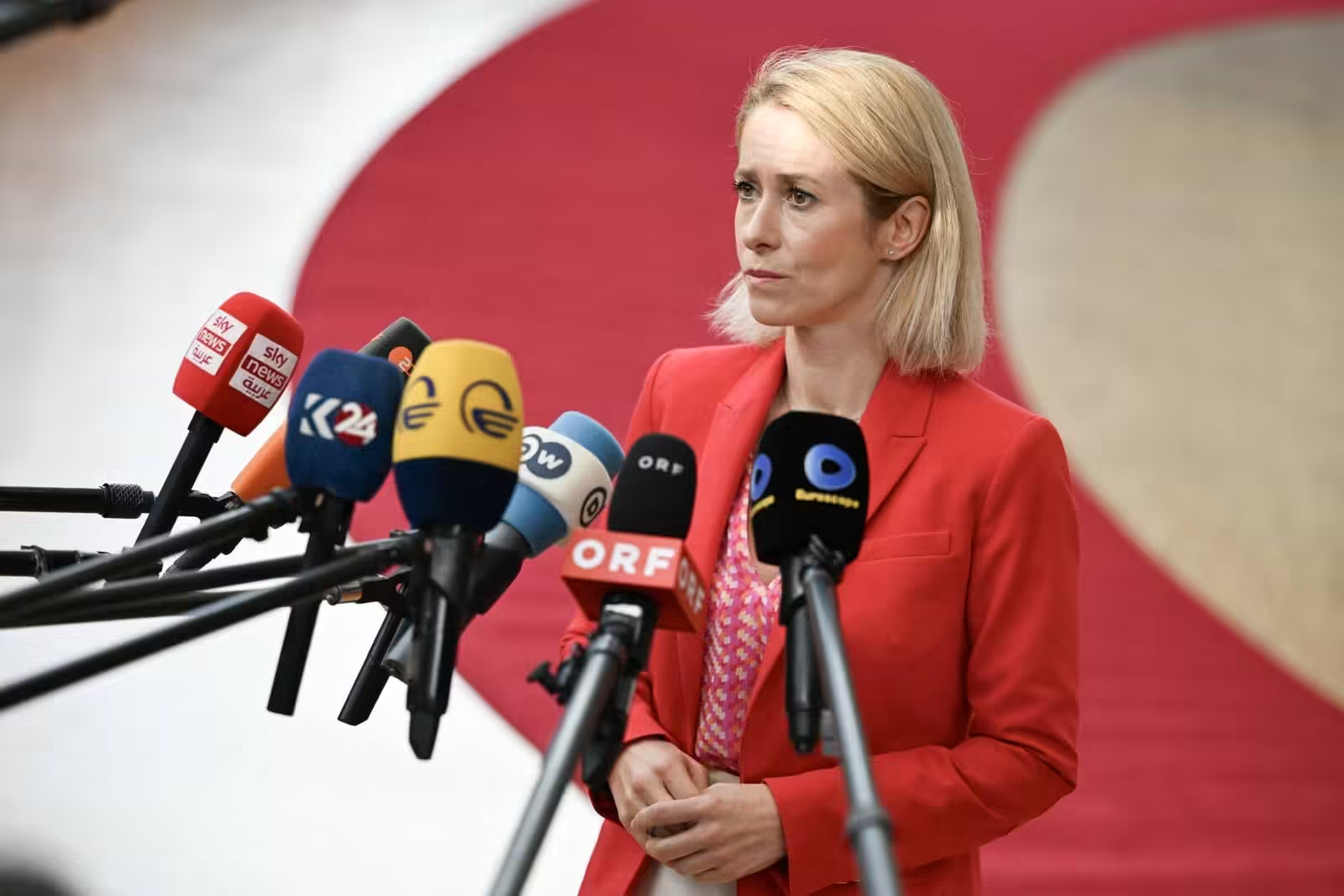

Photo by Nicolas TUCAT / AFP via Getty Images
The Briefing:
- EU foreign policy chief Kaja Kallas declared that the bloc’s 27 member states will refuse to enforce any Ukraine peace agreement reached without European participation.
- Sanctions relief, the disposition of hundreds of billions in frozen Russian sovereign assets, and postwar reconstruction funding all require EU decisions — making Brussels structurally indispensable to any settlement.
- Ukraine and Russia are scheduled to hold US-brokered contacts in Abu Dhabi on November 10–11, with European capitals largely sidelined from the process.
Speaking Friday at a ministerial session of the Council of the Baltic Sea States in Warsaw, EU High Representative Kaja Kallas issued one of the bloc’s sharpest warnings yet: Europe will not carry out a Ukraine peace deal in which it had no hand. Flanked by Polish Foreign Minister Radosław Sikorski and Ukrainian Foreign Minister Andrii Sybiha, the top EU diplomat made clear this is not a negotiating posture — it is structural reality.
No European Seat, No European Compliance
“Any agreement that we are not party to, we are not going to implement either,” Kallas said, cutting through weeks of ambiguity over the bloc’s role in an increasingly active diplomatic process. The backdrop could not be more urgent: trilateral contacts between the United States, Russia, and Ukraine are set for November 10 and 11 in Abu Dhabi — a track from which EU capitals have been systematically excluded.
Kallas framed the bloc’s demand not as obstruction, but as plain arithmetic. Any viable settlement will require the EU to lift sanctions against Russia — a step that only the bloc’s member states can authorize. The same applies to the hundreds of billions of euros in frozen Russian sovereign assets, to security guarantees for Kyiv, to Ukraine’s EU accession trajectory, and to the reconstruction financing the country will require once a ceasefire holds. From every angle, Kallas argued, there is no path around Brussels.
Firmly on Ukraine’s Side — Not in the Middle
“We are not the mediator. We are firmly on the Ukrainian side,” Kallas said, underscoring that Europe’s demand for inclusion does not come with a pretense of neutrality. The bloc’s position, she summarized, is that “concessions should be on the aggressor, not on the victim.” She also disclosed that the EU disbursed an additional €4.36 billion in support loans to Ukraine this week to reinforce the country ahead of another winter of Russian energy strikes — attacks she said had killed at least 45 civilians in Ukraine over the past seven days alone.
Sikorski: The Treaties Already Answer the Question
Polish Foreign Minister Sikorski reinforced the legal architecture underpinning Europe’s stance, reminding attendees that existing EU treaty law has long settled the question of who represents the bloc internationally. Under the Lisbon Treaty, that responsibility falls to European Council President António Costa at the level of heads of state and government, and to Kallas herself at the ministerial level. The frameworks are there, Sikorski said — the question is whether Europe’s partners will acknowledge them.
Meloni Presses for One Voice, One Negotiator
The Warsaw press conference also addressed internal EU tensions that had surfaced the previous day, when Italian Prime Minister Giorgia Meloni sent a letter to Costa voicing frustration with what she described as fragmented European diplomacy. Meloni has consistently argued that “proceeding by trial and error with variable formats that are not adequately representative produces only fragmentation, confusion and weakness” — and pushed EU leaders to appoint a single representative with a clear mandate to sit at the negotiating table on the bloc’s behalf.
The European Commission moved quickly to echo that call, stating the Union must speak with “one voice” in the diplomatic effort to end the war. Costa, in a written reply to the Italian leader, affirmed the same position: Europe must act with coherence, unity, and determination. It was a rare moment of convergence spanning Rome, Brussels, and Warsaw.
Baltic and Nordic Allies Coordinate Before Abu Dhabi
Beyond the declaratory diplomacy, the Baltic Sea States gathering — which included Germany, Denmark, Estonia, Finland, Latvia, Lithuania, and Poland — produced a concrete commitment: member states agreed to closely coordinate their stances in the days leading up to the Abu Dhabi contacts. Separately, Nordic and Baltic heads of government joined a video call with Ukrainian President Volodymyr Zelensky to align their support strategies ahead of the talks.
Danish Prime Minister Mette Frederiksen summarized the collective message publicly, writing that while Ukraine is seeking peace, Russia “is choosing escalation” and continuing to strike civilian populations. Finnish President Alexander Stubb, who also joined the Zelensky call, said leaders had discussed how to reinforce Ukraine’s position over the coming weeks — a clear signal that European solidarity is being deliberately synchronized with the diplomatic calendar ahead of Abu Dhabi.
© {{Year}} Latin Times. All rights reserved. Do not reproduce without permission.
Source: www.latintimes.com