
A recount expected in rural counties along North Carolina’s southern border will decide whether Democrats will take control of the full legislature for the first time since 2010—a scenario once considered almost impossible by many of the state’s political observers.
Republican legislators who have controlled the North Carolina General Assembly for 15 years redrew the state’s election maps in 2023 to give the GOP an advantage in many of the congressional and legislative districts. But on Tuesday that firewall wasn’t enough to protect Republicans from losing multiple congressional seats, the state House of Representatives, and almost half of the state Senate.
The GOP will keep a majority in the upper chamber only if Sen. Danny Britt wins reelection in a district that spans Hoke, Robeson, and Scotland counties—where the Republicans led by about 245 votes on Friday, with more than 650 provisional ballots left to be counted.
North Carolina Republicans knew Democrats would have an edge in the November elections. Midterm elections are historically tougher for the party that controls the White House, and polls consistently found that a majority of voters were upset with President Donald Trump’s handling of the economy.
What North Carolina Republicans didn’t realize until Election Day, party insiders say, was how many Republican voters would stay home and how many unaffiliated voters would break for Democrats.
U.S. Rep. Tim Moore—who on Tuesday lost a Gastonia-area district that Trump won by 15 percentage points in 2024—told WRAL on Oct. 15 that he was “not worried” about his race. And just hours before Democrats flipped 18 seats and took a majority in the state House of Representatives, House Speaker Destin Hall said he was “confident” that Republicans would keep control of the chamber.
The results reflect the electorate’s displeasure with Trump’s tariffs and the war with Iran, political analysts and strategists say. The results also exposed the effects of a weakened Republican U.S. Senate campaign that was expected to turn out more of the party’s base, they said, and the naïvety of incumbent Republicans who didn’t adjust to the political winds until it was too late.
“It’s hard to overstate how badly Hurricane Donald hurt NC Republicans in the elections and wiping our farm team, fundraising and infrastructure,” Doug Heye, a longtime GOP strategist and former spokesman of the Republican National Committee, said in a social media post.
Jason Simmons, chair of the state GOP, said the results were “disappointing” given the time and money local Republicans invested in helping their candidates this election. Simmons said Republicans knew the election would present “significant challenges.”
“As we move forward, we will take an honest look at the results, learn from this election, and identify where we need to improve,” Simmons said in a statement. “We cannot afford to sit back. The work of rebuilding, organizing, and preparing for the next election starts now.
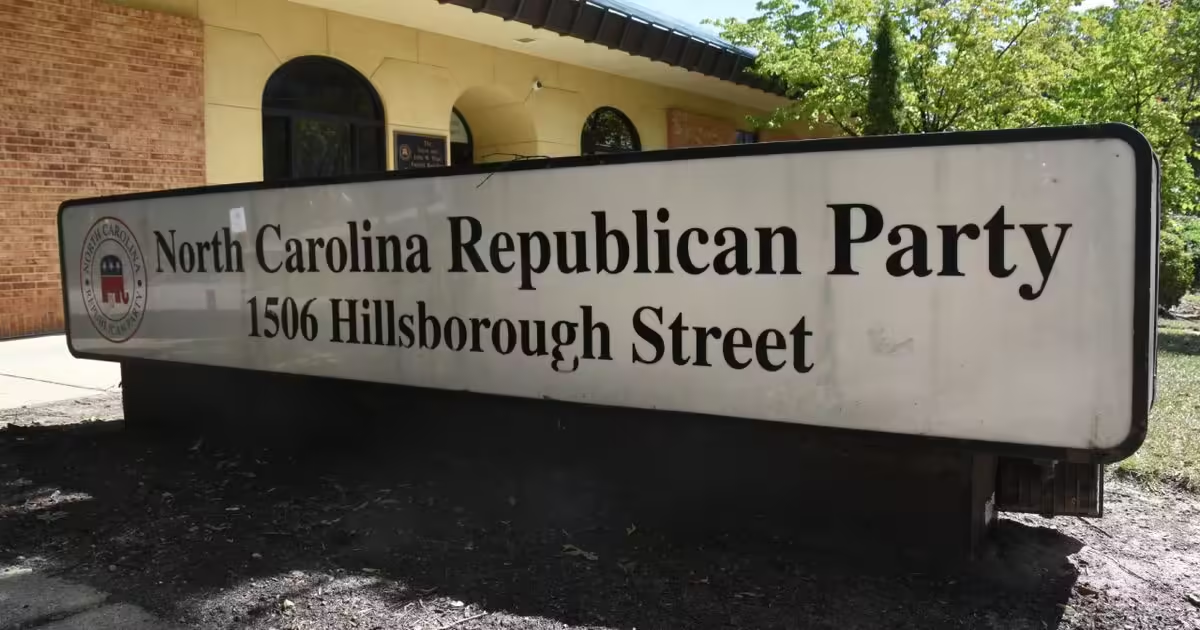
Heye responded to Simmons on social media Friday, saying the North Carolina Republican Party needs new leadership: “The party collapsed like a falling house in Rodanthe, and you can’t rebuild on rotting foundations. Changes are needed on Hillsborough Street,” Heye said.
Simmons didn’t immediately respond to a request for comment.
Financial support dried up for Republican U.S. Senate candidate Michael Whatley in early October as national donors moved money to more competitive races. Although Democrats hadn’t won a U.S. Senate seat in North Carolina since 2008, major Republican groups canceled spending plans in the state because polling consistently showed Democrat Roy Cooper with a near-double-digit lead over Whatley.
The most significant defection was by the Senate Leadership Fund, a political action committee that had pledged to spend $71 million to help Whatley defeat Cooper. By the time SLF pulled its money in early October, the group had spent $30 million on the campaign and had canceled at least $15 million more in advertising, according to data from AdImpact.
That move signaled to other big Republican political groups that they should spend their money elsewhere, political insiders told WRAL. And soon after, Whatley stopped spending his own campaign money on ads. Campaign finance records show Cooper’s campaign entered October with $12.5 million on-hand, while Whatley’s campaign had $916,000.
Lacking resources, Whatley tried to boost turnout by holding as many earned media events as possible throughout the state, said Jonathan Felts, a Whatley campaign spokesman. That included rallies with Trump in Greenville, Vice President JD Vance in Kinston and other administration officials.
“We had, I believe, 32 events over the course of the last 20 days all over the state of North Carolina,” Felts said. “If that doesn’t qualify as running through the tape, I’m not sure what does.”
Congressional flips
Republican and Democratic groups focused primarily on two seats in North Carolina: the seat held by U.S. Rep. Don Davis, a Democrat whose district state lawmakers redrew to favor Republicans, and the seat held by U.S. Rep. Chuck Edwards, a Republican who ended his reelection bid in August following allegations of sexual harassment.
In Davis’s northeastern North Carolina district, the Democrat defeated Republican Laurie Buckhout by about 4 percentage points in a contest that was among the most expensive in the nation, with political groups spending a total of $56 million, according to AdImpact, which tracks political advertising. In Edwards’ western North Carolina district, Democrat Jamie Ager defeated Republican Jennifer Balkcom—a state legislator that GOP officials appointed to replace Edwards on the ballot—by 16 percentage points.
Republican congressional candidates in GOP-leaning districts were largely left to fend for themselves. According to the latest numbers as of Oct. 14, the day before early voting began:
- U.S. Rep. Brad Knott, whose Triangle-area district supported Trump by 16 percentage points in 2024, spent at least $1 million in a losing effort to Democrat Paul Barringer. Roughly $400,000 of that was Knott spending on other candidates rather than his own campaign.
- U.S. Rep. Richard Hudson, whose central North Carolina district supported Trump by 15 percentage points in 2024, spent more than $3 million, and also got outside help from the National Republican Congressional Committee, which Hudson leads, in a loss to Democrat Richard Ojeda, who kept pace, also raising and spending about $3 million.
- U.S. Rep. Tim Moore, whose Gastonia-area district Trump won by 15 percentage points in 2024, spent $2 million before losing to Lakesha Womack, who raised less than $60,000 for her campaign and was served a felony warrant at a campaign event.
- U.S. Rep. Addison McDowell, whose Triad-area district Trump won by 17 percentage points in 2024, spent more than $1 million in a loss to Democrat Cyril Jefferson, who spent about $225,000.
More Republicans could still lose. As of Thursday, U.S. Rep. Virginia Foxx—whose western North Carolina district Trump won by nearly 18 percentage points—trailed Democrat Chuck Hubbard by about 100 votes. Republican U.S. Rep. Greg Murphy — whose eastern North Carolina district Trump won by nearly 13 percentage points — led Democrat Raymond Smith by about 230 votes.
While Buckhout aired television ads for months in the 1st Congressional District, AdImpact data shows that some incumbent Republicans didn’t air TV ads until early voting had already started. AdImpact data shows that McDowell began airing ads the week of Oct. 13, while Foxx and Knott didn’t launch TV ads until the week of Oct. 20.
McDowell, like Moore, had previously expressed optimism about their reelection odds.
When Jefferson entered North Carolina’s 6th Congressional District race in August 2025, McDowell told media outlets that the Democrat “has a better chance of winning the lottery than convincing the 6th district to vote for a woke, far-left politician who raised taxes on middle-class families.”
Legislative losses
Within days of the Senate Leadership Fund’s withdrawal from North Carolina, Republican legislators realized the development could significantly affect their incumbent candidates.
Polls had only gotten worse for the GOP in North Carolina and legislative leaders realized they needed more help contacting voters in long-held Republican districts. Among the Republicans who needed more help: seven-term state Rep. Dennis Riddell, an Alamance County Republican who in 2024 won reelection by nearly 10 percentage points.
The House Republican Caucus made 400,000 phone calls and knocked 200,000 doors between March and November, said Luke Stancil, the Republican House caucus executive director. But as October approached, it looked like those numbers might not be enough.
So the caucus reached out to college Republicans across the state for help knocking doors for incumbents they relied upon to preserve the majority, Stancil said. In Alamance County, where Trump won 53% of the vote in 2024, the House caucus secured help from Elon University students, who went to work in neighborhoods just outside of Burlington.
“We had to invest in ways that we haven’t traditionally done as a House caucus,” Stancil said.
While the help was appreciated, it wasn’t enough. Riddell was one of 18 incumbent House Republicans to fall, losing reelection to Democrat LeVon Barnes by more than 5 percentage points. Anderson Clayton, the chair of the state Democratic Party, singled out Barnes in an interview with WRAL, claiming Barnes personally knocked on thousands of doors for his ultimately successful campaign to unseat Riddell.
Stancil said House Republicans did everything they could. “But we couldn’t survive the worst election since Watergate,” he said.
Saving the senate
Election maps drawn by Republican legislators in 2023 were designed to make it more difficult for Democrats to take the Senate than the House. But as October approached, strategists for Senate Republicans realized that their 30-20 majority might actually be threatened, according to a source directly familiar with the caucus’s strategy.
But public campaign finance records indicate that some Republicans might not have realized just how badly they were faring until it was too late.
On Sept. 29, Britt — the senator whose 245-vote lead could change as provisional ballots are counted — gave $80,000 from his campaign to the NCGOP. Starting the next day, and through early October, the NCGOP transferred that exact amount to Sen. Kevin Crutchfield, a vulnerable Republican incumbent in Concord. In the end, Crutchfield lost in a landslide — and Britt is barely hanging on.
Republicans and the business community helped Senate Majority Leader Michael Lee, a Wilmington Republican widely seen as the heir apparent to dethroned Senate leader Phil Berger, raise and spend more than $2.6 million for his reelection campaign — including at least $950,000 from the Senate Republican caucus. Sen. Lisa Barnes, who represents the Rocky Mount area, spent around $3 million on her reelection campaign — but she raised less than $200,000 on her own, with the other $2.9 million coming from the Senate Republican caucus. Sen. Buck Newton, R-Wilson, received about $400,000 from the Senate Republican caucus for his own reelection campaign.
Lee lost despite outspending his Democratic opponent Jessica Bichler by a roughly 4-to-1 margin, at least as of the start of early voting, the most recent public data. Barnes spent about twice as much as her opponent, Democrat James Gailliard, and Newton’s support from the Senate Republican caucus alone was more than his Democratic opponent Jess Rivera raised for her entire campaign.
But the caucus’s polling eventually showed the money wouldn’t matter — and it turned out to be accurate. Lee and Barnes each lost by more than 5 percentage points, while Newton lost by about 2 points.
What may have preserved the GOP’s majority in the Senate was the caucus’s decision in late September to spend about $500,000 helping candidates who were once thought to be untouchable, according to a source familiar with the planning.
The money paid for mailers and streaming video ads for Britt, as well as Sens. Amy Galey and Brad Overcash. Galey, who won reelection in 2024 by 20 points, won by about 3 percentage points this year. And Overcash, who had won his district by 23 points in 2024, won by 1.82 points this year.
Britt might have been helped, too, by late efforts to boost turnout in Robeson County. On Oct. 23, U.S. Homeland Security Secretary Markwayne Mullin visited Lumberton, where he touted Whatley’s success advocating for full federal recognition for the Lumbee Tribe, which will benefit from millions in federal spending on healthcare, education and other services for the Lumbee following Trump’s approval of a bill last year.
Mullin’s speech did little to help Whatley, who is poised to lose by 20 percentage points. But it was one several small bricks laid by Republicans down the stretch that offered shelter to one of their candidates — and the party’s control of the state Senate — amid a massive blue wave.
Whatley also visited Lumberton on Oct. 30, the final Friday of early voting, after two weeks’ worth of data showed just how energized Democrats had been and how many Republicans had so far been staying at home.
Britt also spoke at that event and delivered a desperate plea to the assembled crowd.
“Get on your phones, call your friends, text your friends,” Britt said. “Call people you don’t like. If you have them in your phone, tell them to go vote. We’ve got to get the right people showing up at the polls. We’ve got to get the right people voting. Right now we don’t have the right people voting.”
The final vote tallies in his district, due as early as next week, could show whether enough of those local Republicans did get out and vote for him — or if control of the entire state legislature will flip back to the Democratic Party.
Source: www.wral.com