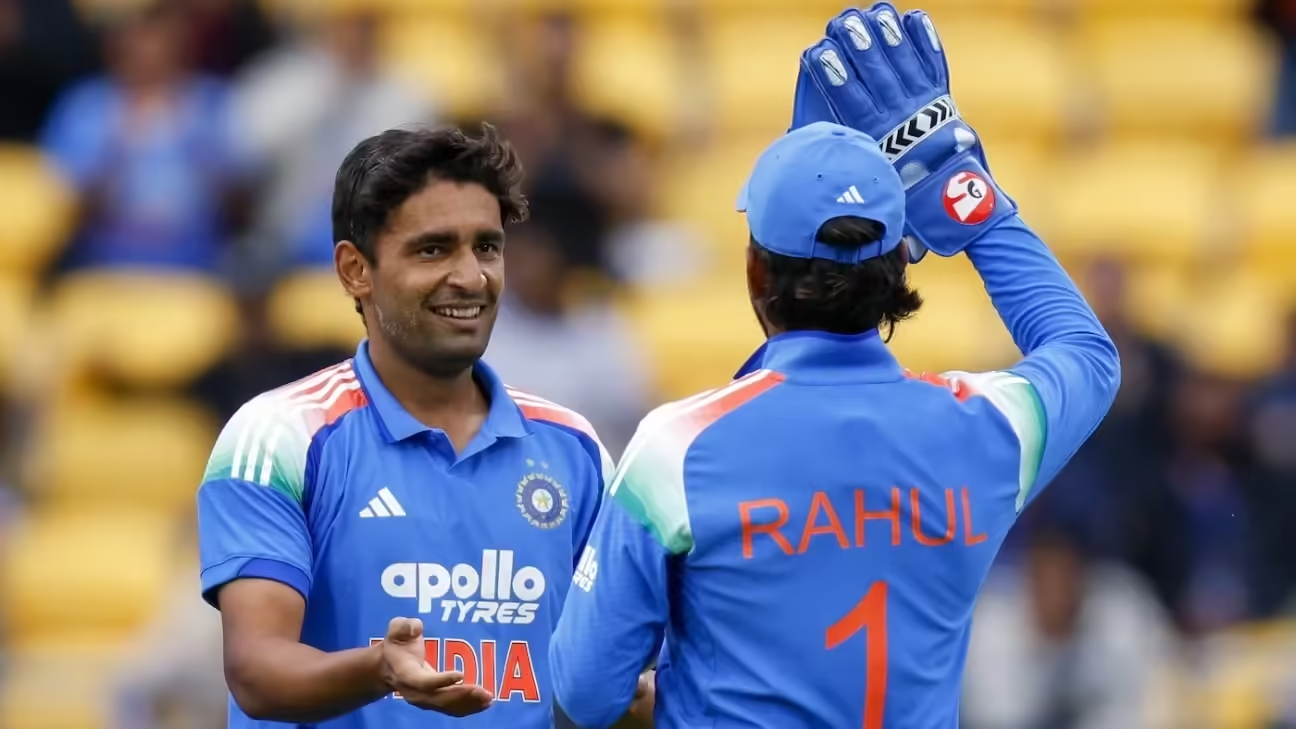

They’re not necessarily the same kind of bowler. Neither is exclusively one or the other, but Nabi is more of a swing bowler and Kamboj, half a yard quicker, is more of a seam bowler. But they’re both medium-fast and accurate and need a little help from the conditions to truly come into their own.
When everyone’s taking a battering no matter what lengths or lines they bowl, how do you tell who’s bowling well and who isn’t?
For India’s fast bowlers, the shift in conditions cannot have been more dramatic. The home series against West Indies was the worst ODI series played anywhere this year for good-length fast bowling. Over the series, it averaged 76.00 and went at 6.86 per over, according to Cricinfo’s ball-by-ball data. No series played in 2026 has been more brutal on either count.
And no ODI series played this year has been more rewarding to good-length fast bowling than the ongoing one in New Zealand: average 12.75, economy rate 2.56.
India’s fast bowlers have essentially played two different sports over their last two ODI series. Where they were having to think on their feet and second-guess themselves for over after over against West Indies, they’ve been able to run in and hammer away at a good length in New Zealand, and take the help on offer.
That’s an oversimplification, of course, because top-level opposition will try and unsettle you – as Daryl Mitchell did on Saturday by standing outside the crease and taking a further pre-delivery forward step on occasion. But still, batters typically can’t hit good lengths for boundaries on bouncy, seaming pitches without taking significant risks. And the stranglehold that bowlers can establish via consistent good lengths can contribute to more risk-taking against other lengths – booming drives against fullish balls that aren’t quite in the slot, pulls against short balls climbing above shoulder height, and so forth.
Exaggeratedly bowling-friendly pitches can prompt the same question as exaggeratedly flat ones: how do you judge good bowling?
This isn’t to say India haven’t bowled well in New Zealand, or that all their success has been down to the conditions. Kamboj hasn’t just been consistent with his lengths and lines but bowled with at times hypnotic control. Brar has been an electric presence, challenging batters with his effortless pace and steep bounce from hard lengths, and getting in their faces and chirping at them at the smallest provocation. He’s the highest wicket-taker in the series so far, and has all the raw attributes that India are looking for in their quest for a tall, fast, hit-the-deck middle-overs enforcer.
But just as no amount of control could have prevented Kamboj from being hit around the park on his debut in New Chandigarh, batters have had to take outrageous risks to try and upset his rhythm in Auckland and Wellington. And these pitches have allowed Brar to go all-out without fear of punishment for marginal errors in direction.
The issue for India, broadly, is that they’re playing a second successive series on extreme pitches – both ends of the spectrum – when they’re building towards a World Cup in Southern Africa where they’ll play on ICC-overseen surfaces that typically tend towards moderation.
There’s time yet for India to figure this out, but they’ll hope they get to play more ODIs on balanced pitches in the lead-up to the World Cup, pitches where bowlers can expect some semblance of reward if they’re at the top of their game and punishment if they aren’t.
Karthik Krishnaswamy is an assistant editor at Cricinfo
Source: www.cricinfo.com