
Tuberculosis (TB) remains one of the most urgent public health challenges globally, ranking as the second leading cause of death from a single infectious agent after COVID-19 (Lu et al., 2021). In China, the burden of TB is particularly severe, with an estimated 842,000 new cases reported in 2020, placing the country among those with the highest TB incidence worldwide (Ye et al., 2023). Preventive strategies such as early detection, public health education, and strict adherence to treatment protocols have proven effective in controlling and preventing TB (Yayan et al., 2024). However, these strategies are often underutilized by individuals due to a lack of awareness and understanding of TB prevention.
Media play a crucial role in shaping individuals’ awareness and enhancing their knowledge (Eveland, 2001; Ho et al., 2013). According to the Cognitive Mediation Model (CMM), paying attention to media can trigger individuals to engage in information processing, during which they integrate new information with existing knowledge and participate in interpersonal discussions, thereby acquiring relevant knowledge (Eveland, 2001; Ho & Chuah, 2022). Notably, individuals with idiosyncratic characteristics may follow different cognitive processing pathways, resulting in variations in the knowledge they obtain (Eveland, 2001).
Building on this premise, recent CMM research has increasingly emphasized the varying effects of individual characteristics in shaping how media attention translates into cognitive processing and knowledge acquisition (e.g., Chen et al., 2023; Fu et al., 2023). Rather than assuming that all audiences process information in the same way, these studies highlight that personal characteristics can strengthen or weaken the mediating pathways proposed by the CMM. In the context of tuberculosis, a topic grounded in scientific knowledge and biomedical evidence, one particularly meaningful disposition is belief in science, which reflects the extent to which individuals endorse science as a credible and valid way of knowing (Farias et al., 2013). Individuals with stronger belief in science are more likely to prioritize evidence-based information and engage in deeper cognitive processing, which may result in higher levels of knowledge gain. Accordingly, examining belief in science as a multigroup factor offers a theoretically grounded way to explain heterogeneity in cognitive mediation pathways.
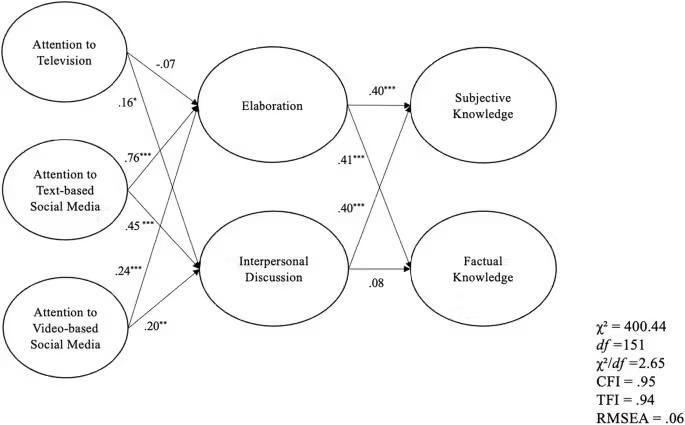
Given these, our study aims to examine how attention to television, text-based social media, and video-based social media—the three primary media platforms— about TB information elicits individuals’ elaboration and interpersonal discussion about TB, thereby enhancing their relevant knowledge. Moreover, following recent studies on the CMM (Chen et al., 2023; Fu et al., 2023), participants are not treated as homogeneous; instead, we investigate how individuals with varying levels of belief in science affect their cognitive mediation processes and knowledge acquisition.
Cognitive Mediation Model
The Cognitive Mediation Model (CMM), introduced by Eveland (2001), provides a framework for understanding how individuals are motivated to acquire knowledge through media use via cognitive information processing. Central to the CMM is the idea that attention to different media platforms serves as a precursor to two key information-processing strategies: elaboration and interpersonal discussion (Eveland, 2001; Ho et al., 2013). Elaboration involves systematically integrating new information with existing knowledge to create comprehensive cognitive structures (Chen et al., 2023), while interpersonal discussion refers to engaging in conversations within social networks to interpret and reinforce understanding (Fu et al., 2023). By engaging in these cognitive processes, individuals acquire relevant knowledge. Recent advancements in CMM research have expanded its application beyond political communication to domains such as health, environmental, and risk communication, highlighting its versatility in explaining media effects (Chen et al., 2023; Fu et al., 2023; Ho & Chuah, 2022).
Attention to primary media platforms and elaboration
Based on the CMM, attention to media serves as the precondition for elaboration (Ho & Chuah, 2022). In China, three media platforms dominate public daily information consumption: television, text-based social media, and video-based social media (Chen et al., 2023; Fu et al., 2023). Television functions as a traditional platform, delivering official content, including news and public policies, to a broad and diverse audience (Bonafide Research, 2023). Text-based social media platforms, such as WeChat and Weibo, are integral to everyday life, allowing users to access and share both user-generated content and official content while facilitating interpersonal interactions (Fu et al., 2023). Video-based social media, exemplified by platforms like TikTok (Douyin in China), has gained significant popularity in recent years, offering visually dynamic and intriguing content that appeals to younger audiences (Fu et al., 2023). Together, these platforms serve as crucial channels for individuals to access and obtain information in their daily lives.
To represent the current media landscape, it is essential to examine the impact of three primary media platforms on individuals’ acquisition of new information, including television, text-based social media, and video-based social media (Chen et al., 2023; Fu et al., 2023). According to the CMM, the more individuals pay attention to different media platforms, the more actively they engage in message elaboration with a high level of active cerebral processing (Ho et al., 2013). During this elaboration process, individuals connect information obtained from media to their pre-existing knowledge and retain the newly acquired knowledge for future application.
Empirical studies have demonstrated a positive association between media attention and elaboration (Chen et al., 2023; Fu et al., 2023; Ho & Chuah, 2022; Lee et al., 2016; Yang et al., 2017). For instance, Fu et al. (2023) found that individuals who paid greater attention to text-based and video-based social media were more likely to engage in elaboration about dual carbon issues in China. Ho and Chuah (2022) showed that attention to television news about nuclear power was positively associated with participants’ elaborative processing in Singapore. Similarly, Yang et al. (2017) discovered that individuals who paid attention to television programs about science and technology exhibited high levels of elaboration on nanotechnology content. Tailoring this to the context of tuberculosis, individuals who pay attention to television, text-based, and video-based social media are likely to engage in elaboration to process the information they obtain from these platforms. Therefore, we propose:
H1: Attention to (a) television, (b) text-based social media, and (c) video-based social media about tuberculosis information was positively associated with individuals’ elaboration on this information.
Attention to different media platforms and interpersonal discussion
In addition to elaboration, attention to different media platforms also facilitates individuals to engage in interpersonal discussion (Fu et al., 2023; Ho et al., 2013; Ho & Chuah, 2022; Lee et al., 2016; Yang et al., 2017). After individuals pay attention to different media platforms about tuberculosis information, this may stimulate individuals to initiate conversations within their social networks to further process this information. During social interactions with their acquaintances, they retrieve information from their memory and make connections with new information by talking with others. This aligns with the two-step flow theory (Lazarsfeld, 1944), which posits that individuals often receive information from media and subsequently share and discuss it within their social networks.
Extant studies have established a positive association between media attention and interpersonal discussion (Ho & Chuah, 2022; Lee et al., 2016; Yang et al., 2017). For instance, Ho and Chuah (2022) demonstrated that attention to televised news about nuclear power was positively associated with participants’ discussions about the topic in Singpore. Likewise, Fu et al. (2023) found that individuals who paid attention to television programs about dual carbon were more likely to engage in discussions about dual carbon with others. Based on the abovementioned findings, it is proposed that attention to television, text-based social media, and video-based social media would encourage individuals to engage in interpersonal discussions about tuberculosis.
H2: Attention to (a) television, (b) text-based social media, and (c) video-based social media about tuberculosis information was positively associated with individuals’ interpersonal discussion about tuberculosis.
Linkages between cognitive processing and different knowledge
In the CMM, knowledge is a multi-dimensional construct with two classical subtypes, factual knowledge and subjective knowledge. Factual knowledge refers to objective knowledge that individuals have about a specific topic, reflecting the accurate understanding of content grounded in facts (Ho & Chuah, 2022). In contrast, subjective knowledge refers to individuals’ perceived understanding or familiarity with a topic, often referred to as perceived familiarity or the illusion of knowledge (Fu et al., 2023). Noteworthy is that subjective knowledge does not necessarily align with actual knowledge, as it reflects how confident individuals feel about their understanding rather than its accuracy (Ho & Chuah, 2022). Taken together, these two types of knowledge capture both the objective and subjective dimensions of what individuals know about a particular subject.
Elaboration processing can lead to both factual knowledge and subjective knowledge acquisition (Fu et al., 2023; Ho & Chuah, 2022; Lee et al., 2016; Yang et al., 2017). During the process of elaboration, individuals link new information accessed from media platforms with their existing knowledge, leading them to develop a deeper understanding and more comprehensive knowledge. Prior studies have demonstrated the decisive role of elaboration on knowledge acquisition. For instance, Lee et al. (2016) found that elaborative processing of breast cancer information was positively associated with both factual and subjective knowledge about breast cancer. Similarly, Fu et al. (2024) surveyed 500 Chinese participants and found that elaboration about dual carbon was positively associated with individuals’ subjective knowledge and factual knowledge regarding dual carbon. Given these, we proposed that:
H3: Elaboration on tuberculosis information was positively associated with individuals’ (a) subjective knowledge and (b) factual knowledge about tuberculosis.
In addition, engaging in interpersonal discussion contributes to increases in both factual knowledge and subjective knowledge (Fu et al., 2023; Yang et al., 2017). During such discussions, individuals exert greater cognitive effort to recall, organize, and share information with their conversation partners, which helps them assimilate new information into their knowledge base, thereby expanding both factual and subjective knowledge. Furthermore, individuals can acquire additional knowledge by interacting with informed others (Fu et al., 2023). These processes collectively facilitate the acquisition of different types of knowledge. Indeed, Yang et al. (2017) found that individuals who engaged in discussions about nanotechnology was positively correlated to knowledge acquisition. Therefore, it is proposed that interpersonal discussion serves as a crucial cognitive processing mechanism for subjective and factual knowledge acquisition.
H4: Interpersonal discussion about tuberculosis was positively associated with individuals’ (a) subjective knowledge and (b) factual knowledge about tuberculosis.
Multigroup analysis based on belief in science
Building on Eveland’s suggestion that individuals may engage in different cognitive mediation processes (Eveland, 2001), recent studies on the CMM have treated participants as heterogeneous and explored the impact of various characteristics on their cognitive mediation processes (e.g., Chen et al., 2023; Fu et al., 2023). For instance, Fu et al. (2023) found that individuals with a high level of environmental concern were more likely to acquire factual knowledge about dual carbon when engaging in elaboration on relevant information, compared to those with low levels of environmental concern. This indicates that the cognitive mediation process varies across individuals with different characteristics. In the context of disease prevention and control, individuals with varying levels of belief in science may engage in different cognitive processing pathways (Kraft et al., 2015).
Belief in science may shape individuals’ cognitive mediation processes regarding scientific topics, such as tuberculosis. Belief in science refers to individuals’ confidence that science serves as a reliable source of knowledge (Farias et al., 2013). Individuals with a high level of belief in science are motivated to seek out scientific evidence when paying attention to various media platforms. This drives deeper elaboration, enabling them to critically analyze and integrate new information with their existing knowledge base, thereby acquiring greater knowledge compared to those with a low level of belief in science. Furthermore, a strong belief in science encourages active participation in interpersonal discussions, where individuals share, debate, and reinforce their understanding of scientific information, ultimately leading to enhanced knowledge acquisition. Based on this, it can be argued that individuals with varying levels of belief in science engage in different cognitive mediation processes.
RQ1: Does the extended CMM model differ among individuals with different levels of belief in science?
Source: www.nature.com