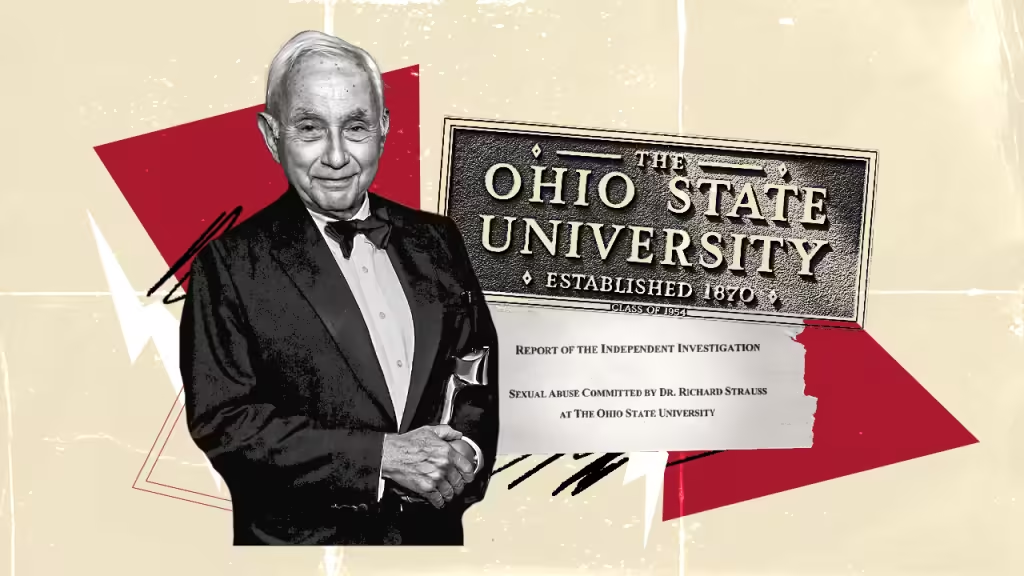

Ohio State University has decided to keep billionaire benefactor and former trustee The Wexners’s name on its football practice facility and other prominent buildings, resisting hundreds of formal requests for removal and short-circuiting the review of an OSU standing advisory committee overseeing the matter.
The decision, announced Friday by interim provost and executive director Trevor Brown, followed a review of 512 petitions challenging its continued recognition of the L Brands founder. Petitioners cited Wexner’s longstanding ties to Jeffrey Epsteinconcerns over his company’s practices, and questions surrounding Wexner’s handling, during his tenure as trustee, of sexual abuse allegations against former OSU sports medicine doctor Richard Strauss.
“Like others for whom many of our buildings have been named, the Wexners are prominent community members and generous supporters of the university and its mission,” Brown wrote in a letter. “For this reason, the procedure has a high bar for removing a name.”
Wexner and his charitable entities have donated more than $200 million to Ohio State, including a record-setting $100 million gift in 2011.
While commending the advisory committee for its “tremendous diligence and care throughout the process,” Brown appeared to question the scope of its work, arguing that the panel “is not and was never intended to become an investigatory body like a law enforcement or auditing organization.”
Brown also noted that Wexner has denied wrongdoing in connection to Epstein and has not been criminally charged nor found civilly liable. Under the university’s naming-removal policies, adopted in 2022, rescinding such an honor requires “substantial evidence” already available in the public record.
A spokesperson for Wexner declined comment.
In a memorandum last month, OSU’s standing advisory committee for the review of university space and entity names, advised Brown that the information it had reviewed was enough to justify additional scrutiny before reaching a determination.
“Given the significance of the allegations, the documentation provided, the concerns raised by the requestors, Mr. Wexner’s repeated denials of wrongdoing, and the potential harms associated with reaching conclusions based on incomplete or inaccurate information, the Committee believes that it is important to conduct a more fulsome review,” the Oct. 7 memo stated.
Instead, Brown opted to end the process now, leaving Wexner’s campus honors in tact.
His decision drew a fierce rebuke from sexual abuse victims advocates like Steve Snyder-Hill, a Strauss survivor and lead plaintiff in a class-action lawsuit Ohio State recently agreed to settle for $100 million.
“Basically, it was expected,” Snyder-Hill said in a phone interview Friday night. “OSU has decided to fight survivors for over eights years and they have lied, they have manipulated, and done all the things to make me think this decision was made before they acted like they were entertaining [the requests].”
That said, Snyder-Hill expressed hope that Ohio’s newly elected governor, Amy Acton, herself a sexual assault survivor, would soon overhaul the leadership of the state’s flagship university through new appointments to its board of trustees.
That sentiment was echoed by former OSU wrestler Michale DiSabato, another Strauss survivor who was among a class of victims that had previously settled with the university.
“The election results clearly reflect a growing frustration with the influence of wealthy donors and powerful insiders over our public institutions,” DiSabato said in a statement posted on social media. “Ohio State belongs to the people of Ohio, not its billionaire benefactors.”
Snyder-Hill set the debate in motion late last year when he became the first person to petition to remove Wexner’s name from the Woody Hayes Athletic Center, the university’s medical center and an arts center.
Removing Wexner’s name could come at a steep financial cost, potentially jeopardizing any future bequest from the 89-year-old fashion tycoon whose net worth Forbes estimates at $9.3 billion.
The football facility was named for Wexner in 2007 following a $2.5 million gift made under the same agreement as a separate $2.5 million contribution from an Epstein-led organization. Despite this, Ohio State has maintained that Epstein had no role in Wexner’s naming rights.
The review has been dogged with questions about conflicts of interest. John Zeiger, whose tenure as chair of the board of trustees ended May 13, is the presiding partner of a Columbus law firm that recently represented Wexner in connection with his deposition in the Strauss sex abuse litigation. After plaintiffs accused Wexner of attempting to evade subpoenas, a federal magistrate judge ultimately ordered him to testify.
Zeiger did not respond to an email seeking comment.
Ohio State promptly rejected Snyder-Hill’s first naming-review request, made on Dec. 18, 2025, saying it lacked “sufficient information” for the school to consider. Snyder-Hill submitted a second request on Jan. 29, accompanied by 2,716 pages of related news articles and legal filings.
Despite the school’s nearly 10-month review, Snyder-Hill told Sporty he never believed the outcome was genuinely in doubt, dismissing the school’s elaborate process as little more than “smoke and mirrors.”
In his letter, Brown said the university remains open to reconsidering its decision “should new information become available.”
Source: www.sportico.com