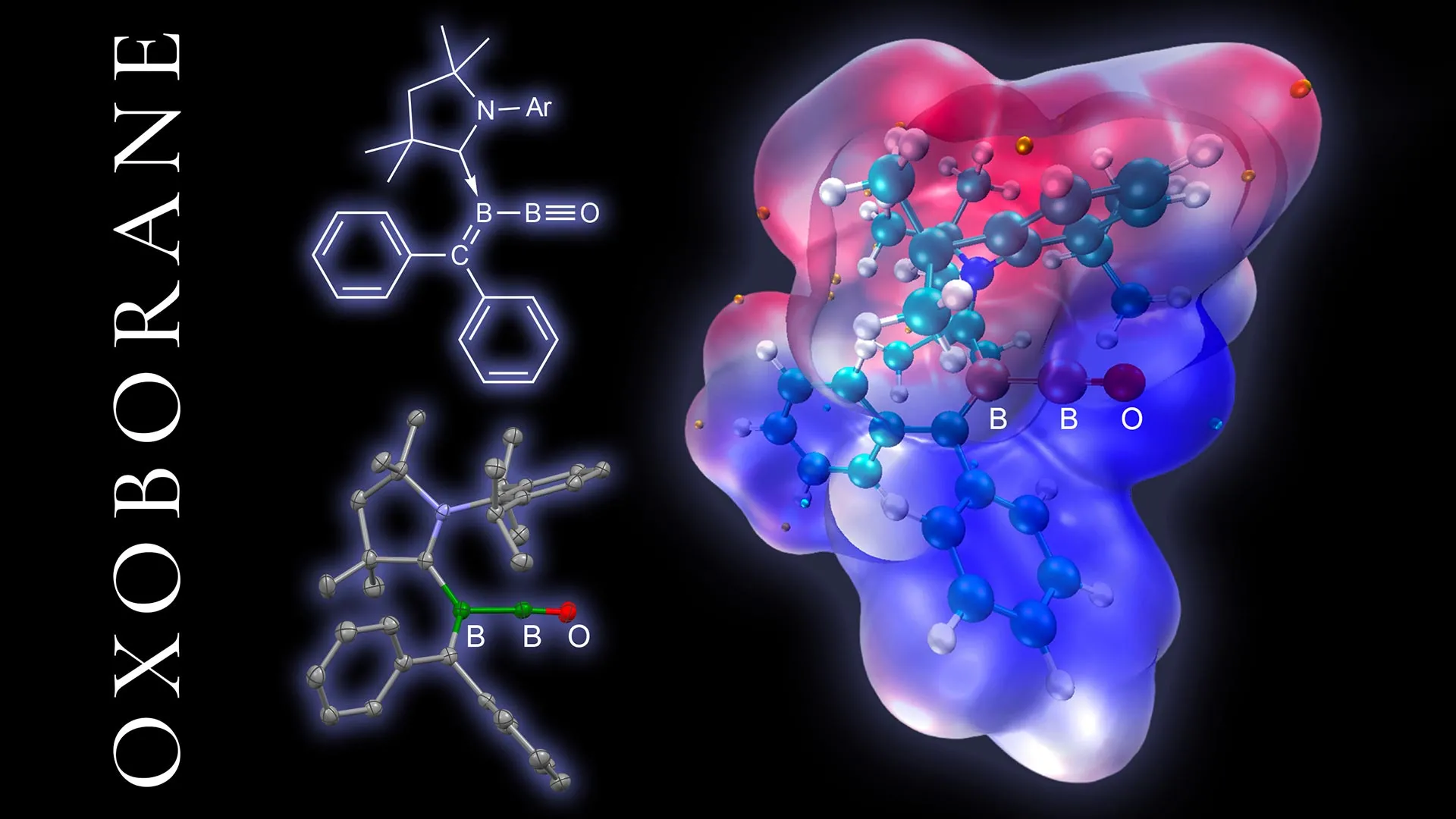

A chemistry challenge that had frustrated researchers for more than 60 years has finally been overcome. Scientists at the University of Würzburg in Germany have discovered a way to produce and isolate oxoboranes, a group of unusual molecules that were long considered too unstable to study under ordinary laboratory conditions.
The breakthrough, published in Nature Chemistrywas led by Professor Holger Braunschweig and his team, with computational support from researchers led by Professor Ashwini K. Phukan at Tezpur University in India. Their findings reveal a surprisingly straightforward way to create these elusive compounds, potentially opening new possibilities for molecular chemistry.
Solving a 60-Year Chemistry Challenge
Boron is an element that rarely forms triple bonds, a type of chemical connection in which two atoms share three pairs of electrons. For more than 15 years, Braunschweig has focused on overcoming this limitation and creating molecules containing unusual bonds involving boron.
His laboratory has already achieved several important milestones. In 2012, the team reported the first molecule containing a triple bond between two boron atoms. Another breakthrough followed in 2025, when the researchers produced the first neutral molecule featuring a triple bond between boron and carbon.
One major challenge remained among the elements in the first row of the periodic table’s p-block. Researchers had yet to isolate stable organic oxoboranes, molecules characterized by a triple bond between boron and oxygen.
Chemists around the world had been pursuing these compounds since at least the early 1960s. Over the decades, scientists working in both organic and inorganic chemistry had managed to detect and trap oxoboranes under extreme conditions. Other experiments provided indirect evidence of their existence, and researchers succeeded in creating several related derivatives. However, obtaining stable examples that could be isolated and examined remained an unsolved problem.
An Unexpected Reaction Produces Elusive Molecules
The long-awaited breakthrough emerged from experiments that initially appeared to be heading in a different direction.
Two doctoral students at the University of Würzburg, Lukas Lubczyk and Christian Markl, were independently investigating reactions between a compound known as a diboracumulene and various ketones, which are commonly used chemicals in organic synthesis.
Both researchers noticed something unusual. Instead of producing only the outcomes they might have expected, the reactions generated distinctive orange or yellow solids.
“The discovery was a pleasant surprise. I never thought the diboracumulene would react the way it did, let alone with multiple different, simple substrates. And when Christian came to me with his compound, I knew we were onto something,” says Lukas Lubczyk.
What made the results particularly remarkable was that oxoboranes emerged as the main products of these reactions, even though several other chemical outcomes had appeared more likely. After decades of unsuccessful efforts to isolate such molecules, the researchers had found that they could form unexpectedly from reactions involving relatively simple starting materials.
Braunschweig described just how surprising the discovery was to scientists familiar with the long-standing challenge.
“Nearly everybody in the field had given up on oxoboranes, as they were thought to be just too unstable to be isolated. So we were stunned to see them spontaneously form in these reactions and stick around long enough that we could study them,” says Holger Braunschweig.
A New Path to Rare Chemical Compounds
Using their newly discovered method, the scientists successfully prepared three different oxoboranes. The fact that the approach worked with multiple compounds suggests that it could provide access to a much wider range of these previously difficult to isolate molecules.
The team is now investigating how broadly the technique can be applied. Beyond producing additional oxoboranes, the researchers hope to determine whether similar strategies could help them create other elusive compounds involving elements throughout the periodic table.
The discovery not only resolves a problem that challenged chemists for more than six decades but also demonstrates how unexpected chemical reactions can reveal possibilities that researchers once considered beyond reach.
International Research Collaboration and Funding
The findings were published through a collaboration between the Würzburg research team and the group led by Professor Ashwini K. Phukan at Tezpur University (India), whose computational research helped support the work.
Funding was provided by the German Research Foundation (DFG), the German Academic Exchange Service (DAAD), and the Department of Science & Technology (DST) of India.
Source: www.sciencedaily.com