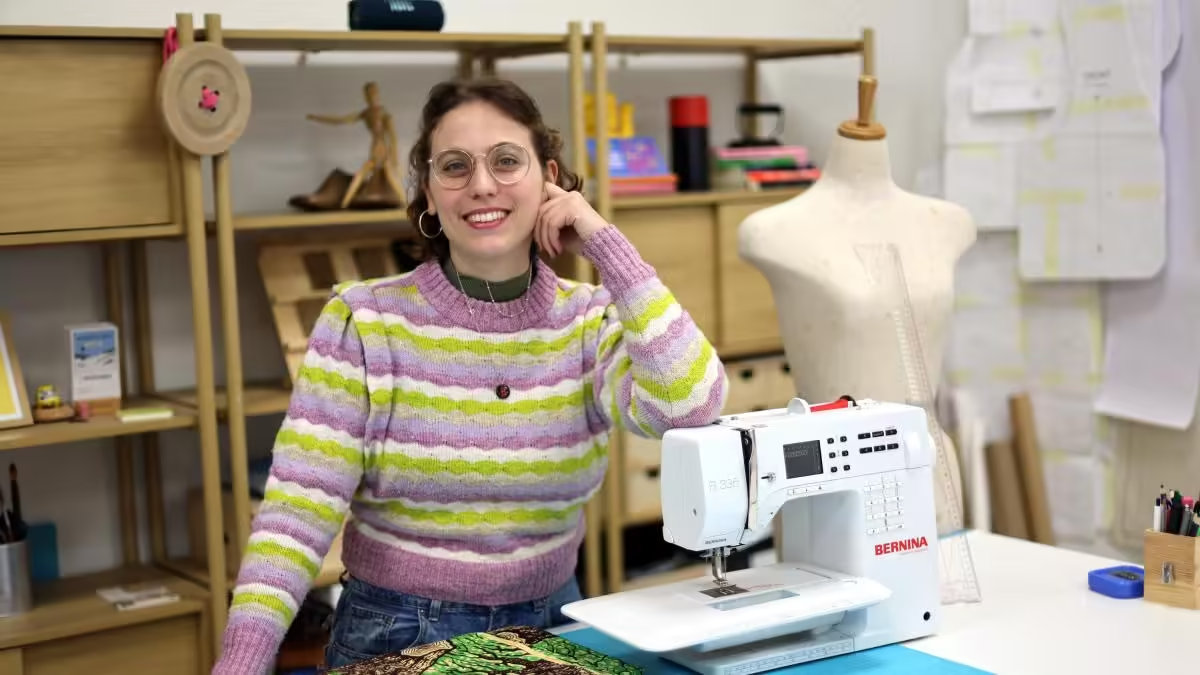

“We usually associate sewing with a bygone generation, but now there is a surge of people who want to learn the trade and use their hands again,” he explains. Isabel Perez Rubio (Murcia, 1997). She arrived in Pamplona around eleven years ago to study Audiovisual Communication at the University of Navarra. Now, it will be a year since it opened. titare (‘dedal’ in Basque), un premises in Rochapea woven with the passion of raising awareness about the value of giving a second life to clothes that you plan to throw away. The initiative is divided into a own brand of sustainable fashion and the offer of different workshops and tailoring courses.
“I was interested in starting a business in fashion, but, of course, I said ‘I don’t want to make clothes’. It’s not that I didn’t want to make them, but that I did not want to generate more product because it is a totally saturated industry“argues the young woman. After working for several years in communication and networks, she had the opportunity to take part in a rhythmic gymnastics leotard-making workshop: “I thought ‘this is my opportunity.’ So, I started to train more. On top of that, since I had done gymnastics all my life, I knew about the subject.”
Genuinely, the first threads that began to arouse your interest go back a long time. With a seamstress grandmother (Maria Verdú), remembers how as a child she received many custom-made suits. “Let’s see, in my house the clothes have always been modified and it is true that, when I was young, when I was 20 years old or so, I already sewed because my sister (María) had a machine that she never used and I kept it. However, my mother (Ángeles) has no idea about sewing, but she does my whole family is very artistic“They are very good at painting…”, he adds. His father’s name is José Enrique and he has two other brothers (José and Ángel).
THE WORLD OF ‘UPCYCLING’
It was not until landing in that first position within the industry that he saw sustainability as an essential foundation. “I was interested before, but being in a small company, you can see the amount of waste that they manage and you realize the magnitude. Many times we know the data. ‘Yes, 15%’, but how much is 15%? You can’t even imagine it. It could be millions of tons. So I wanted to do something with those leftovers,” he explains. Isabel began training in entrepreneurship and fashion, specifically she took a course in “upcycling” (process of reusing old garments, leftover fabrics or waste materials to transform them into new pieces of greater value or quality).
He shared this brainstorm with his partner, Joseba Meabebasterretxea. “The idea for the brand came because my in-laws had a lot of work clothes – my father-in-law is a miner and my mother-in-law has also worked in factories. That’s why my partner and I found a lot of clothes in the “baserri”. In the end, you realize that the work clothes They are surpluses that have no outlet because most of them are used clothes, with logos, that cannot be sold again,” he says while pointing to a pile of construction pants stacked to be treated in his workshop.
Looking to the future, he is working in offer this reuse service to companies so that they do not throw away their old work clothes or their surpluses and can convert them into “packaging” —process of design, creation and production of the packaging and packaging of a product—or other design solutions.
He does recognize, however, the inevitable fear he had before undertaking, the weight of uncertainty of ‘what if it’s not profitable?’. “It is true that I had already tested before launching whether this could be of interest or not and I also have the support of my family and my partner, but There are people who cannot undertake in the same way.who has no support in case everything goes wrong, who cannot risk his money. I remember that the places were very expensive, everything was exorbitant. The truth is that it is difficult for young people to be able to have a space and make a living from it,” he clarifies.
DISCLOSURE CLASSES
In addition to the brand, Isabel was clear that I wanted to offer workshops: “I started them because many people can buy, but without having any idea of the process behind it. Hence the need for dissemination.” Today, with the help of Laura Montesanother designer, offers two types of courses: annual —hour and a half a week—and monographs —specific days focused on learning a single technique or working on a specific garment. This year, the annuals have a full capacity, 70 people divided into small groups throughout the week.
The classes are divided into three blocks: accessory, skirt and body. “The idea is to start with a walletfor example, but, from there, each one proposes what they want. Maybe some make a fanny pack; others, a backpack; others, scrunchies, cushion covers for the home… there are a lot of things to do and learn. We see how to put on a zipper, how to make a lining, a pocket, a hem or how to sew a tear,” exemplifies the young woman.
If Isabel has to define the profile of your studentsthe age range is specified between 22 years old and 80 (laughs). “It’s just that super different people come, I didn’t expect it. Many want to learn the basics, not be great designers. They want to be able to repair their clothes, make themselves basic things that they like because many times we are within a circle of work, eating, home, going out… that we do not have time to stop for three hours to do something manual, creative. So I think that in some way it is a space to dedicate time to yourself. I think it’s super cool to see how they all come together in the same class. Normally, women who are 50 or older remember tailoring techniques that they had been taught at school. Of course, the young women are amazed. That interaction is beautiful,” he details.
“I want the people of Pamplona and the surrounding area to have the option to consume or train sustainably if they want. It would be cchange your mentality a little, which I know is difficult because it is the battle of expensive versus cheap. Many students say: ‘Joe, the shirt cost 60 euros.’ And I say: ‘How much did it cost you to make a purse? Do the math,’” Isabel points out nearby. Generating that awareness and bond was one of his objectives: “In the end, By having a physical space you become a lot of neighborhoodyou are sending a message, which is also something political, right? Like a slow fashion, another way of consuming, of doing things. And that was kind of the idea behind the brand, to unite the trades and the workers locally.”
DAYS
Isabel Pérez Rubio She is the creator of Titare, a sustainable fashion project. He was born on September 11, 1997 in Murcia. He arrived in Pamplona in 2015 to study Audiovisual Communication at the University of Navarra and, since then, he has worked in different jobs in the Community. Specialized in “upcycling” and sustainability, she chairs the Navarra Sustainable Fashion association, which was born a year ago. He has trained in production and networking courses, and is currently studying Basque.
Source: www.diariodenavarra.es