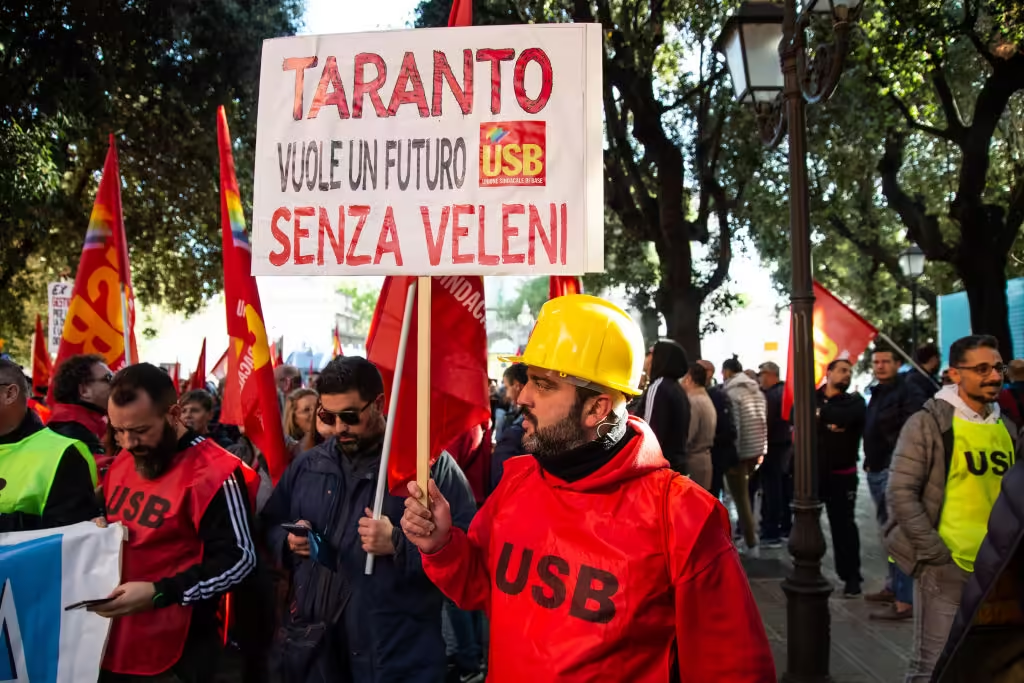

In Italy, at the height of the European Green Deal investment projects in the early 2020s, the prime minister was none other than Mario Draghi. He had previously been a key figure at Goldman Sachs and, as president of the European Central Bank throughout the 2010s euro crisis, a key figure in the troika that imposed austerity on the Greek government. Since 2024, Draghi’s name has come to symbolize EU competitiveness and the associated watering down of European environmental and human rights policies.
In the meantime, in 2021–22, Draghi served as Italian premier and developed a climate road map for the steel plant in Taranto. Beginning in 2019, Europe’s steel manufacturers successively announced decarbonization plans to transition from coal to hydrogen and electric furnaces in order to reduce greenhouse gas emissions. In Taranto, according to Draghi’s plan, €4.7 billion in largely private capital was to be invested to achieve full employment and increase production by 2025.
The political ideology in which economic policy levers are adjusted so that unattractive investments like “green steel” become viable business cases is called “derisking.” The European Green Deal aims to make the steel industry climate neutral and competitive again through such means. Specifically, this meant free emissions allowances, billions in state aid for steel and hydrogen, protective tariffs against China, public procurement of “green steel,” energy price subsidies, and more lenient reporting requirements.
In an attempt to make green investments attractive to private capital, several EU countries dealt with ArcelorMittal. The world’s second-largest steel company holds a de facto monopoly on blast furnace production in Spain, France, Belgium, and Poland and operates additional blast furnaces in Germany (Bremen and Eisenhüttenstadt). From 2018 to 2024, ArcelorMittal also operated the plant in Taranto. Yet governments underestimated the steel giant’s negotiating position; it abruptly announced that it could not invest at all locations, thereby provoking a subsidy race among member states.
Up to €15 billion in low-carbon subsidies has since been awarded to steelmakers, but even that is not enough. As a result of high energy prices following the invasion of Ukraine, ArcelorMittal put all hydrogen projects on hold at the end of 2024. Seven lost years after the Green Deal, only a few Swedish and German steelmakers in the EU are still pursuing significant decarbonization projects. Meanwhile, many locations are in an even worse economic position than before. The EU’s “derisking” project appears to have failed, at least for now.
Draghi is quite right to blame the industry’s struggles to a lack of competitiveness. Raw materials and energy mostly have to be imported. Labor costs are comparatively high due to Europe’s past imperial might but also its historic labor struggles. Europe’s historical advantage in innovation has long since been squandered; the innovation hubs of the steel industry are now in Japan, Korea, and above all China. Added to this are persistent global overcapacity and higher returns in the financial sector, which is why ArcelorMittal prefers to carry out share buyback programs rather than make forward-looking investments.
Yet instead of EU member states pursuing alternative and more democratic economic models, the lack of competitiveness serves as a pretext to pursue austerity measures and the upward redistribution of wealth. Europe’s steel-producing regions are thus kept in a state of perpetual crisis, which further exacerbates health and climate damage. The authoritarian right skillfully exploits the resulting uncertainty about people’s jobs and the economic survival of their hometowns. This too is a result of timid industrial policies. In turn, these same right-wing parties, building on neoliberal ideological assumptions, further undermine democracy.
Source: jacobin.com