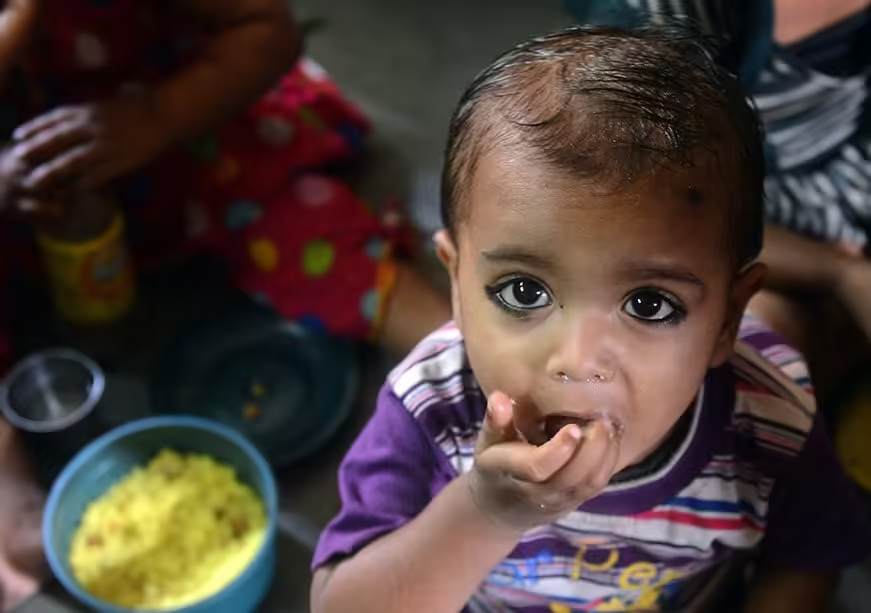

Image Source: Getty Images
The critical biological window from conception to a child’s second birthday, often called the first 1,000 days, forms the foundation of human capital and lifelong health. Feeding practices during this period, specifically the transition from exclusive breastfeeding to complementary feeding, shape not only immediate survival but also lifelong cardiometabolic and cognitive outcomes. In India, however, millions of children face a compounding crisis where biological vulnerabilities intersect with harsh socioeconomic realities and policy coverage gaps. The result is a cycle that entrenches poor nutrition and raises the risk of chronic non-communicable diseases (NCDs) for a generation.
Data from the National Family Health Survey (NFHS-6) show a persistent failure: only a small fraction of children aged 6–23 months receive the Minimum Acceptable Diet (MAD). This gap is not merely a lack of knowledge but the product of interconnected structural constraints that link biology, household choices, economics, and policy efficacy.
The Metabolic and Microbiome Pathways Fuelled by Market Realities
Traditional approaches to infant feeding focused primarily on preventing wasting by ensuring caloric adequacy. However, contemporary research demands a paradigm shift: complementary feeding is a complex metabolic and epigenetic programming window that affects insulin kinetics, adipose tissue development, anaemia prevalence, and the infant gut microbiome, and so shapes lifelong risks of diabetes, cardiovascular disease, and poorer cognitive function.
Traditional approaches to infant feeding focused primarily on preventing wasting by ensuring caloric adequacy.
Three pathways illustrate how complementary feeding shapes lifelong health:
- Diets heavy in refined dairy but lacking diverse protein sources can accelerate surges in insulin and insulin-like growth factor 1 (IGF-1), which promotes early adipocyte differentiation, a process that research links to a higher risk of obesity and diabetes.
- Insufficient introduction of bioavailable iron-rich complementary foods sustains high anaemia rates. This condition is directly associated with immunodeficiency, fatigue, and reduced productive capacity.
- The infant gut microbiome, formed during complementary feedingis shaped by diet quality. Fibre-deficient ultra-processed foods may induce gut dysbiosis, which is implicated in metabolic diseases including type 2 diabetes and metabolic-associated steatotic liver disease.
Yet, these biological vulnerabilities are tightly linked to the local food environment. Across India, from urban informal settlements to rural villages, affordable, safe, and wholesome complementary foods are scarce, while retail spaces are flooded with ultra-processed snacks, high in sugar, salt, and fat, that are heavily marketed to caregivers. Time-constrained mothers, burdened with domestic and economic responsibilities, often rely on these convenient but nutritionally poor options.
Economic Constraints and Policy Gaps: The Limits of Awareness
The 2024 dietary guidelines of the Indian Council of Medical Research-National Institute of Nutrition (ICMR-NIN) identify dietary diversity as essential for complementary feeding. However, the cost of these diets remains a major constraint for many low-income and vulnerable households. Behaviour Change Communication (BCC) strategies often operate on an awareness-only premise, which places disproportionate responsibility on mothers and frontline workers without accounting for the unaffordable cost of the recommended diets or the commercial environment full of unhealthy alternatives.
Nutrition knowledge increases, but feeding practices or behaviour changes don’t follow through because structural barriers remain.
This disconnect creates a paradox for policy efforts: nutrition knowledge increases, but feeding practices or behaviour changes don’t follow through because structural barriers remain. Even when mothers are aware of the guidance, they cannot act on it due to economic hardship, time poverty, and limited access to affordable, good-quality foods.
Structural Interventions Breaking the Cycle: Lessons from States
Innovative state-level programs provide evidence of how integrated, structural approaches can break this cycle by aligning policy with local realities. Three examples show how it works:
- Bihar’s JEEViKA Modelanchored in women’s self-help groups (SHGs), integrates infant feeding education into participatory community platforms, turning nutrition practices into shared social norms instead of isolated maternal duties.
- States that perform well on MAD indicators strengthen the capacities of Anganwadi workers (AWWs)and Accredited Social Health Activists (ASHAs) through practical, locally relevant cooking demonstrations paired with performance incentives. These help the frontline workers translate guidelines into feasible household practices.
- Odisha and Chhattisgarh have revamped their Take-Home Ration (THR) programs, moving from raw staples to culturally appropriate, fortified complementary foods that buffer families from seasonal price shocks while mitigating the menace of omnipresent ultra-processed foods.
These programmatic successes illustrate how decentralised, culturally sensitive food system interventions directly dismantle barriers to adequate complementary feeding.
Additionally, while the Infant Milk Substitutes (IMS) Act remains a strong framework protecting breastfeeding, India currently lacks vigorous regulation against aggressive marketing of processed complementary foods directed at young children. Strengthening these regulations is urgent to protect infant feeding norms.
Policy Recommendations: An Integrated Roadmap for Impact
For India’s nutrition goals to align with its Viksit Bharat 2047 ambitions, a transformative, multisectoral approach is needed one that integrates biological science, economic realities, and policy implementation into a coherent strategy. Key priorities include:
- Expand and Enforce Marketing Regulations: Broaden the scope of the IMS Act to cover ultra-processed complementary food products and restrict misleading advertising aimed at caregivers. Empower public health authorities to issue clear, evidence-backed advisories that guide parents away from nutritionally inadequate, convenience-driven products.
- Institutionalise Lived-Experience Behaviour Change Communication (BCC): Move from top-down messaging to empathetic, context-sensitive counselling that accounts for time poverty, economic constraints, and gender dynamics within households. Engaging male family members is critical since they often influence purchasing decisions. Leverage digital tools and local SHGs to enhance reach and participation.
- Anchor Nutrition Policies within Local Food Systems and Use SEHAT as a Platform: The Science Excellence for Health through Agricultural Transformation (HEALTHY) initiative, co-led by ICMR and the Indian Council of Agricultural Research (ICAR), envisions sustainable healthy diets through decentralisation and local food systems interventions. It presents a scalable opportunity to embed better nutrition-dense products as THR through diverse, regionally adapted food production and supply mechanisms. Indigenous grains, seasonal vegetables, and affordable proteins sourced this way can improve accessibility and reduce reliance on processed foods.
- Empower Frontline Workers with Appropriate Resources: Support AWWs and ASHAs through dedicated untied funds, training, and performance incentives linked to measurable outcomes on complementary feeding and dietary diversity.
- Promote Multisectoral Coordination: Facilitate collaboration across the Ministries of Health, Women and Child Development, Agriculture (leveraging programs like SEHAT), and Consumer Affairs to harmonise policy, regulation, and program implementation, addressing the multifaceted drivers of poor infant and young child feeding.
By reframing complementary feeding as a foundation for lifelong health rather than merely a dietary transition, India can protect its youngest populations from the compounded burdens of malnutrition and chronic disease, setting them on a trajectory towards national prosperity.
Way forward
Complementary feeding shapes not only immediate child survival but also long-term cardiometabolic health and cognitive outcomes. In India, a reinforcing cycle of biological risks, structural economic constraints, and policy gaps undermines feeding practices, leaving a generation vulnerable to avoidable malnutrition and lifelong disease. Breaking this cycle requires moving beyond awareness campaigns to structural policy interventions that ensure affordable healthy foods, empathetic community engagement, rigorous regulation of commercial marketing, and stronger decentralised local food systems.
By reframing complementary feeding as a foundation for lifelong health rather than merely a dietary transition, India can protect its youngest populations from the compounded burdens of malnutrition and chronic disease, setting them on a trajectory towards national prosperity.
Dr. Shweta Khandelwal is a Senior PHN (Public Health Nutrition) Expert at the Centre for Chronic Disease Control (CCDC) (Honorary).
The views expressed above belong to the author(s). ORF research and analyses now available on Telegram! Click here to access our curated content — blogs, longforms and interviews.
Source: www.orfonline.org