
By Dr. Kenneth Washington
Las Vegas, November 2026
US Black Engineer, Career Communications Group
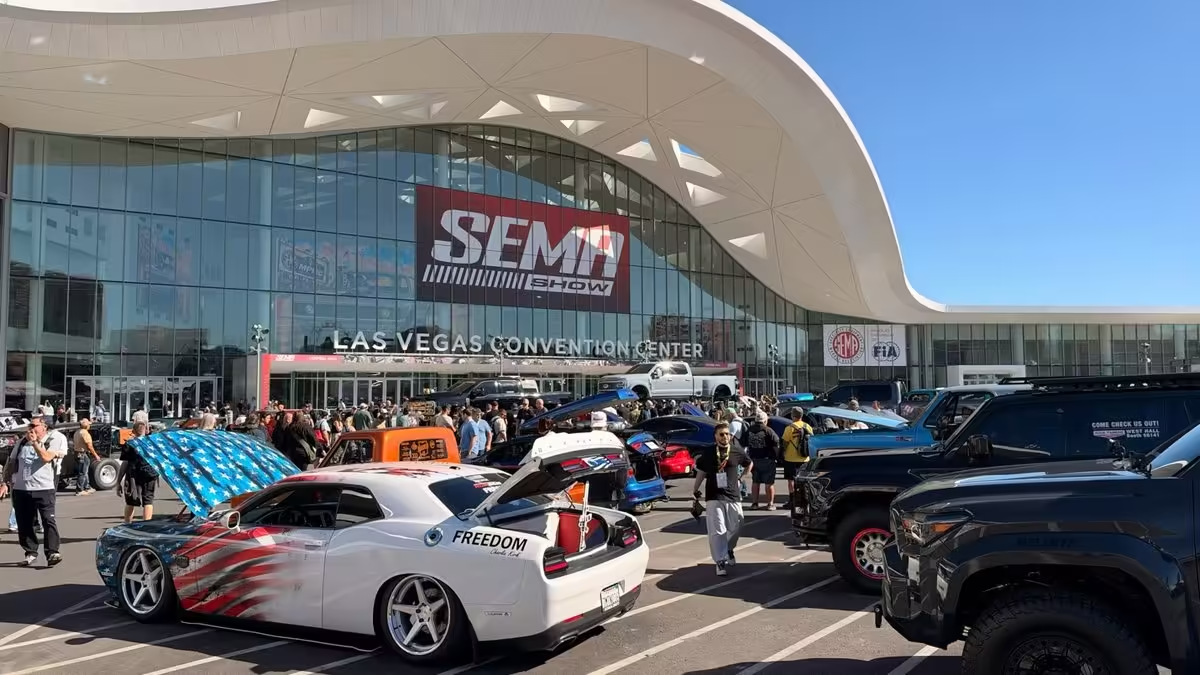
LAS VEGAS — Every November, Las Vegas becomes the center of the automotive aftermarket universe as manufacturers, engineers, entrepreneurs, custom vehicle builders, and automotive enthusiasts converge for one of the industry’s most influential gatherings. The Specialty Equipment Market Association (SEMA) Show, held November 3–6, 2026, at the Las Vegas Convention Center, is far more than a showcase of customized cars and high-performance engines. It is a global business marketplace where manufacturers introduce new technologies, demonstrate innovative products, and compete for the attention of buyers from around the world. The event spans nearly every corner of the specialty automotive industry, from performance tuning and off-road equipment to advanced electronics, manufacturing technologies, and emerging mobility solutions.
The scale is extraordinary. According to organizers, the 2026 SEMA Show features more than 2,200 exhibiting brands, including over 400 first-time exhibitors, across more than 1.1 million net square feet of indoor exhibition space. The industry itself contributes an estimated $383 billion annually to the U.S. economy and supports 1.25 million American jobs. Alongside SEMA, the Automotive Aftermarket Products Expo (AAPEX), held concurrently at the Venetian Expo and Caesars Forum, brings together another major segment of the industry focused on vehicle parts, repair, maintenance, and distribution. Together, the events offer a remarkable window into an industry undergoing profound technological change. Beyond the spectacular custom vehicles and elaborate product displays, artificial intelligence is beginning to transform how automotive products are designed, how businesses operate, and how skilled workers perform their jobs.
Day One: AAPEX — Technology, Competition, and the Changing Automotive Business
My first day began at AAPEX, where the emphasis is less on automotive spectacle and more on the complex global ecosystem that keeps vehicles operating long after they leave the factory. Walking the exhibition floor, I encountered manufacturers of everything from conventional oil filters and replacement components to sophisticated electronic systems and emerging software solutions.
One of my most revealing conversations was with an aftermarket industry veteran who first attended SEMA approximately 40 years ago. His perspective provided a fascinating historical backdrop to the technological changes now reshaping the business.
He described the growing influence of Chinese manufacturers, arguing that global sourcing has fundamentally changed the economics of automotive replacement parts. My casual walk through the show floor validated his statements, where a large fraction of exhibitors were from China. As one example, he pointed to genuine Honda-branded oil filters manufactured in China, challenging the assumption that a product manufactured overseas is necessarily inferior.
His larger point was about the changing nature of competition. He explained that manufacturers of independent aftermarket components must compete not only on product quality and price but also against the branding advantages and purchasing restrictions associated with original equipment manufacturers.
“The market has changed,” he observed. “People are smarter than they used to be.”
He also highlighted the impact of online marketplaces such as Amazon, eBay, and Walmart.com, which have made comparison shopping dramatically easier and intensified pricing pressure throughout the industry. Consumers are also using AI to help them comparison shop, thereby making it nearly impossible to differentiate on price.
His comments illustrated how globalization, electronic commerce, and increasingly informed consumers have been reshaping the aftermarket for decades. Artificial intelligence is now entering an industry where competition is already fierce and differentiation increasingly difficult.
AI Enters the Distribution Business
Another encounter at AAPEX demonstrated that artificial intelligence is not limited to automotive engineering or vehicle technology. It is also being applied to the business processes supporting the industry’s extensive distribution networks.
I spoke with Devi Dumbadze of Augment who introduced me to Augie, the company’s AI teammate designed specifically for logistics and distribution businesses.
Augie automates time-consuming activities across purchasing, sales, logistics, customer service, and routine business communications. According to the representative, the system can help employees recover hours otherwise spent pursuing orders, answering emails, making calls, and coordinating follow-ups.
“Your employees can spend their time on high-value tasks,” he explained.
Devi explained that customers can go live with Augie and see value in a matter of days, with minimal upfront integration. Augment also reports that its platform supports distributors representing more than $100 billion in combined annual revenue.
For an industry characterized by enormous product catalogs, complicated supply chains, and intense pressure on operating margins, technologies like Augie represent an important evolution: AI is becoming an operational teammate rather than simply an analytical tool. The significance of this approach extends well beyond any single software product. AI-enabled automation offers the possibility of improving responsiveness and operating efficiency without requiring proportional increases in staffing.
Bridging the Mechanical and Digital Worlds
A third conversation at AAPEX shifted the focus from business operations to the future automotive workforce.
An exhibitor named Justin described what he sees as a growing divide between the mechanical knowledge traditionally associated with vehicle maintenance and the increasingly sophisticated digital skills required in modern automotive service.
He compared the emerging automotive technology landscape to science fiction, observing that highly advanced technologies often coexist with surprisingly conventional manual tasks.
In a typical repair shop, a technician might become highly proficient at working with tools, engines, pneumatic systems, and mechanical assemblies without necessarily developing the same level of comfort with computers or software.
Justin believes that bridging this divide represents one of the industry’s biggest opportunities. This same dynamic played is happening in other industries in parallel such as aerospace and defense, construction, and healthcare so it isn’t surprising to see the automotive aftermarket follow suit.
“How do you bring those together?” he asked.
He described meeting a young man whose father owns an automotive repair shop. Having grown up in the business, the young man was now exploring how artificial intelligence could help him solve problems and improve operations.
The example captured an important generational shift: younger automotive professionals may bring familiarity with digital tools into businesses historically built around mechanical expertise.
Justin also pointed toward robotics as an emerging force in automotive maintenance.
“I actually think robotics are going to change a lot of things too,” he said.
He envisioned future service environments in which robotic systems might perform repetitive operations such as oil changes, while AI-enabled diagnostic technologies could help technicians identify mechanical problems by analyzing sounds and other vehicle data.
These applications remain at different stages of technological maturity, but they illustrate the possibilities emerging as robotics, artificial intelligence, and traditional automotive service begin to converge.
For students and early-career professionals, the implication is clear: the automotive workforce of the future will increasingly reward people capable of combining hands-on mechanical knowledge with software, automation, and data-analysis skills.
Day Two: SEMA — Artificial Intelligence Meets High Performance
On my second day, I shifted my attention to the SEMA Show itself, where the emphasis moves from replacement parts and service operations to performance, customization, and the extraordinary creativity of automotive builders and engineers.
The spectacle began before I even entered the convention center. Outside, towering customized pickup trucks stood on enormous wheels, their elaborate suspension systems and intricate metallic finishes reflecting the extraordinary craftsmanship that defines this segment of the automotive industry. One black truck featured extensive gold-colored decorative detailing throughout its suspension, grille, and wheel assemblies—a rolling example of how far personalization can be taken.
But one of the most interesting technologies I encountered was invisible from the outside. It was embedded in the electronic systems controlling an engine.
When Old-School Electronics Meets Cutting-Edge AI
During a conversation with a representative of VIEZU Technologies, a company specializing in automotive engine-control software and performance tuning, I learned how artificial intelligence is changing the way engineers analyze and optimize electronic control units, or ECUs.
His description of the evolution of engine tuning was particularly revealing.
“We used to pull chips and then analyze them, and then we stopped because we could analyze them without removing them. We’ve now come full circle where we again pull chips off the board because they’re locked down, and removing them allows us to use modern AI tools to inspect what they do and optimize them.”
He was describing the physical removal of semiconductor chips by desoldering them from ECU circuit boards.
In earlier generations of engine-control technology, technicians often needed direct access to electronic components to retrieve or modify calibration information. Later, increasingly sophisticated programming interfaces made it possible to perform many tuning operations without physically removing chips.
But modern ECUs increasingly incorporate security protections that restrict access to their software and calibration data. As a result, some specialized tuning operations again require direct physical access to semiconductor components.
What has changed dramatically is the technology available to analyze the information obtained.
AI-assisted tools can help engineers examine complex software structures, identify calibration information, and evaluate opportunities to optimize engine performance. The combination of physical electronics expertise and intelligent software tools creates new possibilities for working with increasingly sophisticated vehicle-control systems.
In effect, an old-school electronics technique is being paired with cutting-edge artificial intelligence—a striking reminder that technological progress does not always follow a straight line.
AI as a Force Multiplier, Not a Replacement
The VIEZU representative was equally enthusiastic about artificial intelligence’s impact on his workforce.
Rather than seeing AI as a technology that will eliminate engineering and technical jobs, he described it as a way to increase productivity and expand the amount of work his existing team can accomplish.
To illustrate the point, he noted that approximately 10 percent of the company’s workforce was attending SEMA while the team back home continued operating without missing a beat, aided by their use of AI.
His perspective closely mirrored what I had heard the previous day from the AI distribution software representative at AAPEX.
In both cases, the emphasis was not on replacing skilled employees but on reducing the time spent on repetitive or labor-intensive tasks, enabling people to concentrate on work requiring experience, creativity, and judgment.
That distinction is important for an industry that depends on specialized technical expertise.
The Next Competitive Advantage: Combining Human Expertise With AI
My first two days at AAPEX and SEMA revealed several dimensions of a common technological transformation.
Globalization and e-commerce have already changed the competitive landscape for automotive suppliers, creating increasingly intense pressure on pricing and differentiation. AI is now accelerating the transformation by providing new tools for engineering, customer service, distribution, diagnostics, and business operations.
At AAPEX, I encountered AI systems designed to help distributors operate more efficiently and heard about the growing importance of combining mechanical and digital skills in automotive service.
At SEMA, I saw how the same fundamental technology is being applied to an entirely different challenge: extracting insights from sophisticated automotive electronics and improving the productivity of highly specialized performance engineers.
Across these conversations, a consistent theme emerged. The most interesting opportunities may not involve replacing human expertise but rather amplifying it.
For the next generation of automotive engineers, technicians, computer scientists, and entrepreneurs, this creates an increasingly interdisciplinary career landscape. Mechanical engineering remains essential, but expertise in artificial intelligence, software development, electronics, data analytics, and robotics is becoming equally relevant.
The automotive aftermarket has always celebrated people who find creative ways to make vehicles perform better, look different, and last longer. Now the industry is discovering that some of its most important innovations may come not from another mechanical component, but from the intelligent technologies that help people design, manufacture, distribute, diagnose, and optimize them.
And judging from my first two days in Las Vegas, that transformation is just getting started.
Source: www.blackengineer.com