
Why This Matters
Africa’s solar market is growing at record speed, but governments and utilities are largely blind to how much and where most of this capacity is being installed. This has significant implications for electricity demand forecasting, generation procurement, dispatching, balancing, reserve planning, or tariff setting, all of which rely on accurate installed capacity.
With another 17 GW of solar installations expected in 2026, closing this visibility gap is becoming increasingly urgent. The new methodology developed in this study offers a way to begin addressing it. Policy and regulations need to catch up.
Africa’s Solar Capacity Figures Are Incomplete and Outdated
Estimates of how much Africa’s solar capacity increased in 2025 vary widely, from 2.3 GW (according to the African Solar Industry Association, AFSIA) to 4.58 GW and 6.2 GW (the International Renewable Energy Agency, IRENA, and the International Energy Agency, IEA, respectively). Searching public records, we could only find official solar capacity figures for 36 of 54 countries, and only 14 of those had 2025 data. Similarly, IRENA’s 2025 statistics show solar capacity unchanged in 32 countries, while IEA’s renewables tracker only has solar capacity data for seven countries. National reporting is clearly inadequate, and even when the data exists, the timeliness and quality of reporting are not fit for purpose in most cases.
A key reason for this gap is that different types of solar installations have very different levels of visibility. While utility-scale solar is fairly well-documented and visible through government procurement projects, distributed solar is mostly invisible because in many places no regulation exists, leaving these privately owned assets with no formal route to registration.
So, We Developed a New Method to Estimate Africa’s Solar Capacity
To bridge these reporting gaps, we analyzed Chinese customs data, which at the moment offers the most complete data on solar panel exports to Africa from China. This dataset covers all 54 African countries, and given Africa’s near-total dependence on Chinese supply, it also serves as a good proxy for actual installations. We calibrated these numbers using actual installations in the European Union, Brazil, South Africa, the United Kingdom, Chile, and Australia, and further adjusted for non-Chinese imports (using COMTRADE data), re-exports, and domestic manufacturing.
We found that about 73% of reported Chinese exports show up as installed capacity, with a roughly six-month lag. That lag also means full-year 2026 solar capacity can be reasonably estimated, since Chinese customs data already runs through June 2026.
Africa’s Solar Is Booming, Yet Missing from Official Records
With this new method, we are able to get a much clearer picture of solar growth across the continent.
- We estimate Africa added 26 GW of solar capacity between 2023 and 2025. That is two to three times higher than the IEA and IRENA estimates, respectively.
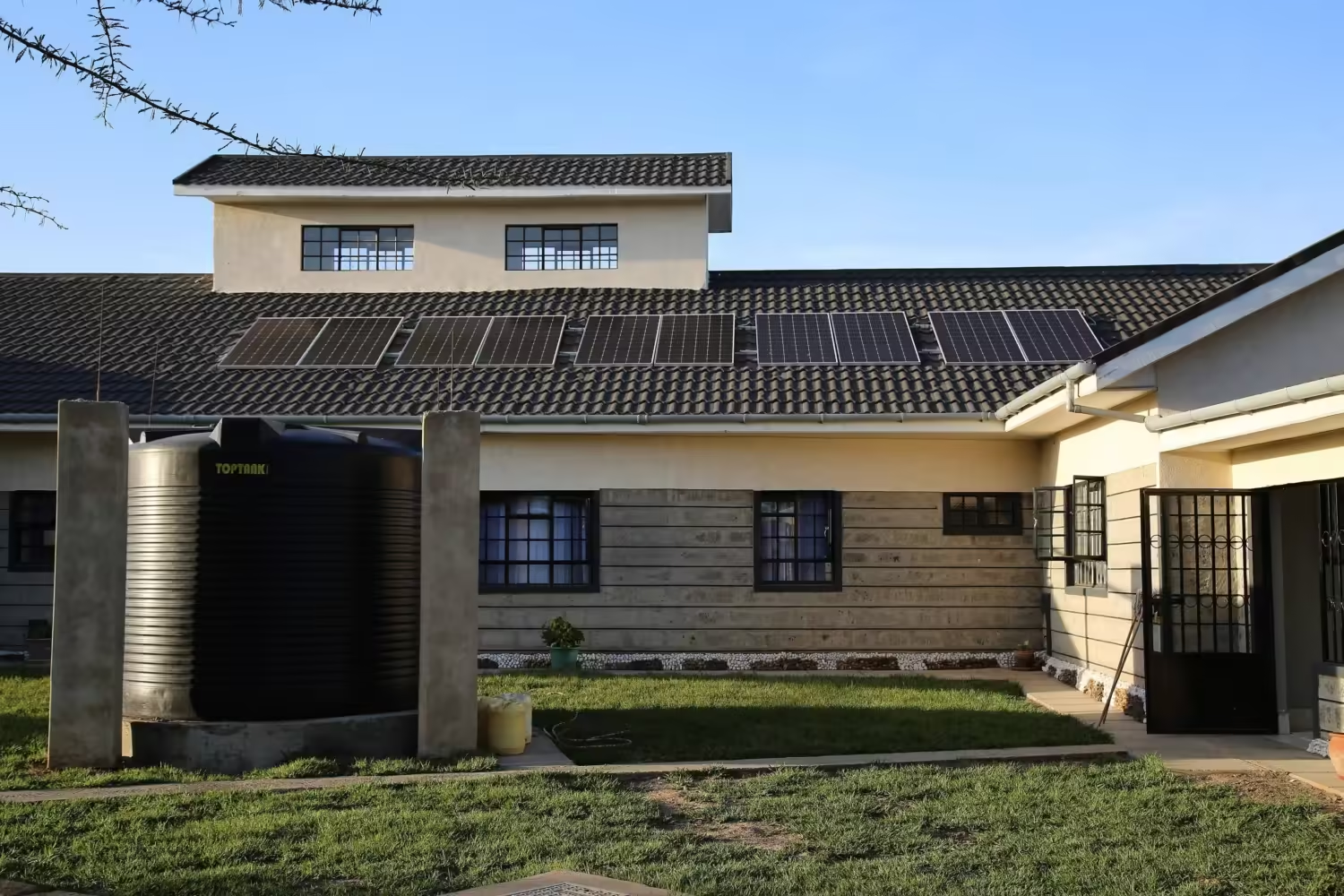
- Three-quarters of it was deployed behind the meter — more than all utility-scale solar ever built on the continent. We compared our numbers to the Global Energy Monitor and IRENA databases on utility-scale (5.9 GW) and off-grid (0.2 GW) solar installations. These numbers account for only a quarter of the total solar capacity added in 2023-2025. The rest, 20 GW (75%), is estimated to be behind-the-meter distributed solar, which largely goes unrecorded in official stats. This means that in just three years, businesses and households installed more solar behind the meter than all utility-scale solar capacity ever built on the continent, combined.
- Even countries that track behind-the-meter distributed solar rarely have visibility into the full installed capacity. Only 15 of 54 countries report an official or semi-official distributed solar capacity figure. In several of these countries, our estimate for the last three years exceeds the entire official installed capacity recorded across all years.
- By the end of 2026, African markets will break another solar installation record. An estimated 17 GW of new solar capacity will be added this year, a 45% year-on-year increase. Nearly two-thirds of this capacity is expected to be installed in just six markets: South Africa, Nigeria, Egypt, Morocco, Algeria, and Congo (DRC) — with the last four expected to install at least 1 GW of solar capacity for the first time. Even so, 36 of Africa’s 54 countries are expected to install record amounts of solar capacity this year.
- It’s not just solar. Battery storage is having its moment, too. Between 2024 and 2025, Africa imported more batteries by value ($4,432m) than solar ($3,562m), with South Africa, Nigeria, and the DRC alone accounting for half of that spending. As with solar, there are no consolidated national records of where this battery storage capacity is being installed.
Source: energyforgrowth.org