
Lisa Poyneer, a distinguished member of the technical staff at Lawrence Livermore National Laboratory (LLNL), and Aaron Lemmer, a member of LLNL’s adaptive optics research staff, will present “Sharpening Our View of the Cosmos: Adaptive Optics in Action” on Tuesday, Nov. 17, from 6–7:15 p.m. at Las Positas College.
The presentation is offered in partnership with LLNL and Las Positas College as part of the 17th annual Science and Engineering Seminar Series, “Theory to Practice: How Science Gets Done.” The series is designed to strengthen the partnership between the two Livermore institutions while providing a forum for Laboratory scientists and engineers to share groundbreaking research with the college’s students, staff and faculty.
This is the second event in the seminar series. The first event was held on Oct. 21 at Las Positas College, where Kelli Humbird and Bogdan Kustowski presented “Harnessing Exascale: Transforming Science and Innovation with El Capitan.”
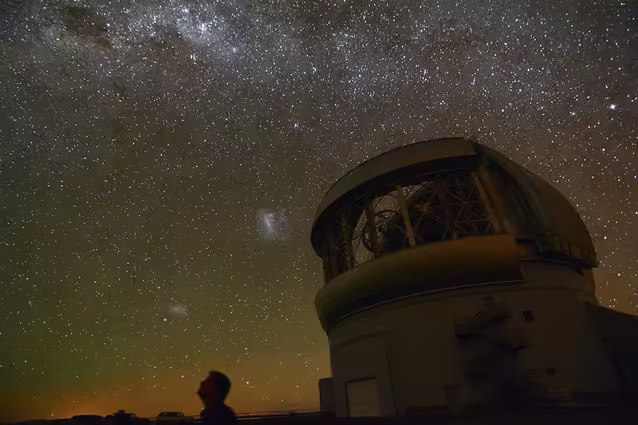
During this second seminar event, presenters will explain how Earth’s atmosphere distorts light and how engineers design and build adaptive optics systems to correct that distortion. These systems enable applications such as imaging planets orbiting other stars. Three key steps are performed thousands of times each second: measuring starlight distortion with a wavefront sensor, estimating the distortion from noisy data and correcting the light with the adjustable surface of a deformable mirror.
The presentation will show how this technology helps modern telescopes produce sharper images of distant worlds and generate new insights into the universe.
About the speakers
Aaron Lemmer is a member of the adaptive optics research staff at LLNL. He earned a bachelor’s degree in applied physics and mathematics from the University of Wisconsin-River Falls and master’s and doctoral degrees in mechanical and aerospace engineering from Princeton University, where he focused on adaptive optics instrumentation for future space-based astronomical observatories. His work includes developing adaptive optics technology for ground-based observatories with laser guide stars and future space telescope missions, including NASA’s Habitable Worlds Observatory.
Lisa Poyneer is a distinguished member of the technical staff at LLNL and an internationally recognized expert in adaptive optics. She earned bachelor’s and master’s degrees from the Massachusetts Institute of Technology and a doctorate in electrical engineering and computer science from the University of California, Davis. Poyneer led the testing and verification of the adaptive optics system for the Gemini Planet Imager, which was the world’s most powerful astronomical adaptive optics instrument when deployed in 2014. Her work has included adaptive optics projects involving lasers, microscopy, space security and X-ray optics. Her current research focuses on designing and testing predictive control algorithms.
The seminar is open to the public and will be held in Building 1000, Room 1011, at 3000 Campus Hill Drive in Livermore.
More information is available on the Las Positas College website.
Source: www.llnl.gov