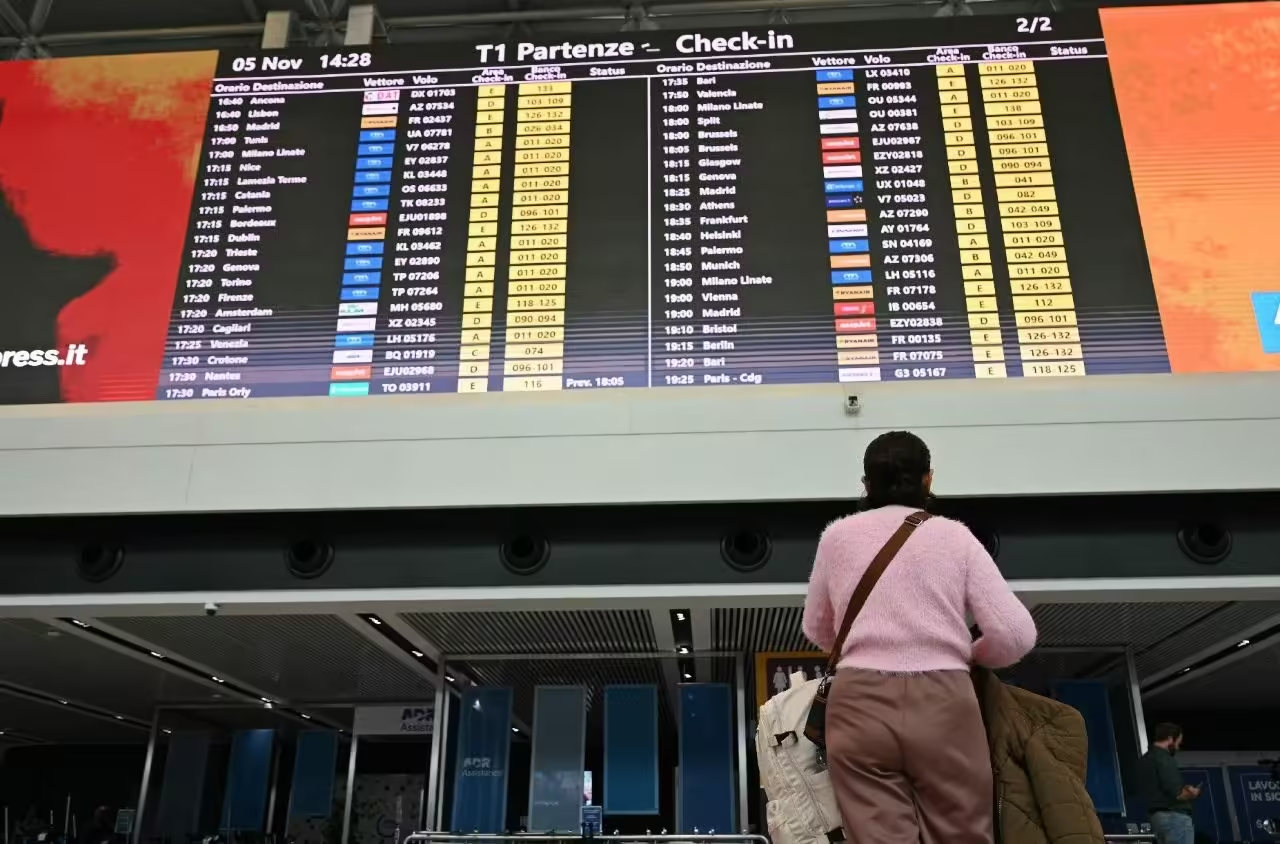

A wave of bomb threats targeting at least 16 passenger flights across Europe prompt military fighter jet escorts, emergency diversions and airport security alerts on Thursday, raising concerns about aviation security amid growing fears of hybrid warfare.
By Stefan J. Bos
Fighter jets were scrambled in France, Italy and Bulgaria on Thursday as a new wave of bomb threats disrupted passenger flights across Europe.
Military aircraft escorted five passenger planes, while three flights were diverted to alternative airports. All landed safely, and authorities reported finding no explosives.
The incidents followed similar threats earlier in the week, raising concerns about a possible coordinated campaign to disrupt European air travel.
In France, an Aer Lingus flight carrying 151 passengers and six crew members from Dublin to Rome was diverted to a military airbase west of Paris, escorted by French fighter jets.
Fighter jet escorts
Bulgarian fighter jets escorted three Ryanair flights arriving from Copenhagen, Madrid and London. Two landed in Sofia, while the London flight was diverted to Plovdiv.
Italian warplanes also escorted a Finnair flight from Helsinki to Rome, where it landed safely.
In the Czech Republic, four aircraft heading to Prague received bomb threats, while other alerts affected flights in Poland, Austria and elsewhere in Europe.
A Wizz Air flight from Milan to Warsaw was diverted to Vienna, while a LOT Polish Airlines flight to Paris was stopped before takeoff.
Airport security alerts
Earlier in the week, passengers were forced to disembark a Ryanair aircraft in Spain following a bomb threat. In Poland, an airport serving Warsaw was briefly closed after a similar alert.
Speaking to journalists in the Bulgarian city of Pernik on Tuesday, Transport Minister Georgi Peev sought to reassure passengers after two flights arriving in Sofia received bomb threats.
“Our air traffic controllers and all other institutions, including the air force, acted according to protocol. I can tell people to remain calm,” he said.
A Wizz Air flight was also diverted to Budapest, Hungary, where a Hungarian fighter jet escorted it to safety.
Hybrid warfare concerns
The incidents come amid growing European concerns about what officials describe as hybrid attacks and sabotage, involving efforts to destabilize countries through unconventional means.
European governments have accused Russia and Iran of involvement in such activities, but Moscow and Tehran deny conducting such campaigns. Authorities have not established a connection between either country and the latest aviation bomb threats.
The alerts also coincided with cyberattacks that disrupted supermarket refrigeration systems across Europe, although no link between the incidents has been confirmed.
Cybersecurity experts say bomb threats could be intended not only to disrupt flights but also to test how airlines, airports and national security authorities respond to simultaneous security emergencies.
European aviation security
The incidents have renewed questions about the ability of European aviation authorities to respond to widespread threats while maintaining passenger safety and minimizing disruption to international air travel.
Source: www.vaticannews.va