
Despite my impending retirement from DCI, I can’t resist sharing a few thoughts on the news that CVS Health plans to split itself up.
This split is a belated acknowledgement that the synergies between CVS Pharmacy and Caremark were overblown from the start. As I argue below, CVS Pharmacy will have greater freedom to make the hard choices—and also find new friends. Regulatory and legislative risks are real, but I view this primarily as a strategic and financial decision.
I’ll have a lot more to say about the future of vertical integration during the Drug Channels Outlook 2027, which will be my final DCI webinar.
In the meantime, click here to share your thoughts with the Drug Channels community on LinkedIn.
READ ME
As always, I encourage readers to review the original source material. Here are links to the relevant reports:
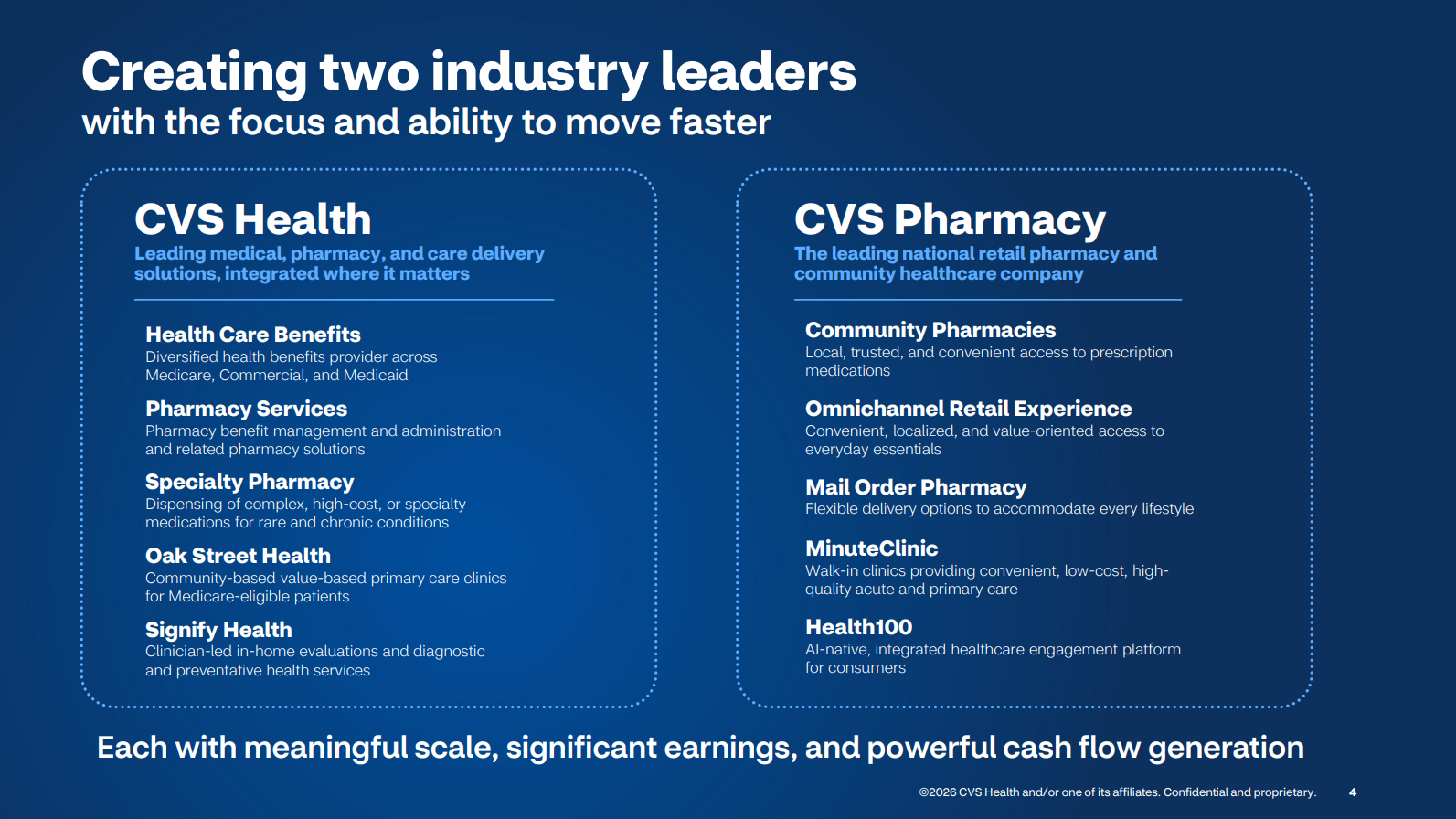
As the summary chart below shows, CVS Health will be making itself look a lot more like Cigna. It will retain insurance, pharmacy benefit management, and specialty pharmacy under one roof. The retail and mail dispensing businesses, along with MinuteClinic and the Health100 technology services business, will become part of the new standalone CVS Pharmacy company.
[Click to Enlarge]
Here’s the coverage from two major newspapers:
BTW, Wall Street was unimpressed. CVS Health’s shares dropped by 12.5% yesterday.
FOUR TAKEAWAYS
1. The synergies between a retail chain and a PBM were overblown from the start.
Frankly, that’s been my long-held viewpoint. More than 15 years ago, I wrote about the lack of compelling synergies in multiple Drug Channels articles. In 2011, for example, I wrote Still Searching for Synergy. (Tip: Read any old articles before the blog’s archives get nuked.)
In 2009 (two years after the CVS-Caremark merger), The Wall Street Journal’s CVS Caremark Merger Has Insignificant Impact noted that the theoretical synergies from the combination had yet to appear, writing: “The nearly $27 billion merger, however, hasn’t driven a major shift in market share, or stopped growth at rival pharmacy-benefit managers, which are known as PBMs, or prompted similar mergers in the sector.” (Yes, I’m quoted in that ancient article.)
Consider Maintenance Choice, which provided the first glimmer of revenue benefit for retail pharmacies. Under the original version of the program, a beneficiary could obtain maintenance medications from either a CVS retail pharmacy or a Caremark mail pharmacy. This model shifted an unknown number of maintenance prescriptions dispensed by Caremark’s mail pharmacy and by other retail pharmacies into CVS retail pharmacies.
Further evidence that the program doesn’t require common ownership comes from its current structure. Today, Maintenance Choice includes CVS, Costco, and Kroger pharmacies as well as select pharmacies as required by state regulation. Costco was added in October 2023, and Kroger was added in April 2024. Apparently, you don’t have to own the pharmacy to offer the benefit. 😉
And it sure doesn’t look like CVS Pharmacy has provided Caremark with an insurmountable advantage. Caremark’s share of equivalent prescription claims processed has plunged, from 34% in 2023 to 26% in 2025. See The Top Pharmacy Benefit Managers of 2025: Market Share and Key Industry Developments.
2. CVS Pharmacy will have greater freedom to make the hard choices—and also find new friends.
Check out Pharmacy Shakeout: Why U.S. Drugstores Are Disappearing for my five-minute primer on the grim realities of retail pharmacy economics.
These problems are compounded by the weak front-store economics behind CVS retail pharmacies. Front-store merchandise generates only about 15% of CVS’s Pharmacy & Consumer Wellness segment revenues, despite occupying about 80% of a typical store’s retail square footage. Amazon, Walmart, Target, and others have undercut this business for years.
Retail healthcare also turned out not to be a reliable solution for excess store space. Consequently, retail chains are unwinding their ill-timed investments in healthcare sites that compete directly with urgent care clinics, physician offices, and other healthcare providers. Note that CVS is distinguishing among care delivery models. Oak Street and Signify are staying with the insurance/PBM businesses, while MinuteClinic is going to the new CVS Pharmacy company. (BTW, the number of MinuteClinic locations has dropped by almost 35% over the past four years.)
Freed from common ownership with an insurer and a PBM, a standalone CVS Pharmacy business could pursue different reimbursement arrangements, expand direct-to-consumer and cash offerings, and build new partnerships with PBMs that may have been reluctant to work with a Caremark-owned competitor. Many benefits of retail–PBM collaboration can be preserved through arm’s-length contracts. That newfound flexibility should help CVS pharmacies compete more effectively with such big chains as Walmart and Kroger as well as emerging alternatives such as Mark Cuban’s Cost Plus Drugs.
Independence would also let CVS Pharmacy make decisions about store size, front-store space, service offerings, and capital spending based on the economics of its own business.
I’m not delusional. The separation won’t magically make the pressures on retail pharmacy disappear. CVS Pharmacy will still have to demonstrate that dispensing prescriptions and providing community healthcare can generate attractive returns without ownership by a PBM.
For a deep dive on the state of the U.S. pharmacy market, check out our 2026 Economic Report on U.S. Pharmacies and Pharmacy Benefit Managers.
3. Regulatory and legislative risks are real, but I see them as secondary drivers behind the breakup.
All 50 states have passed nearly 250 laws focused fully or partially on PBMs. States’ requirements for PBMs vary widely on such items as fiduciary obligations, drug pricing, pharmacy reimbursement, transparency, and access. For example, California’s SB 41 introduced a comprehensive set of regulations for PBMs operating in the state. These include rebate pass-through requirements, fiduciary duties, transparency disclosures, pharmacy network rules, cost sharing limits, and formal regulatory oversight.
CVS Health’s large retail assets have created additional risks.
So far, two states—Arkansas and Tennessee—have enacted laws that restrict certain forms of joint ownership involving PBMs and pharmacies. The legality of these laws remains uncertain. Arkansas’ law had been scheduled for January 1, 2026, implementation, but is blocked by a federal injunction. (Perhaps coincidentally, Walmart, which operates the third-largest U.S. retail pharmacy but not a PBM, is headquartered in Arkansas. Nothing to see here, I’m sure.)
CVS Health still faces risks through its ownership of Caremark and CVS Specialty. But centralized dispensing offers more geographic flexibility than a network of retail community pharmacies, although it doesn’t fully eliminate exposure to state licensing and ownership rules. Retaining Caremark and CVS Specialty together means keeping a combination targeted by these rules. That’s why I view regulation as a contributing factor, rather than the central explanation for the breakup.
4. Vertical integration isn’t dead.
As you can see above, CVS Health will retain insurance, pharmacy benefit management, specialty pharmacy, and care-delivery businesses. That looks a lot like vertical integration to me.
The growing administrative complexity of state and federal regulation will disproportionately burden smaller PBMs that lack the scale, capital, and integrated infrastructure of the largest organizations. That’s why I believe that vertical integration will continue to create strategic and financial advantages for the largest healthcare organizations—along with new opportunities to shift profits, manage risk, and coordinate services across multiple parts of the healthcare system. See my comments in PBM Shakeout: How Vertical Integration Is Reshaping What’s Next.
As I had predicted in previous outlook webinars, the forces of deconsolidation are strong. Companies can unwind some combinations while preserving others.
Fortunately, I’m retiring and won’t have to update DCI’s infamous vertical integration chart.
See you at Drug Channels Outlook 2027!
BONUS: WHAT I LOOKED LIKE YESTERDAY WHEN I HEARD THE CVS NEWS
Source: www.drugchannels.net