
In recent weeks, the Maldives’ Thilafushi Port has made headlines in Indiawith President Mohamed Muizzu’s government accused of favouring Beijing over New Delhi for this infrastructure project. The Maldivian government has dismissed these reports, asserting its impartiality and its right to choose partners in line with its own interests and development priorities. India’s response to the port project has thus far been muted, reflecting two intertwined policies at play. First, India continues to accommodate the Maldives’ agency and is selective about where it seeks to persuade the government. Second, it is using economic and development assistance to build leverage with the Muizzu government and further its long-term strategic ambitions.
The Story So Far
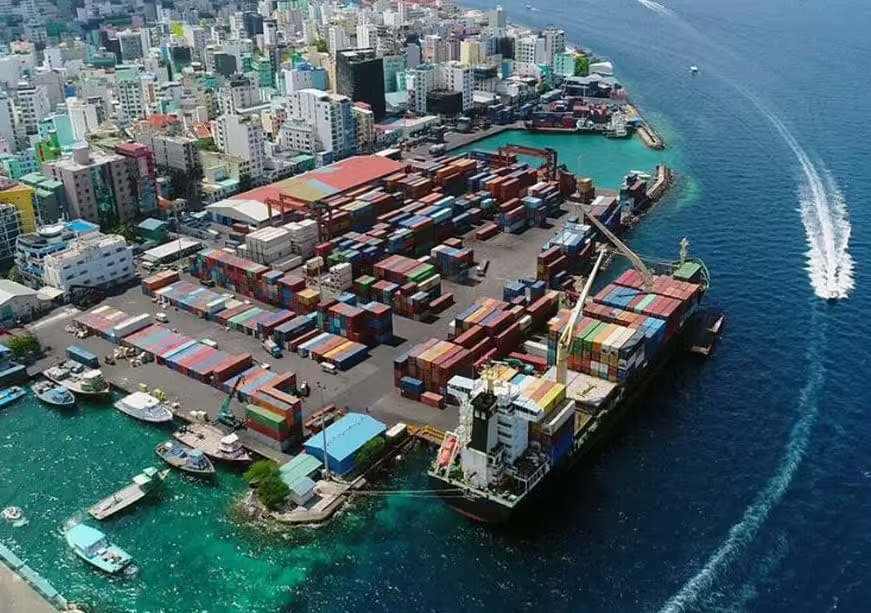
Thilafushi is an artificial island near the Maldivian capital, Malé (see Map 1), created as a landfill for the country’s waste management. Over the years, it has evolved into an industrial zone. Malé, home to more than half the country’s population and better equipped in socio-economic infrastructure, naturally became the hub of trade and commerce. But rising migration, growing domestic demand, and the country’s geographic significance for trade have made it necessary to decongest and expand the Port of Malé, also known as the Malé Commercial Harbour. At present, clearing cargo at the port takes one to two weeks.
Map 1. Greater Male region

Source: Google Maps
As a result, in 2015, the government of President Abdulla Yameen signed an agreement with the UAE’s DP World to develop and manage a port at Thilafushi. The deal, however, fell through owing to a lack of consensus on ownership and operations. In 2018, the government of President Ibrahim Solih moved the project to Gulhifalhu (see Map 1) — another reclaimed island near the capital. The dredging and the subsequent port development, estimated at US$400 millionwere to be financed by a US$800 million Indian line of credit. While the port was to be owned and operated by the state-owned Maldives Port Ltd (MPL), the conditions of the credit line required that at least 75 percent of the project value, in the form of goods, works, and services, be sourced from India, especially during the development phase. Accordingly, by August 2023, the Export-Import Bank of India (EXIM Bank) was preparing to open a tender for the port’s construction.
However, Muizzu, who came to power in late 2023, moved the port back to Thilafushi, calling it the most feasible option. The Thilafushi port featured regularly in his pitch to investors from the UAE and China. Drawing on his anti-India politics and his drive to diversify partnerships, he also left little room for India in the project. The Finance Ministry announced that more than US$400 million of the EXIM Bank-financed funds for the Gulhifalhu port project and land reclamation would be diverted to other projects. India even expressed interest in the project during Muizzu’s 2024 visit, yet remained excluded. By then, discussions were under way with the China Harbour Engineering Company (CHEC), DP World, and the Philippines’ International Container Terminal Services.
The port will expand to 20 hectares, with more than 650 metres of quay wall, a 125-metre roadside jetty, and a capacity of 400,000 20-foot containers, along with a warehouse, an X-ray facility, and other automated services. The project will bring together port services, logistics, warehousing, re-export, and small industries, cutting the minimum clearance time to 2-5 days. The port is expected to be operational by November 2028 and will remain with MPL. The state-owned Maldives Transport and Contracting Company has already built a 100-metre quay wall and paved three hectares. Earlier this year, CHEC was selected to develop phase one of the port, which includes building a segment of the quay wall and space for container storage.
India’s response to these developments has been muted, reflecting two recurring features of its approach to the Muizzu government.
Accommodating Agency
The Maldivian government exercised its sovereignty and agency to shift the project and seek investment from other partners without consulting India. Since the port tender was never formalised, it saw no legal obligation to involve India. It thus maintained ambiguitysignalling that India’s assistance had been meant for land reclamation rather than the port itself.
Unlike the previous Maldivian Democratic Party (MDP) governments, which saw India as a natural ally, Muizzu approaches the relationship in more transactional terms. His politics and ideology remain sceptical of India, even as geographic proximity and economic necessity have compelled him to cooperate with it, respect its red lines, and avoid antagonising it.
For its part, India has accommodated the Maldives’ agency. It understands that Muizzu’s policies have revolved around reducing reliance on India under the pretext of making sovereign choices and diversifying partnerships. Unlike the previous Maldivian Democratic Party (MDP) governments, which saw India as a natural ally, Muizzu approaches the relationship in more transactional terms. His politics and ideology remain sceptical of India, even as geographic proximity and economic necessity have compelled him to cooperate with it, respect its red lines, and avoid antagonising it.
India has avoided stoking nationalism and anti-India sentiment by being selective about when it pushes back or seeks to persuade the government. It has drawn clear red lines and reiterated the Maldives’ responsibility to preserve peace and stability in the Indian Ocean Region. In other words, India applies pressure and pushback where it matters the most. Examples include the compromise over the withdrawal of Indian military personnel and the relocation of a Chinese agricultural project away from Uthuru Thila Falhu (UTF), where India is helping build a harbour and dockyard for the Maldives National Defence Force (MNDF). The same logic applies to China’s presence. India understands that China’s engagement cannot be ruled out altogether, and that it should not have to compete dollar for dollar with Beijing.
India likely views the Thilafushi port project as a purely commercial arrangement, with no significant implications for its security or strategy. After all, China is involved in only one phase of the project, and its interest in Thilafushi is no different from its engagement in the Maldives over the past three years. While Chinese development assistance has fallen short of expectations, Chinese state-owned entities have become contractors in housing, construction, infrastructure, land reclamation, energy, and connectivity projects. These projects are financed not by China but by the Maldivian government or third parties. Historic ties, the urge to diversify, faster implementation, and strong financial and technical capacity have further raised the preference for Chinese contractors.
As Muizzu seeks to diversify partnerships, India has watched, and even encouraged, like-minded partners to expand their presence in the country. The United States has also shown interest in assisting the Maldives with the Thilafushi port, though the details are yet to be finalised.
Indeed, as Muizzu seeks to diversify partnerships, India has watched, and even encouraged, like-minded partners to expand their presence in the country. The United States has also shown interest in assisting the Maldives with the Thilafushi port, though the details are yet to be finalised.
Building Leverage
To reinforce its accommodative stance and selective pushback, India has used economic and development assistance to build leverage and protect its interests. It has extended a US$150 million treasury bill (T-bill) facility on multiple occasions, all of which were repaid recently, with India bearing nearly US$45 million in interest. Similarly, two currency swapsworth US$400 million and INR 3,000 crore (US$357 million), were concluded. India has also pushed for the use of the Unified Payments Interface (UPI), RuPay, and trade in rupees to promote financial connectivity and ease pressure on the Maldives’ depleting dollar reserves.
Rather than object to the Maldives’ decision to shift the port project, India has supported it. It is speculated that, after the project moved to Thilafushi, a portion of India’s US$800 million line of credit (LoC) was left underutilised. Exact figures have not been made public, but more than US$495 million of the credit line is reported to have been utilised. To assist the Maldivian government, India capped and closed the LoC at this amount and amended its terms, reducing annual debt servicing from US$51 million to US$29 million. A new LoC worth INR 4,850 crore (US$500 million) has replaced the older credit line and will be used for infrastructure projects. This keeps open the possibility of Indian assistance for the port, should the Maldivian side request it.
India also recognises that the Maldives needs infrastructure and investment. It has therefore continued to support the government and cultivate goodwill. The port project also stands to benefit from India’s US$500 million assistance (US$100 million in grants and US$400 million in credit) for the Greater Malé Connectivity Project (GMCP), which will link Malé to Villingili, Villingili to Gulhifalhu, and Gulhifalhu to Thilafushi. In essence, regardless of the change in location, the port is set to benefit from India-funded connectivity.
With Muizzu’s popularity waning and the MDP gaining ground and pressing for reforms, India’s policy appears non-partisan, which is helping New Delhi bide its time. Its stance on the Thilafushi port exemplifies this strategic patience and the intertwined policies behind it.
These policies have given India enough leverage to keep its security and strategic interests intact even as it accommodates the Maldives’ agency. With presidential elections less than two years away, this approach is currently working in India’s favour. Despite a surge in religious and nationalistic rhetoric, India’s role has seen little politicisation, at least for now. With Muizzu’s popularity waning and the MDP gaining ground and pressing for reforms, India’s policy appears non-partisan, which is helping New Delhi bide its time. Its stance on the Thilafushi port exemplifies this strategic patience and the intertwined policies behind it.
Aditya Gowdara Shivamurthy is an Associate Fellow with the Strategic Studies Programme at the Observer Research Foundation.
The views expressed above belong to the author(s). ORF research and analyses now available on Telegram! Click here to access our curated content — blogs, longforms and interviews.
Source: www.orfonline.org