
Since Tuesday night, the obituaries for the MAHA movement have been piling up fast: “RFK Jr and MAHA Suffer Brutal Election Night Wipeout,” wrote the Daily Beast. Midterms could be the “‘death knell’ of the MAHA-Trump alliance,” according to USA Today. Even STAT reported “MAHA mowed down.”
No doubt it was a brutal night for MAHA-allied-candidates. STAT counts at least 11 who lost, including Ken Paxton in Texas, backed by a MAHA super PAC; Texas Gov. Greg Abbott, who signed MAHA-backed legislation into law; and Kansas Republican Sen. Roger Marshall, a founding member of Congress’s MAHA Caucus (and a physician). Nowhere was the defeat more pronounced than in Iowa, where MAHA-aligned PACs poured in more than $1.5 million to support Republican Zach Lahn for governor, only to see him lose by double digits.
But while the MAHA political movement suffered an electoral wipeout, the grassroot movement’s goals of preventing chronic disease, reducing pesticides, and fighting for healthier food and water were strikingly similar to the health agendas championed by winning Democratic candidates, including Democrats Abdul El-Sayed, Michigan’s next senator, and Rob Sand, the next governor of Iowa.
And many voters appear to identify with the movement. Liz Hamel, KFF’s senior vice president and director of public opinion and survey research, tells us that her organization’s analysis of a midterm voter poll found that 30% of voters told surveyors they support the MAHA movement, including 22% who said they strongly support MAHA.
But as pollsters piece together what was behind the results, one verdict is clear: Only 21% of voters said the Trump administration is making the nation healthier.
In our conversations with grassroots MAHA supporters, many have told us the alliance with Trump never made sense to them, that it was an opportunistic grab for votes from the jump. Discontent has been building for months. We hear it on our podcast and in conversations with supporters all the time. The frustration was recently crystallized in a scorecard produced by a group of MAHA faithful that concluded that the administration partially kept just five of its promises to MAHA — and broke 37. Tiffany Cianci, one of the report’s authors, told us on the podcast this week, “I actually think the outcome on Tuesday was the inevitability of a bunch of self-inflicted wounds.”
Since Tuesday night, MAHA supporters have told us they aren’t done — far from it. But yes, many are looking for new allies. Which means Democrats, as they take over Congress, may have an opportunity to bring a new group into their tent.
There are some signs they will. In September, a House Democratic working group co-led by Rep. Alexandria Ocasio-Cortez sketched out a health agenda with a section titled “Reclaiming MAHA and Protecting American Families.” Along with calls to “protect vaccine recommendations from political interference and restore unlawfully withheld NIH funding,” the proposal calls for blocking liability shields for glyphosate makers, setting stronger infant formula safety rules, and closing a loophole that lets companies declare their own food additives safe. Ocasio-Cortez has been meeting with MAHA grassroots leaders for months.
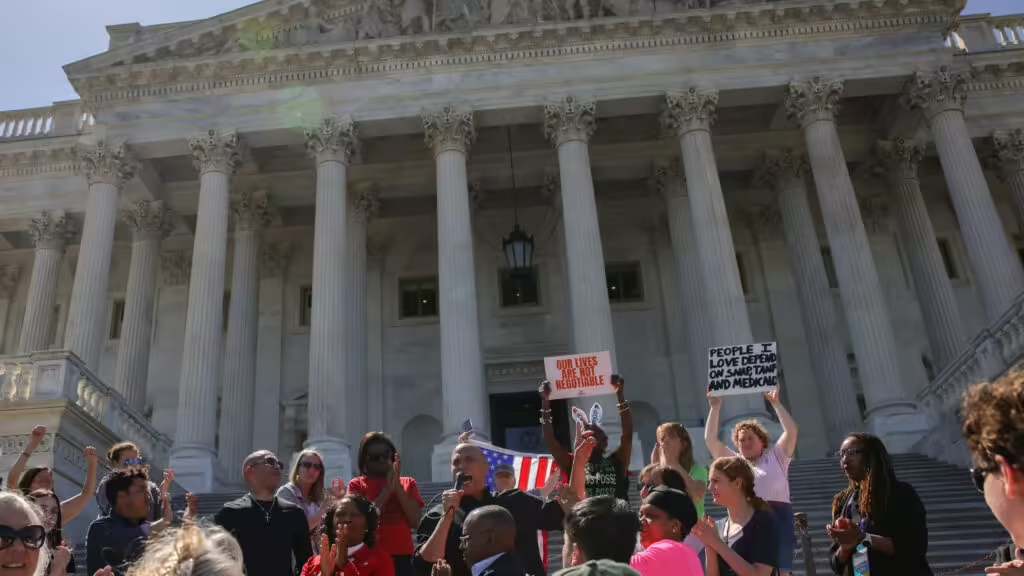
Similarly, Democratic Sen. Cory Booker gave an impassioned speech in April at the People vs. Poison Rally on the steps of the Supreme Court, as the justices heard a case over glyphosate and health liability. Booker stood alongside key MAHA grassroots leaders and supporters, decrying pesticide immunity shields.
It seems logical that MAHA and the Democrats would find each other. MAHA and MAGA were always the stranger alliance. Holding industry accountable on behalf of individual and environmental health is a bread-and-butter Democratic issue.
Yet recently on health, Democrats have more often been seen as the defender of Obamacare or institutional medicine. To be clear, access to affordable care is the cornerstone of health and is perpetually under threat. But in the meantime, fighting for people’s health against industrial pollution of America’s air and water or pumping out unhealthy food has not been the defining rallying cry for the party in recent years. As Booker put it this year, “A movement called MAHA caught fire in the vacuum we left behind.”
Despite big differences over health secretary Robert F. Kennedy Jr. and vaccine policy, Booker, along with Democrats Chellie Pingree and Jim McGovern, have been working with MAHA on legislation on regenerative farming and healthy food. They’ve created real bonds with MAHA grassroots leaders and staunch Kennedy allies such as Zen Honeycutt and Kelly Ryerson. The latter told us, “My Democratic heroes on the pesticide and farming issues are Pingree, McGovern, and Booker. But they have been pretty lonely when bringing forth policy change.” In describing her conversations with reporters and organizers about MAHA, Cianci told us: “I talk more about Cory Booker, and Ro Khanna and Thomas Massie than I do about any of the Republicans that claimed MAHA in this election.”
As for the profoundly divisive issue of vaccines, Rep. Chellie Pingree has recounted telling Honeycutt she’d work with her on pesticides, PFAS (better known as “forever chemicals”), and school lunches, but not on vaccines or 5G. In other words, Pingree found a way to work with someone on issues they agree on, while setting aside ones they don’t.
These areas of potential Democratic and MAHA alignment would appear to be popular with the broader public. KFF found in April that 75% of Americans say there isn’t enough regulation of chemical additives in food, and 64% say the same of pesticides. A 2025 poll by the progressive firm Navigator Research found more than 80% of Democrats, Republicans, and independents want corporate polluters held accountable.
Of course, the change in power in Washington will usher in a season of accountability. Democratic Senate newcomer Annie Andrews, a pediatrician who just pulled off a stunning victory in South Carolina, has said that impeaching and removing Kennedy is one of her top goals, calling Kennedy her “professional archnemesis.” Abdul El-Sayed, an M.D. who worked in public health, told us he sees Kennedy as a “grifter” who needs to be held accountable.
Democrats can and should exercise oversight of the federal health agencies and the White House, including potential hearings with Kennedy. They have serious questions about disruptions to vaccine policy, the response to measles outbreaks, and the upending of scientific research infrastructure.
But when it comes to health, if hearings are all that come out of this blue wave, it will be seen as a big missed opportunity. Voters expect the new Congress to fight for real change that will improve their lives, not just be locked in partisan investigations for the next two years.
Honeycutt told us efforts to impeach Kennedy would be a “colossal mistake.” She warned, “We cannot abide by people who are trying to get rid of the only person in this administration who has vowed to die with his boots on protecting the health and safety of our children.” Responding to a post by Democratic Sen. Angela Alsobrooks calling for Kennedy to “resign or be fired,” Vani Hari, the healthy food activist known as “The Food Babe,” responded: “Dear Democrats — This is not how you win a coalition or work together. This is how you waste time while our children continue to get sicker than any developed nation.”
None of this will be easy. Among many MAHA supporters, loyalty to Kennedy runs deep. Kelly Ryerson told us she would still work with Democrats who wanted to oust Kennedy, but she thinks they are mistaken about him. She says she wishes there was equal Democratic fervor for impeaching EPA Secretary Lee Zeldin, whom she believes deserves to be hauled before Congress.
Many MAHA supporters describe to us their deep anger toward Democrats over the party’s treatment of Kennedy back in the 2024 election primary and alignment with what they saw as public health and government overreach during the pandemic. Many continue to perceive the left as elitist, condescending, and too connected to the corporations they see as corrupting the very systems of regulation Democrats have long supported.
And even if Democrats and MAHA align and pass legislation in the House, Senate Republicans could filibuster, and President Trump has already talked about his ultimate veto pen. Democrats also have their own stated priorities, such as trying to undo Medicaid cuts now kicking in and investigating members of the Trump administration for corruption.
As election night fades, the possibility of a new alliance is coming into view: Democrats, a party with a long history regulating industry and MAHA (maybe they’ll take a new name?), a grassroots movement with energy and organization.
When it comes to food, air, and water, both seek to use the levers of government to protect Americans’ health. Will they seize the opportunity?
Brinda Adhikari and Tom W. Johnson are the co-hosts and co-creators of the “Why Should I Trust You?” podcast.
Source: www.statnews.com