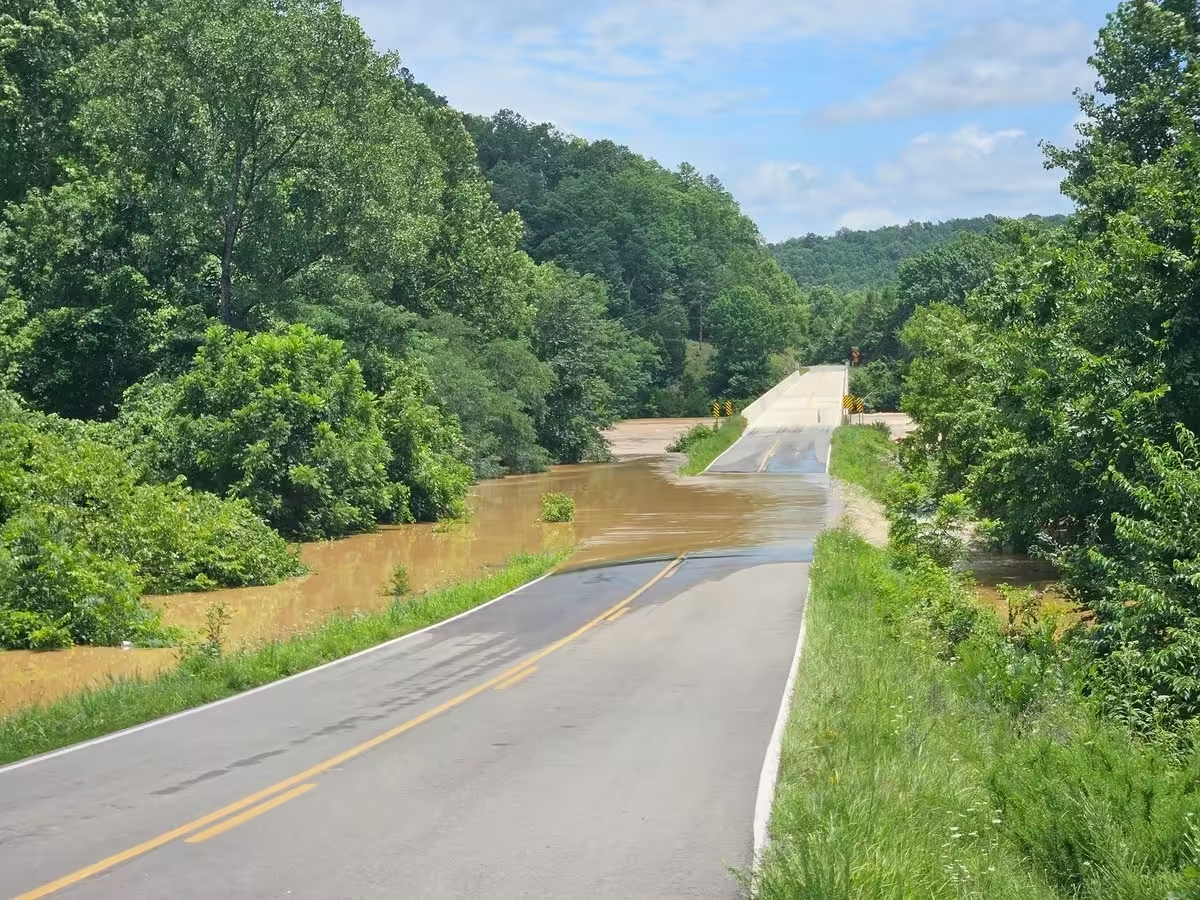

Floodwater from the Black River cover a roadway near the Highway K Campground at Clearwater Lake in Piedmont, Missouri, July 10, 2026. The rapidly rising water left campers stranded on higher ground, requiring an evacuation by boat.
View original

Doug Stilts, a natural resources specialist with the U.S. Army Corps of Engineers Little Rock District, paddles a kayak through floodwaters near the Highway K Campground at Clearwater Lake in Piedmont, Missouri, July 10, 2026. Stilts borrowed the kayak from a local concessioner to check on campers stranded on higher ground after floodwater cut off access to the park entrance road.
View original

Chris Alley, a natural resources specialist with the U.S. Army Corps of Engineers Little Rock District, and volunteer Gale Wells navigate floodwaters in a work boat near the Highway K Campground at Clearwater Lake in Piedmont, Missouri, July 10, 2026. The two helped evacuate campers stranded on higher ground after rising floodwater from the Black River cut off access to the park entrance road.
View original

U.S. Army Corps of Engineers Little Rock District personnel and a volunteer prepare to evacuate campers near the Highway K Campground at Clearwater Lake in Piedmont, Missouri, July 10, 2026. Rising floodwater from the Black River blocked access to the park entrance road, requiring a boat to transport campers to safety.
View original

U.S. Army Corps of Engineers Little Rock District personnel, from left, John Will, Russell Cooper, Robert Daniel, Doug Stilts, Ronald Sutton, Matthew Brown and Chris Alley pose for a group photo at Clearwater Lake in Piedmont, Missouri, Nov. 3, 2026. The employees responded to historic flooding July 10, 2026, when rising floodwater from the Black River cut off access to the Highway K Campground, leaving campers stranded on higher ground.
View original
The woman was still wearing her life jacket when she reached dry ground.
Chris Alley, a natural resources specialist with the USACE Little Rock District, told her she could take it off.
“Nope,” she told him. “Not until we get to that cabin.”
It was her first visit to Clearwater Lake, and it had turned into something none of the campers had planned for.
Hours earlier, the Black River had begun rising at a rate Clearwater Lake employees had never seen before. Roads into the Highway K Campground disappeared beneath the water, electricity was lost and campers who had remained on higher ground found themselves cut off from the outside world.
By the time Alley arrived at work that fateful day, the only practical way to get them out was by boat.
Getting that boat there was another matter.
The morning of July 10 began with Clearwater Lake employees watching the weather and the river gauges closely.
More than 12 inches of rain had fallen north of the lake, and the water was making its way downstream toward the project. The flooding was affecting communities throughout the region, with local authorities conducting search-and-rescue operations at other campgrounds north of the project.
Doug Stilts, a natural resources specialist who has worked at Clearwater Lake for 20 years, knew the conditions were worth watching but the speed of the rise was something different.
The river had been climbing steadily when Stilts and Operations Project Manager Robert Daniel headed toward the Highway K Bridge to check conditions. Maintenance employees had already tried to reach the area and had been stopped by floodwater, so Stilts and Daniel took a longer alternate route in hopes of finding another way through.
When they reached the area near the campground, they stopped at a local canoe concession. That was when Stilts noticed someone moving on the other side of the floodwater.
“We had thought everyone had already been evacuated,” Stilts said.
Earlier that morning, around 2 a.m., Missouri Department of Conservation game warden Caleb Neese, had been called to the area and evacuated the campers from the lower A and B sections. So, Stilts and Daniel had every reason to believe the campgrounds were empty.
But the people Stilts had spotted were still there, farther up the hill in C Section, where the water wasn’t expected to reach them.
The problem was that the floodwater had cut off their access to the park entrance road.
Stilts couldn’t drive across the flooded campground, so he asked the concessioner if he could borrow a kayak. He hopped in and paddled across to find out how many people were still there and what condition they were in.
The campers were not in immediate danger of being overtaken by the water. They were on a hill. The problem was that the hill had effectively become an island. If anyone needed emergency medical attention, responders could not simply drive in.
Cell service at the top of the hill was also notoriously unreliable, sometimes allowing a text message through and sometimes leaving the campers without a way to communicate.
After speaking with the campers, Stilts returned in the kayak and told Daniel what he had found.
They needed a boat and quickly.
Alley had been watching the gauges as well. After more than 25 years with USACE, he knew what rising water could mean for Clearwater Lake, particularly after heavy rain upstream.
The gauge had already jumped several feet in an hour.
Then it jumped four.
“We knew then we had something potentially historic going on here,” he said.
While Stilts paddled his way toward the campground at Daniel’s direction, Alley and volunteer Gale Wells, prepared a USACE boat at the marina in case a water rescue was needed.
The boat was a work boat designed for Clearwater Lake operations, not a specialized rescue vessel, but it had one feature that would prove especially useful: a landing craft on the front that could lower into the water and create a level platform.
The boat was ready before they knew exactly what they would be dealing with.
Then Stilts returned from the campground with the information they needed. There were campers still on the hill, including someone who used a walker, and they needed a way out.
Alley and Wells took off with the boat and headed toward the campground.
The floodwater had continued to spread by the time they arrived. Water was now running across the highway before the bridge, with about a foot of water over the road.
Alley climbed into Daniel’s truck and they drove down to assess the roadway him and Wells would have to cross with the boat.
At the bottom of the hill, Rob threw the truck in park and slowly turned to Alley and asked, “Do you think we can make it?”
Alley studied the road for a minute.
“Yeah, as long as we can see that yellow line on the road the entire time, I know the road is still there,” he said. “We’re not going to get washed away or drive into a hole.”
And in that moment, the decision was made. Alley returned to his truck and he and Wells made the crossing.
Once they reached the campground, Alley launched the boat directly from the highway into the floodwater.
Using a depth finder, he could see that the water around the campground was roughly 8 to 10 feet deep. He maneuvered toward a campsite on higher ground and lowered the boat’s landing craft.
As Alley stayed at the controls, Wells walked up the hill to gather the campers and bring them down to the boat.
The platform settled at the same level as the water beside the dry ground, allowing the campers to walk directly onto the boat. Even the camper using a walker could make the step without difficulty.
For others, there was another problem: convincing them to leave.
Some campers did not want to go. They believed the water would eventually recede, and from where they were standing, they were not in immediate danger.
Alley understood why they were reluctant, but he also knew that the situation could change quickly. There was no electricity, it was sweltering hot, communications were unreliable and emergency services could not easily reach the campground.
“I understand why you want to stay,” Alley told them, “but you have to evacuate. The boat is here now. We gotta get you out of here.”
It took four or five trips to move everyone to safety.
The ride between the highway and the campground was only about 100 yards, but the landscape around them had changed completely. What had been a campground was now covered by deep, moving water.
Alley tried to keep the campers from becoming overwhelmed by the situation and set their minds at ease by bringing some levity to the situation.
“Welcome to the Black River excursion,” he joked. “I’m your tour guide, Chris.”
He reassured them that he had driven boats his entire life and that they were headed to dry ground, where a local cabin rental company had offered them cabins for the night, along with food and water.
By that time, the river was nearing its crest.
The response moved like a well-choreographed dance. Maintenance employees were shutting off power without waiting to be told. Others were handling phone calls, cancelling reservations and issuing refunds as the situation unfolded.
“Everyone worked together really well,” Stilts said. “We all knew our roles, and just got it done.”
The water itself offered no such order. The river was rising faster than the people watching it had ever seen, roads were disappearing under water and decisions had to be made while conditions continued to change.
But at Highway K, the response came together one decision at a time.
Stilts borrowed a kayak because there was no other way to reach the campers.
Alley and Wells brought a work boat into water deep enough to cover the campground.
And one crossing at a time, the campers left the rising water behind.
The Black River at Highway K crested at 28.7 feet that day, more than two feet above the previous record. Additionally, the rainfall that drove the flooding was a 1-in-1,000-year event in parts of the region.
The campers on that hill had arrived at Clearwater Lake for a camping trip and left with a story they would not soon forget.
Source: www.army.mil