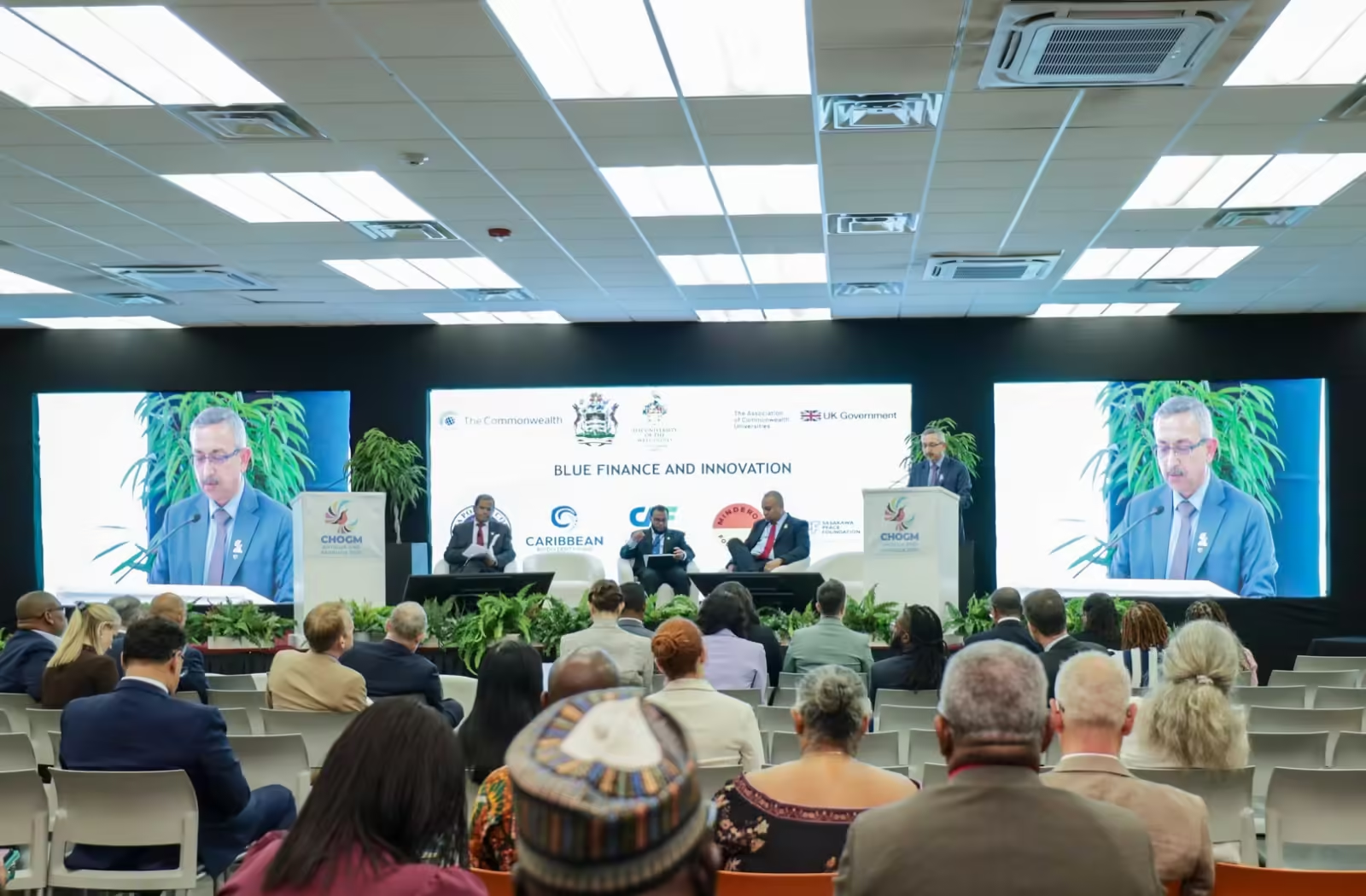

Speech by Deputy Secretary-General (Programmes) Amb Tanmaya Lal at the Blue Finance and Innovation side-event at the Commonwealth Heads of Government Meeting (CHOGM).
It is great to see the interest and the level of participation that this event has generated.
It demonstrates the growing popular understanding of the importance of oceans to global food supplies, livelihoods, trade & economy and security, and also the deeper interconnection between oceans and global climate.
Rising ocean temperatures and acidification, rapidly growing levels of marine pollution threatening entire ecosystems & biodiversity, unsustainable exploitation of fish stocks all directly impact climate and economies.
Costs are borne disproportionately by SIDS, developing countries and coastal communities.
25 of the 56 Commonwealth countries are SIDS or large ocean states. Nearly 50 of the Commonwealth countries are coastal states. The Commonwealth is home to almost half of all coral reefs and one third of mangroves of the world.
The Commonwealth spans every major ocean region, collectively stewarding one-third of marine waters under national jurisdiction.
It is no surprise that Climate resilience and Ocean conservation are prioritised in the Strategic Work Plan of the Commonwealth.
The Ocean-Climate nexus is increasingly finding serious discussion at the UNFCCC COP negotiations.
The Taku Pakasoa Declaration adopted earlier this month at the pre-COP31 hosted by Fiji and Tuvalu – both are Commonwealth members – speaks of the common threats faced by SIDS across the Pacific, the Indian and Atlantic Oceans and the Caribbean.
Another Commonwealth member -Australia – will chair the negotiations at the upcoming COP31 negotiations.
This year’s ‘Our Ocean’ Conference was hosted by Kenya, and the next one will be hosted by Canada next May. Both are Commonwealth members.
Pacific leaders have led the global discourse on ocean governance and sustainable ocean development. 11 of the 14 Pacific countries are Commonwealth members. Two years ago at the Samoa CHOGM, the Commonwealth leaders adopted the Apia Ocean Declaration.
The Apia Declaration goes beyond other global legally-binding instruments on reducing plastic pollution, sustainable management of marine waters and fixed maritime boundaries despite sea-level rise.
Beyond advocacy and negotiations, action requires practical solutions.
Finance, technical capacity and human resources remain the key constraints in real climate action. Going beyond advocacy and multilateral negotiations, the Commonwealth Secretariat continues to deliver on climate action and ocean conservation in several ways.
The Secretariat, through various partnerships, is helping mobilise grants, to facilitate technical delivery for climate projects, especially for small states. For instance, the partnership with COP29 Presidency.
We have launched two new grant programmes for ocean-related projects – the Commonwealth Blue Charter Incubator in partnership with CAF-Development Bank for Latin America and the Caribbean, and Prince Albert II of Monaco Foundation. This would provide grants of up to £ 50,000 for early stage ocean conservation projects. The Call for proposals is open.
The other is Commonwealth COP29 Environmental Resilience Programme. This will provide grants of upto £ 200,000 each to Commonwealth SIDS to develop early-stage Ocean, climate change and sustainable energy projects.
We are also assisting large ocean states to better understand how to access capital markets. In partnership with Blue Bond Accelerator and ORRAA, we have published the Commonwealth Guide to Blue Bond issuance.
We have recently completed the Commonwealth Blue Bond Readiness Programme – a six-month training workshop to assist 25 Commonwealth countries in building country level roadmaps.
Another recent innovative initiative is Space4Resilience. It brings together advances in Technologies – from space-based remote sensing to data analytics to AI and guides their deployment for wider public good for disaster resilience, by bringing together different stakeholders into this international collaboration.
Over the last decade, the Commonwealth Climate Finance Access Hub has placed long-term advisers in 19 countries and helped mobilise access to around £600 million for climate change and adaptation projects.
The Secretariat has also been working with member countries to help them with the ratification of the BBNJ the High Seas treaty.
We are also working with member countries to develop bankable projects.
The Commonwealth has also been advocating for much greater concessional finance from multilateral development banks, to be allocated on vulnerability.
Today Geopolitical flux is undermining confidence in multilateralism. But real collaborative projects remain invaluable to build collective capacities in meeting global challenges.
The Commonwealth remains a trusted partner in climate advocacy and action.
Source: thecommonwealth.org