
To fix gluteal amnesia (or “dead butt syndrome”), you need to stretch tight hip flexors and retrain your brain to fire your glute muscles using targeted activation exercises. Movement is how you remind your glutes what they’re capable of doing.
“You want to give both your brain and your body a reason to adapt,” said Dr. Mercer, PT, DPT, a physical therapist at Hinge Health. “When you practice an exercise and intentionally use your glutes, you strengthen both the muscle and the signal telling it to contract.
Targeted exercises can help improve strength and coordination, but your everyday movement matters, too. Walking, standing up regularly, climbing stairs, and changing positions throughout the day all give your glutes opportunities to contribute.
“The key is frequent movement,” Mercer said. “The more often you get up and use your glutes, the easier it becomes for them to participate when you need them.”
Daily fixes and habits
• Move more: Stand up or walk for a short break every 30 minutes.
• Stretch hip flexors: Do a half-kneeling hip stretch to loosen the front of your hips, which blocks your glutes from firing.
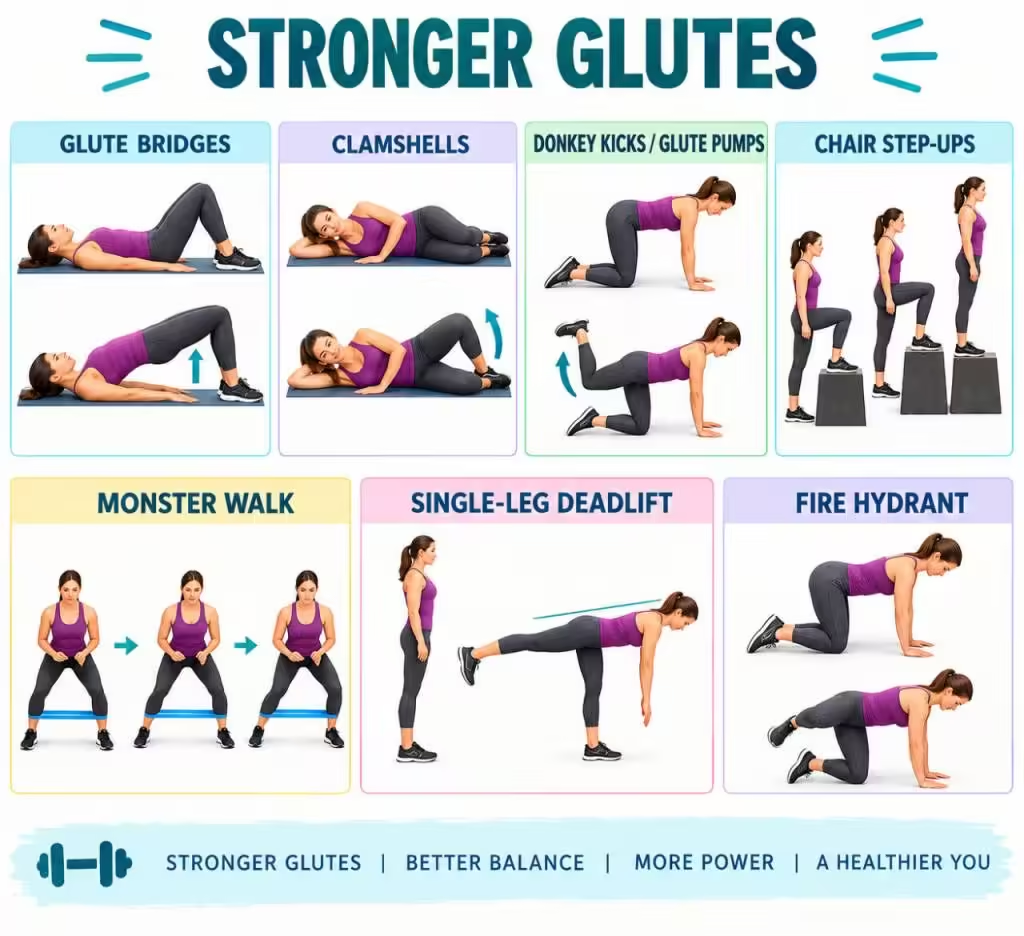
Best activation exercises: If the exercise descriptions are confusing, you can find them on YouTube!
• Glute Bridges: Lie on your back on a comfortable mat. Bend your knees and place your feet flat on the floor, about hip-width apart. Keep your arms resting flat at your sides. Push your heels down and squeeze your glutes to lift your hips toward the ceiling. Lift until your body forms a straight diagonal line from your knees down to your shoulders. Pause at the top for a second and squeeze your glutes tightly. Push through your heels, not your toes, to make sure your glutes do the work. Keep your core tight so you do not arch your lower back too much at the top. Do not lift your shoulders off the floor; keep your upper body relaxed.
• Clamshells: Lie on your side with your head resting on your arm or a pillow. Stack your hips, knees, and feet directly on top of each other. Bend your knees at about a 45-degree angle. Keep your feet glued together. Slowly lift your top knee toward the ceiling as high as you can without moving your hips. Pause for a second at the top; keep your legs open. Slowly lower your top knee back down to meet the bottom knee. Complete your repetitions on this side, then flip over to work the other leg. Do not let your hips rock backward as you lift your knee; keep your hips facing straight ahead. Keep your core tight to help keep your body steady. Move slowly and with control. Do not use momentum to swing your leg open.
• Donkey Kicks / Glute Pumps: Get on all fours and pulse or kick your foot up toward the ceiling. Start on your hands and knees on a comfortable mat. Place your hands directly under your shoulders and your knees under your hips. Keep your right knee bent at a 90-degree angle and flex your right foot so the bottom of your foot faces the ceiling. Imagine you are trying to stamp your footprint flat onto the ceiling. Squeeze your glute and push your foot straight up toward the ceiling. Lift until your thigh is parallel to the floor. Do not arch your lower back as you kick up; keep your belly button pulled in tight. Pause for a second at the top and squeeze your muscles tightly. Keep your neck straight by looking down at the floor between your hands. Slowly lower your knee back toward the floor, stopping just before it touches so you keep the muscle working. Finish all your repetitions on the right leg, then switch to the left leg.
• Chair Step-Ups: Stand facing your box or chair. Place your entire right foot firmly onto the step. Press down through your right heel and push yourself up. Make sure your entire foot is flat on the step; do not let your heel hang off the edge. Try not to bounce off the floor with your back foot. Let your front leg do all the heavy lifting. Keep your chest upright and look straight ahead, rather than staring down at your feet. Bring your left foot up to meet your right foot on top of the step. Stand completely tall at the top by straightening your hips and knees. Carefully step backward down to the floor with your left foot, then lower your right foot to return to the starting position. You can alternate legs each time or complete all repetitions on the right leg before switching to the left.
• Monster Walk: Place a loop resistance band around your ankles or just above your knees. Stand with your feet hip-width apart so there is tension on the band. Bend your knees slightly into a mini squat. Step forward and out to the side at a diagonal, like a monster walking. Bring your other foot forward and out to match, keeping space between your feet. Walk forward for several steps, then reverse the movement and walk backward. Make sure to keep your chest up and your core tight. Do not let your knees cave inward against the band and keep your feet wide enough so the band never gets loose.
• Single-leg Deadlift: Stand tall with your feet together. Shift your weight onto your right leg and keep that knee slightly soft (not locked). Lean your upper body forward from your hips. At the same time, lift your left leg straight out behind you. Keep leaning forward until your body and back leg form a straight line parallel to the floor, like a T-shape. Squeeze your right glute to pull your upper body back up into a standing position and lower your left leg. Complete your repetitions on that side, then switch to the other leg. Keep your hips level like headlights pointing at the floor; do not let your pelvis twist open to the side. Also, keep your back flat and do not let your shoulders round forward. Finally, focus your eyes on a steady spot on the floor a few feet in front of you to help keep your balance.
• Fire Hydrant: Start on your hands and knees on a comfortable mat. Place your hands directly under your shoulders and your knees under your hips. Keep your knee bent at a 90-degree angle. Lift your right leg out to the side until it is level with your hip. Pause for a second at the top of the movement. Slowly lower your leg back down to the starting position without letting your knee touch the floor. Complete your repetitions on that side, then switch to your left leg. Keep your core tight and your back flat like a tabletop. Do not let your hips twist or lean to the opposite side while lifting your leg. Keep your neck relaxed by looking down at the floor between your hands.
Building a strong connection between your brain and your body does not happen overnight. By consistently practicing targeted movements like monster walks, single-leg deadlifts, and fire hydrants, you force your nervous system to wake up and pay attention. As Dr. Mercer reminds us, you have to give your brain and body a clear reason to adapt. Start small, move often, and give your muscles the wake-up call they need to support you every single day.
_____________________
The information provided in this article is for educational and informational purposes only and is not intended for health, medical, or financial advice. Do not use this information to diagnose or treat any health condition. Always consult a qualified healthcare provider regarding any questions you may have about medical conditions or health objectives.
Source: www.sequimgazette.com