
Audi A2 e-tron consumption gains come from many small loss reductions, showing how maturing electric drives now improve step by step
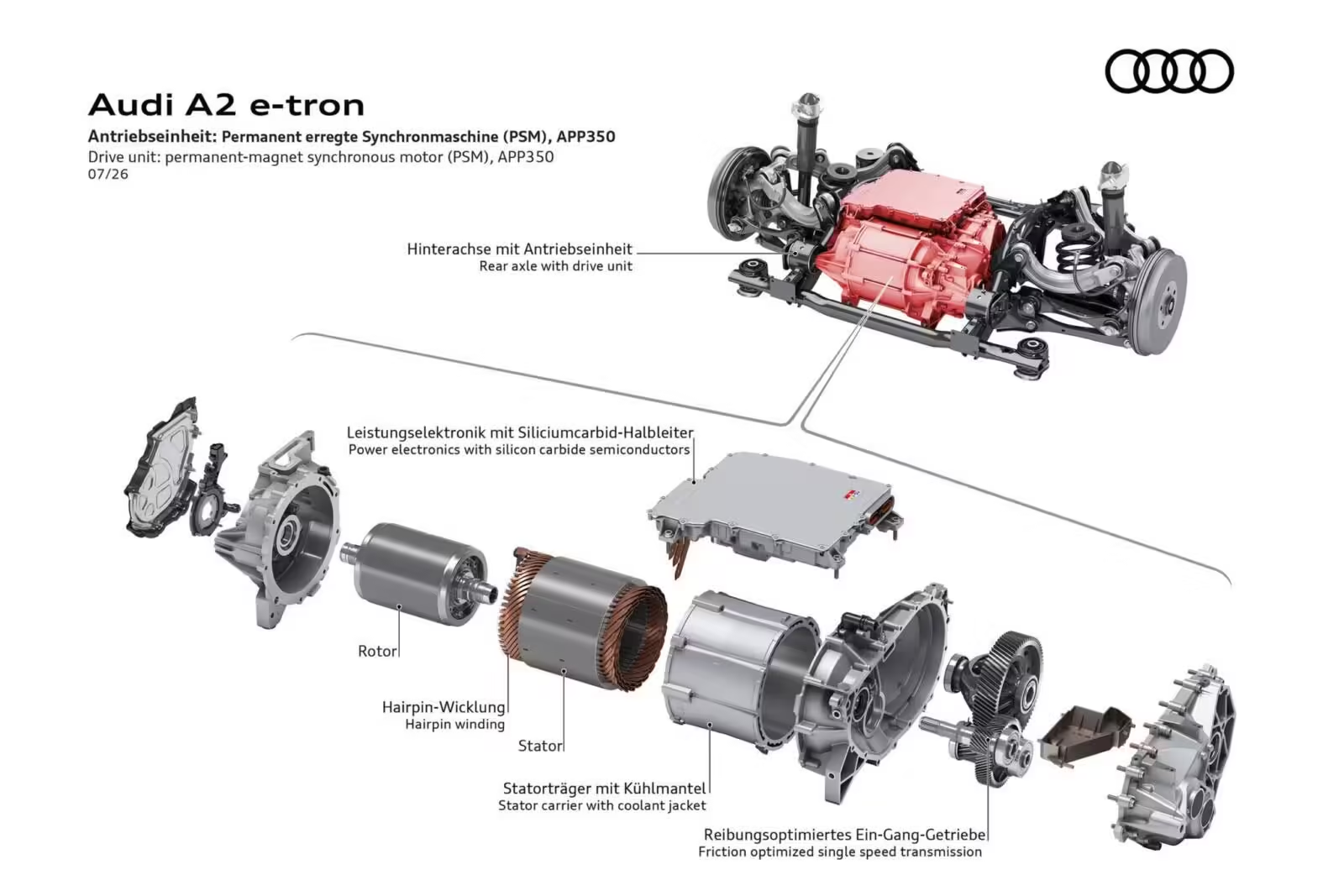
Audi has detailed the upgraded APP350 drive behind the new Audi A2 e-tron, which it rates as its lowest-consuming model, at 12.8kW/h per 100km in 140kW form with an optional package. Changes to the Volkswagen Group unit target losses in the inverter, motor and transmission, alongside measures to cut drive noise.
The rear-mounted permanent-magnet synchronous motor runs at 400V and delivers up to 350Nm. Its inverter swaps conventional silicon transistors for silicon carbide ones, keeping conversion losses below 3%, while new software lowers switching frequency at the medium speeds and loads typical of town and country driving.
Inside the motor, rotor laminations are more than 30% thinner than on the APP310, reducing iron losses. Rewiring the stator from star to delta, with fewer parallel branches, improves partial-load running, and staggered rotor segments suppress tonal noise when pulling away. The inverter also injects high-frequency harmonics into the motor current to cancel unwanted cabin noise.
Two ratios cover three outputs: 10.21:1 for the 125kW and 140kW versions and 11.53:1 for the 170kW car, holding motor speed in its lowest-loss range. Fine-machined gear teeth allow a thin, low-friction oil that reduces churning.
Because the APP350 was developed for the Volkswagen Group’s Modular Electric Drive Matrix, the gains reach beyond a single Audi. Applying silicon carbide at 400V also takes the material beyond the 800V platforms where it first gained ground.
Source: Audi
Source: www.automotiveworld.com