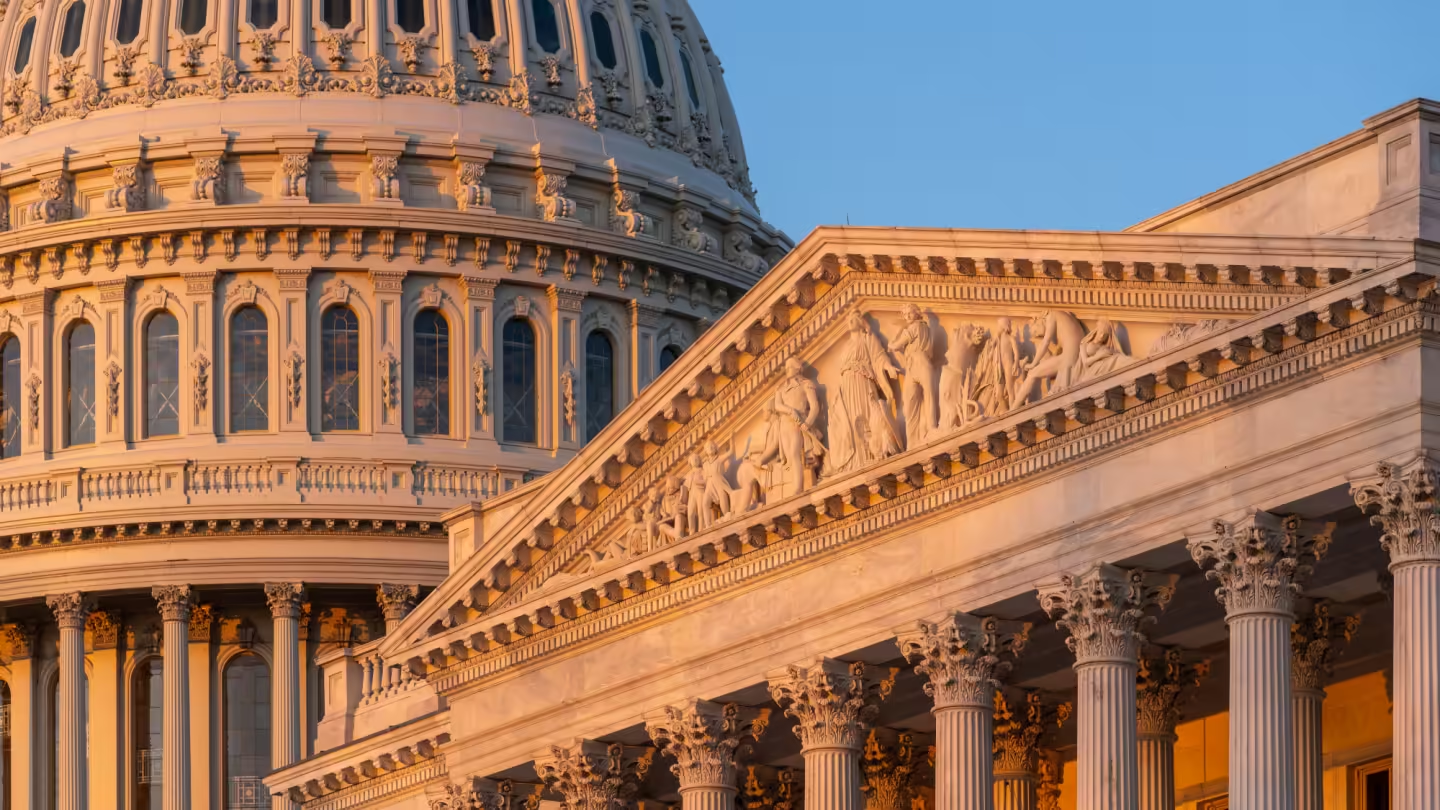

The Capitol Building.
Architect of the Capitol
Midterm outcomes will affect science policy
Tomorrow’s midterm elections have significant implications for federal science policy. Democrats, buoyed by polling indicating they’ll at least gain control of the House, plan
to investigate grant terminations and leadership conduct at the Department of Energy, the National Science Foundation, and other federal science agencies. That said, some observers caution
that lawmakers possess limited tools to reverse Trump administration policies, which have led to heavy losses
of agency scientists and grant terminations. Several prominent appropriators
with power over science agency budgets are up for reelection, as are their counterparts
on the authorizing committees that oversee those agencies.
The election’s outcome will set the tone for the remainder of 2026. Congress returns from a month-long recess on Nov. 9. Most federal funding expires on Dec. 12, meaning the current Congress will need to pass some form of spending legislation before then or face a government shutdown. Another open question is whether Congress will continue to block
the implementation of a controversial Office of Management and Budget rule that would give White House political appointees direct authority over federal grantmaking decisions. Any bills not passed before the new Congress arrives in January will expire, putting pressure on their backers to get them across the line before the end of the year.
NSF walks back changes based on OMB proposal
For now, the National Science Foundation will not align its grant decisions with a proposed Office of Management and Budget rule,
agency documents show. NSF updated its proposed grant policy changes based on more than 3,000 public comments. The new version removes
language based solely on the OMB’s proposed rule, which would have eliminated fixed-price awards, disallowed publication costs, allowed for termination of grants for convenience, and suggested that indirect-cost recovery is subject to availability of funds. NSF also “reiterates that it will continue to follow its established merit-review process,” the response to comments states. It also says the agency will address future changes to the Uniform Guidance after final government-wide requirements are issued.
NSF originally proposed
the changes in June to align with OMB’s proposed rule. The October update follows massive pushback from scientists and lawmakers against the OMB proposal, including Congress pausing
the proposal until Dec. 11 in a recent stopgap funding bill.
NSF’s current proposal is now under a 30-day review
by the White House Office of Information and Regulatory Affairs. The office can approve the proposal or decide that the agency has not adequately addressed public comments. After OIRA approval, the agency may finalize the rule immediately. NSF’s changes would only apply to new awards or new funding for existing awards. The agency “will allow sufficient time” between the publication and implementation of the new policy so proposers and recipients can sufficiently implement necessary changes, the response to comments states.
Tech-heavy PCAST convenes inaugural meeting
The President’s Council of Advisors on Science and Technology will hold its first meeting
of the second Trump administration on Friday. Rechartered
in 2025 to advise the president on “science, technology, education, and innovation,” the panel now largely seats technology industry leaders, such as Oracle’s David Ellison and Meta’s Mark Zuckerberg. Historically, PCAST and its predecessors largely consisted of academic and industry researchers. Venture capitalist David Sacks and OSTP Director Michael Kratsios, who co-chair the panel, have stressed
an anticipated role in advising on emerging technologies.
President Trump awarded
National Medals of Science to three PCAST members, Nvidia’s Jensen Huang, Alphabet’s Sergey Brin, and AMD’s Lisa Su, as well as a National Medal of Technology and Innovation to member Michael Dell, at an October “Science: A New Golden Age” summit. National Medals of Science more typically went to prominent figures in fundamental research in past administrations.
Historically, PCAST members have advised presidents on emerging scientific and technological issues. The group produced reports
on topics such as STEM education and artificial intelligence during the Biden administration. The panel has not published any reports so far during the Trump administration.
Also on our radar
- The White House directed
DOGE grant cuts at NSF, according to public records reported by FedScoop. Florida’s gubernatorial office was also mentioned in some grant termination decisions. - AGU launched
an “Initiative for Science Assessments” to broadly support scientific reviews on matters of public interest. AGU previously launched initiatives to support the National Climate Assessment
and the Arctic Report Card,
two scientific assessments that lost federal support under the Trump administration. - A scientific and university coalition asked
NASA to rescind grant policy changes that “preemptively” follow the OMB proposed rule on grantmaking and to disburse grant funds
“in a timely and predictable manner.” (The coalition includes AIP Member Societies.) - A Planetary Society report
finds that low-cost NASA Science missions produce less science per dollar and fail more often than costlier efforts. Meanwhile, the report notes that the space agency says it is moving to smaller, higher-risk, commercially supported science missions. - NIST published
post-quantum cryptography guidance for federal agencies. The guidance maps out agency transitions to new encryption algorithms ahead of a 2031 deadline. - The Federal Labor Relations Authority dismissed
an NIH petition to decertify its early-career research fellows union. - FCC commissioners approved
two spectrum proposals for publication in the Federal Register. Experts warn
the proposals could disrupt astronomy and weather satellite data. The administration plans to auction
up to 400 megahertz of spectrum by 2028. - NSF has begun searching
for an inaugural head of its new Office of Metascience.
The office will experiment with the agency’s research funding vehicles to improve research outcomes.
Correction: A previous version of this newsletter misspelled the name of OSTP co-chair David Sacks.
Source: www.aip.org