
November 2, 2026
Tyler Greene
BIG RAPIDS, Mich. —
Tyler Greene plays defensive back for the Ferris State University football team, but he says his
hardest assignment this fall comes Thursdays at 4:30 p.m. in a Big Rapids radio studio.
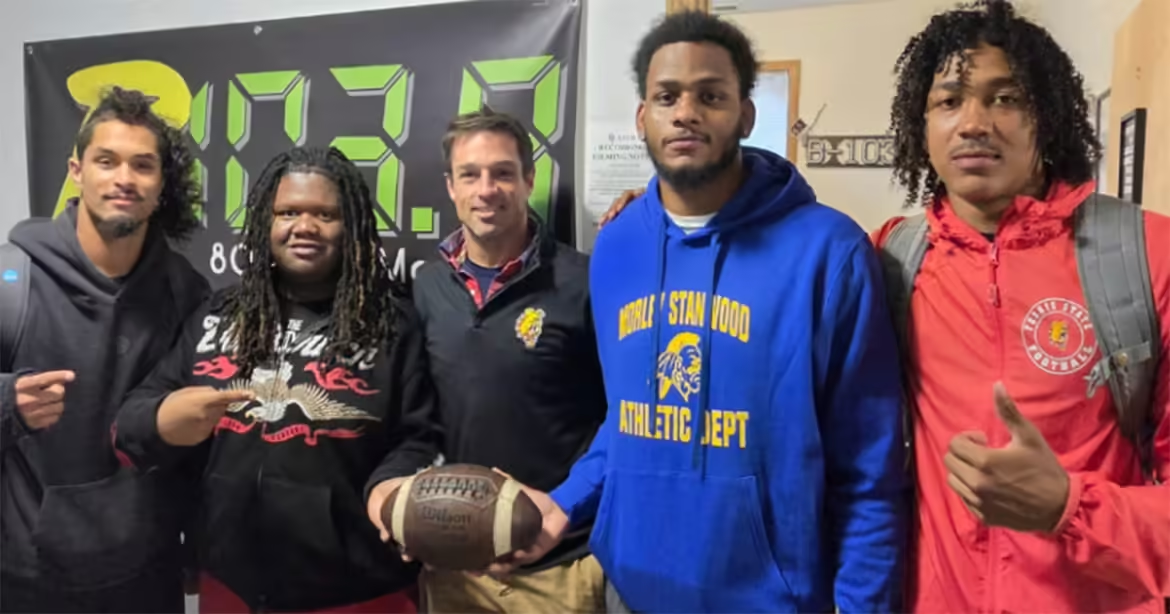
Greene and three classmates in COMM 389: Sports Communication host a live, one-hour
sports show on B103.9 WBZX. The course’s 12 students split into three groups of four,
and each group plans and hosts two shows on the station.
“When it comes to football, I feel like I could pick it up and blend in,” Greene said.
“When it comes to the communication part, I’m still learning things, and trying to
be a professional the best way possible.”
Greene, a junior, shares the microphone with fellow defensive back Eric “EJ” Jackson; James Cummings, a former Ferris State wide receiver and outside linebacker who now
coaches boys varsity basketball at Morley Stanwood High School; and La’Quan Watson-Boyd,
a sophomore who worked at the student radio station at his native Harper Woods High
School. Watson-Boyd took the host chair and left the insider perspective to his teammates.
“You can talk a lot about sports, but hearing it per se from the athlete and coaches
is a lot different,” Watson-Boyd said.
Dr. Jen Coburn, who teaches the course and coordinates Ferris State’s sports communication
program, said the students surprised her.
“Frankly, I did not expect the students all to want to be on air,” she said, noting
a live audience raises the stakes. “It’s not just their peers; they can’t sleep on
this assignment. If you didn’t do your research, and you’re at your job, nobody’s
going to say, ‘Well, I’ll give you an A-minus because you almost did it.’”
Kyle Wells, an on-air personality and salesperson at B103.9 in his 10th year in radio,
mentors the students inside the studio. He doesn’t interrupt live segments. He slides
students handwritten notes that tell them to take a break, read a sponsor or wrap
up a topic. Watson-Boyd said the first note he received told the group to thank the
Big Rapids community.
“It’s about the broadcast. It’s not about you. It’s not about me. It’s about the listener,”
Wells said.
Wells pushes students to cut filler words and reintroduce guests often, because listeners
tune in and out throughout the hour.
“If nobody tells you, then how are you going to know?” Wells said. “They just won’t
hire you.”
“In the next 10 years we could be fighting for the same job,” Watson-Boyd said of
Wells. “When a guy breaks it down to you like that and he’s still unleashing all his
secrecy, you got to respect that.”

Watson-Boyd said his group needed about 15 minutes to settle in during its first show.
By its second broadcast Oct. 15, the group moved between segments faster. Greene said
the students learned to read sponsor ads during breaks and to pick up a question when
a teammate isn’t ready.
“I just look to be more comfortable each and every time I get a microphone,” Greene
said.
The practice carries into his class presentations. “I’ve become way better at just
not stuttering or using the um and things like that,” he said.
For the athletes, the show also tests what to leave unsaid. “I try to keep all our
personal issues and what we deal with as a team collectively private,” Greene said.
Cummings said live radio sharpened his word choice. “I don’t say I held things back,”
he said. “I just say it a certain way.”
Coburn grades each show on preparation, delivery and structure, then meets with each
group to talk through what worked. She dropped written reflections.
“In this day and age of AI, I could have them write a reflection piece, they’d have
it done in five seconds,” she said.
Students also keep a recording of each show for future employers. The show fits a
broader goal of the sports communication major at Ferris State’s College of Arts, Sciences and Education: training students to read people, connect with them and communicate under pressure.
Coburn said graduates apply those skills across the sports industry, in roles from
ticket sales to on-field entertainment.
“That puts them way ahead of a graduate who just read about it,” she said.
Greene’s advice for future classes is simple.
“Take it seriously,” he said. “Treat this as it’s your first job.”
Source: www.ferris.edu