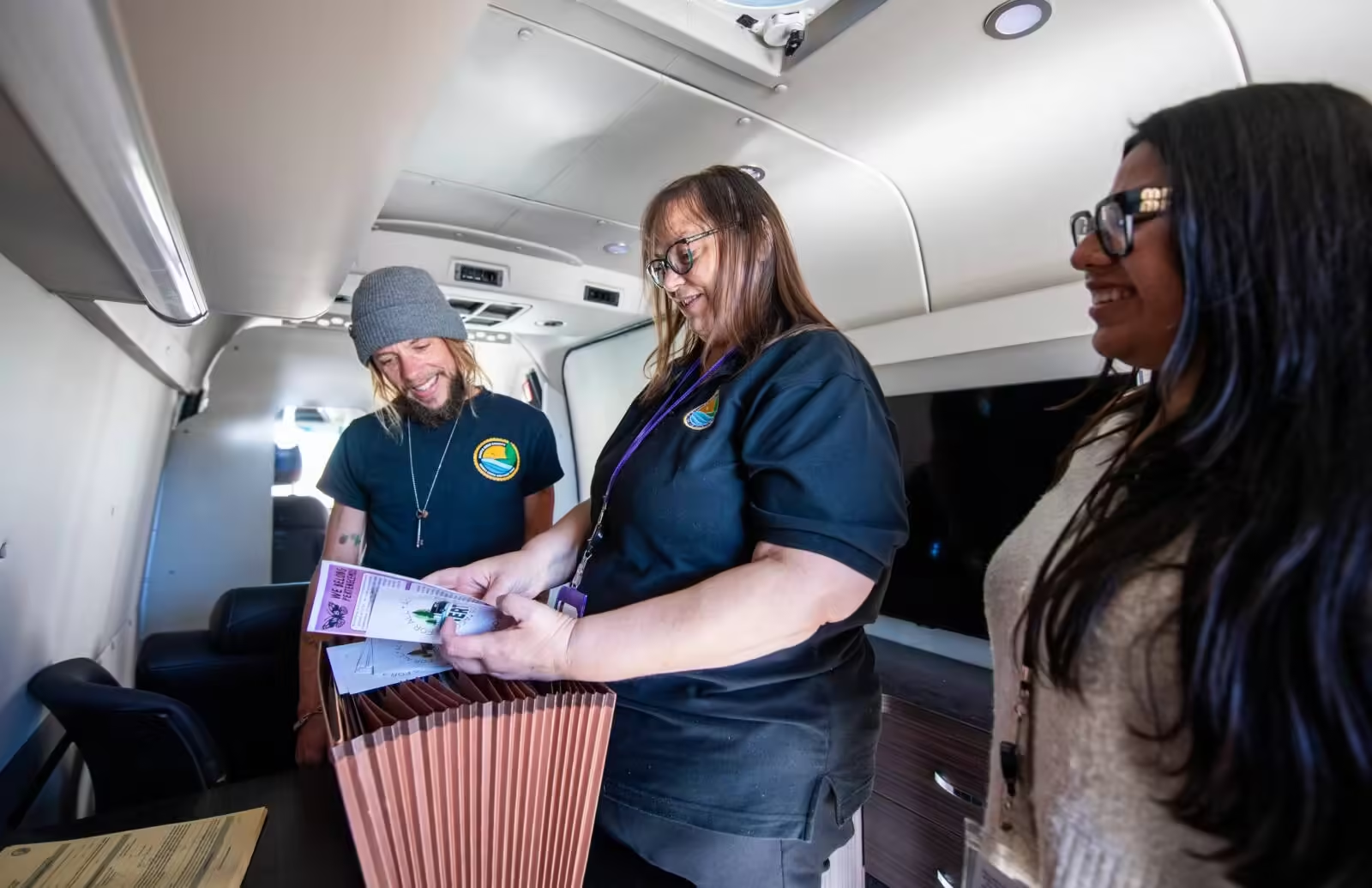

As mobile crisis response teams in Northern California de-escalate and stabilize thousands of people with mental health conditions every year, they’re meeting a financial roadblock: health insurance companies.
Records obtained by Bay Area News Group show insurers rejected $4.1 million in payments to 11 counties for these key mental health services since 2024, despite a state law requiring that companies cover crisis responses for their members.
“Health plans collect premiums from you and me,” said Michelle Doty Cabrera, who leads the state association of county behavioral health directors. “The safety net comes through, and they’re not paying the bill. So, what are they doing with those premiums in the first place?”
The state government and counties have poured out hundreds of millions in taxpayer funds to build a small army of mobile crisis responders since the pandemic. These alternative first responders replace police when traveling throughout their regions to help people in the throes of psychosis, depression or suicidal thoughts — often, experts say, saving lives and preventing more expensive medical treatments. Gov. Gavin Newsom’s administration has required every county to make these crisis services available, and many operate their own teams.
But overwhelmingly, insurance companies denied or paid fractions of bills submitted by counties for crisis responses to their members over the past two years, according to the records.
Contra Costa County charged insurers $2.47 million for hundreds of crisis responses to residents with symptoms of bipolar disorder, schizophrenia, depression or anxiety from 2024 to mid-2026, records show. Insurers paid about $210,000 — less than 10% — while giving a variety of explanations and rejections.
Staff in 10 other counties reported similar trends to state regulators this year. San Mateo County billed more than $248,000 over a one-year period, but insurers paid about $1,500. San Francisco charged $253,000 but received about $4,000 in payments. Stanislaus County lost out on $640,000 in unpaid claims.
Advocates are calling on Newsom’s administration to enforce part of a sweeping mental health law passed in 2022. Named for an East Bay man with mental illness killed by police, the law requires insurers to cover crisis responses for their members without prior approval, and even if the service is considered “out of network.”
County staff said they continue to lose revenue and are still waiting on action from state regulators.

Mary Ellen Grant, a spokesperson for the California Association of Health Plans, said insurers evaluate claims based upon information included in those bills, whether documentation is complete, and if there are apparent issues with codes — the key medical jargon describing a patient’s symptoms and treatment. They also consider coverage requirements, she said.
“We recognize that some counties have experienced reimbursement challenges and that those concerns deserve careful review,” she wrote in an email.
The California Department of Managed Health Care has the power to fine insurance companies for mishandling payment disputes. It may do so in these cases, said spokesperson Kevin Durawa. But he also said improper billing by county staff may be a factor, echoing insurers. Agency staff is scrutinizing claims that counties say were denied or underpaid by United Healthcare, Anthem Blue Cross, Cigna and others.
Mental health advocates said counties submit the occasional incorrect bill for crisis responses. But they pointed to the pattern playing out across Northern California.
“This is a persistent problem across the state,” said Tara Gamboa-Eastman of the Steinberg Institute, which seeks to improve California’s behavioral health system. “I am not aware of any counties that are not having issues with commercial insurance reimbursement except for those who have entirely given up trying.”
In Stanislaus, San Mateo and Monterey counties, insurers told county accountants the service was “not covered,” “not authorized” or the “patient’s responsibility” when denying payments, records show. In Contra Costa County, the records show more than 200 denied claims with no explanation.
And in Merced County, the nonprofit health plan Blue Shield of California said the service was both out of network and not pre-authorized when denying more than $11,000 in payments, which state law prohibits.
That would appear to break the law, said state Assemblymember Rebecca Bauer-Kahan, who sponsored the legislation in 2022.
“I don’t think that’s a mis-coding problem,” she said. “That would be completely unacceptable.”
In Contra Costa County, the health department’s behavioral health accounting team has experimented with using different billing codes, to no avail. Staff said they continue to burn time and resources navigating insurance company phone trees to dispute rejections, spending up to an hour for every denial.
“Commercial healthcare insurers should follow state requirements,” Contra Costa Health spokesperson Will Harper wrote in an email, “and pay their fair share for mobile crisis services.”
Saving lives, and expensive healthcare
In the Bay Area, a series of tragedies has shown the perils of dispatching police officers to people in a mental health crisis.
In 2019, Walnut Creek police killed Miles Hall, a Black man in his twenties known to police and neighbors as suffering from a mental health condition that wrought hallucinations and delusions. Two officers fatally shot Hall when he ran toward them holding a long metal bar.
In the South Bay, a Mercury News investigation in 2023 found 80% of people killed by San Jose police were mentally impaired or intoxicated between 2014 and 2021, along with nearly three-quarters of those injured by police.
Outrage over police killings and spikes in rates of mental illnesses and addiction during the pandemic led Newsom’s administration to set deadlines in 2023 for counties to provide non-law enforcement responses to people in crisis at all times. The administration also made the service covered by Medi-Cal, the government health insurance for low-income people, at an estimated cost of $1.4 billion over five years.
Research has shown crisis responders also cut down on unnecessary — and costly — trips to emergency departments and stays at inpatient psychiatric hospitals. Nationally, the vast majority of callers to crisis lines can be de-escalated and assisted over the phone, or through an in-person visit with a response team.

Like others in the Bay Area, Santa Cruz County’s crisis response team is made up of pairs of clinicians who assess struggling people at their homes or in public. They are licensed therapists and social workers, peers, or they hold Master’s degrees, said Danielle Long, a social worker who manages Santa Cruz County’s crisis network.
If they’re able to provide relief, clinicians connect the patient with resources and work together on a plan for their safety. They might help arrange a same-day appointment with a therapist, or provide a lock for their firearms, Long said. If needed, they arrange for their transport to a medical facility.
Contra Costa Health rolled out its own mobile crisis response team in 2022, three years after Miles Hall’s death. The two Walnut Creek police officers were cleared of wrongdoing, but the killing inspired a major state law in 2022. Carried by Bauer-Kahan, who represents Walnut Creek, the Miles Hall Lifeline Act established the statewide 9-8-8 mental health hotline.
Tucked into the law was the requirement that health insurance companies reimburse mobile crisis units for responses to their members.
That’s required “regardless of whether the service is provided by an in-network or out-of-network provider,” the Department of Managed Health Care told insurance companies in a letter last year. Insurers are also barred in these instances from seeking prior authorization, the widespread and controversial insurance industry practice of approving care as necessary before doctors can provide it.
But records collected by the Bay Area News Group detail more than 1,800 denied or underpaid claims in 11 counties. More than 1,000 were just in Contra Costa County.
“Right now, commercial plans regularly deny our claims or severely underpay them for reasons that are often not clear,” said Harper of Contra Costa Health. “On the whole, they’re reimbursing us for less than 10% of our billed costs, forcing the county to make up the difference.”
“Non-payable” and “non-covered” bills
In June 2025, Contra Costa Health’s mobile crisis team responded to a person with bipolar disorder experiencing a severe manic episode and psychosis, records show.
It’s unclear how the encounter ended. After, Contra Costa Health submitted a $2,350 bill to United Healthcare, the nation’s largest health insurance company. In the paperwork, a county accountant labeled the service as a crisis intervention with a standard five-character code used by behavioral health providers. United Healthcare paid $0, according to the records, and said the code was “non-payable.”
Most people interacting with crisis responders are covered by Medi-Cal. When crisis responders work with those patients, accountants bill the government program and receive reimbursements.
But mental health challenges can afflict the rich and poor alike, insured or uninsured, and mobile crisis teams respond to patients as medically necessary, even if they have private insurance. In Santa Cruz, crisis teams often respond to tourists who have fallen into crisis, Long said, who typically have private coverage. In Contra Costa County, nearly 15% of mobile crisis encounters were with people covered by private plans during the last fiscal year.
Claims can take more than a year to resolve in a back-and-forth process between county accountants and insurers, but the records show unpaid claims stretching back to early 2024. That year, United Healthcare also denied a $2,283 claim from Contra Costa Health for a response to a person with an unspecified mood disorder. The charges were “non-covered,” it said in its explanation. A spokesperson for the company declined to comment.
Elsewhere, insurers and county accountants have disagreed about the cost of a crisis response. Last year, when Santa Cruz County charged Cigna Healthcare about $2,500 for one such response, also using the standard billing code, the company paid just $27.
“The diagnosis is inconsistent with the procedure,” the company wrote. A spokesperson for Cigna did not comment.
State scrutiny
Bauer-Kahan said the root cause of the nonpayments is “insurance companies not wanting to pay.”
“It happens to me with insurance,” she said. “It’s not surprising it happens on an institutional level too.”
California lawmakers held a hearing on the mobile crisis billing issue in May. At that point, the Department of Managed Health Care had analyzed more than a thousand denied or underpaid claims, said Stephanie Welch, a state behavioral health official. The agency had already sent health insurance companies a follow-up letter with guidance on complying with the Miles Hall Lifeline Act in March 2025.
Durawa, spokesperson for the Department of Managed Health Care, did not say when asked how much longer staff will take to complete their investigation. Insurers said they’re involved.
“We believe significant progress is being made to improve clarity regarding billing, claims submission and payment processes,” said Grant of the California Association of Health Plans.
But Cabrera, of the County Behavioral Health Directors Association of California, said the problem remains unsolved. She called on state regulators to enforce the Miles Hall Lifeline Act.
“What is going on here,” she said, “that we’re not really seeing the benefit of this new law?”
Source: www.mercurynews.com