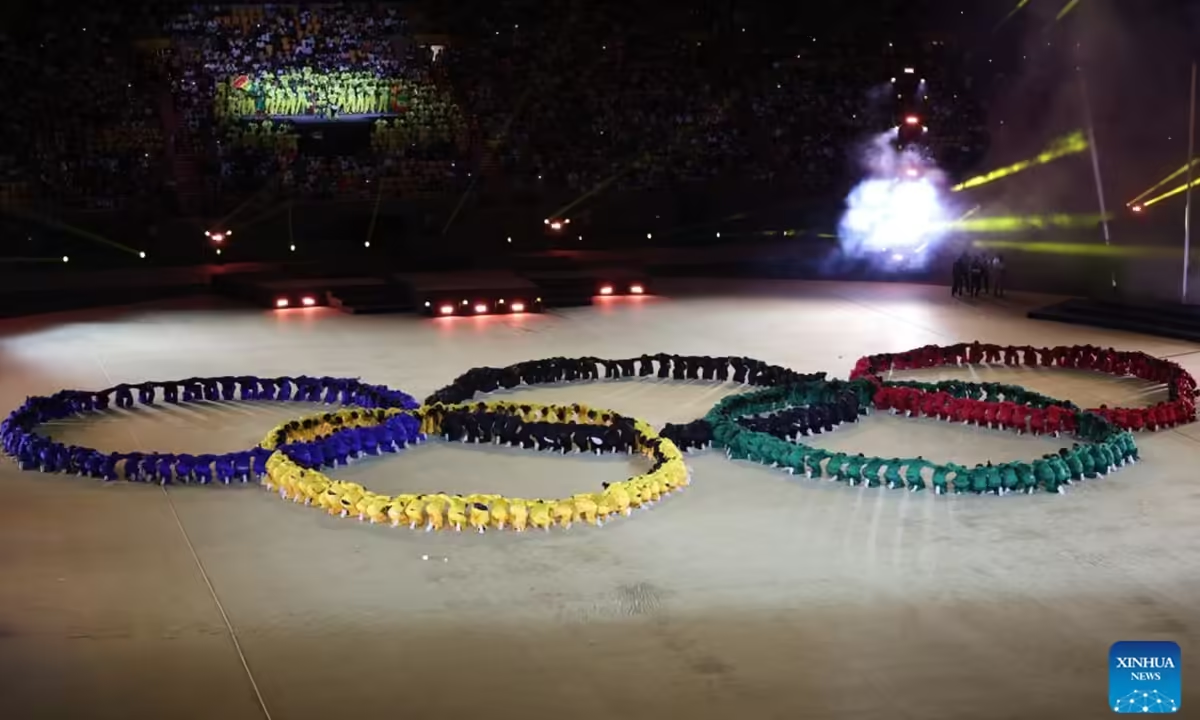

The Olympic rings are displayed during the opening ceremony of the Dakar 2026 Youth Olympic Games in Senegal on October 31, 2026. Photo: Xinhua
On October 31, the Dakar 2026 Youth Olympic Games opened, marking the first time the African continent has hosted an Olympic sporting event. International Olympic Committee President Kirsty Coventry said, “This historic moment is for Senegal, for Africa.”
The flame is lit, and the venues are buzzing. The cameras focus on the athletes and the stands – the rightful protagonists of event coverage. But a historic sporting event is not only about the cheers in front of the scenes; it also depends on the support behind them. Its real significance lies in the foundation that makes the event possible.
According to public information, China Civil Engineering Construction Corporation (CCECC) undertook the renovation and expansion of Iba Mar Diop Stadium, one of the main venues of the Youth Olympic Games, including an 8,000-seat football stadium, an international-standard athletics track, an indoor handball hall, a multipurpose gymnasium and other supporting facilities. In this sense, Africa’s Olympic “debut” stands on a venue built through joint China-Africa cooperation.
What sustains a historic moment? A major sporting event is never just a competition lasting a dozen days; it is also a concentrated test of urban infrastructure. Venues, tracks, lighting and stands – things that never mount the podium – determine whether a continent can firmly host its “first.” This is the core issue behind Africa’s Olympic debut.
China’s role here is not to host the Games on Africa’s behalf, but to participate as a partner in setting the stage. The stage belongs to Senegal and to Africa; the builders are partners standing side by side. This relationship matters. China-Africa cooperation has been discussed for many years, and the most visible examples are railways, ports and highways. Sports venues follow the same logic: They turn development aspirations into tangible public goods. For local young people, a standard running track or a stadium capable of hosting international events may be more concrete than any grand narrative.
Building the venues is only the first step. More important is what comes after the Games: How they will be operated, how they will benefit communities and how construction-period jobs can become long-term capacity.
After the Youth Olympic Games, the venues will continue to open to local athletes and young people, helping drive sports training and the event economy, and turning “built by China” from hardware into real development dividends. That is where China-Africa cooperation should focus on more in the next stage: not only “turnkey delivery,” but also “leaving capacity”; not only building a venue, but also driving development in the surrounding area. The policy principle of sincerity, real results, amity and good faith toward Africa must ultimately translate into concrete projects and tangible, accessible gains for local people. That is the lasting measure of this cooperation.
Africa’s first hosting of an Olympic sporting event is a coming-of-age ceremony for the continent. China’s construction presence appears at the sidelines: It need not steal the spotlight, nor should it be overlooked. It reminds us that a historic moment needs the flame, but also a foundation; it needs applause, but also someone to build the stands solidly. The central point is simple: this debut rests on shared effort.
The stage is Africa’s; the cooperation is shared. From the Railway to the Olympic venues, the forms of China-Africa cooperation are changing. Still, the logic of extensive consultation, joint contribution and shared benefits remains unchanged. The opening of a sporting event reflects the steady, step-by-step progress of China and Africa pursuing modernization together. It serves as a quiet footnote to the vision of a community with a shared future for humanity.
Source: www.globaltimes.cn