
Industry & Competitive Context
Scaler operates in India’s online higher-education and upskilling market. Technopak Advisors valued this market at Rs 30,000 crore in FY23 and projected growth at a 23.1% CAGR to Rs 85,000 crore by FY28. An earlier RedSeer–Omidyar Network India report identified online higher education and professional upskilling as significant growth drivers of Indian edtech after the pandemic.
The category carries a documented credibility problem around outcome claims. India’s Advertising Standards Council (ASCI) reported that complaints it upheld were concentrated in the education sector, most commonly for unsubstantiated claims such as “100% placement” or “No. 1”. These are sector-level findings.
Analysis: in a market where the central promise is a career result, the outcome claim is both the strongest selling point and the greatest reputational exposure. Any strategy in this segment must be read against that tension.
Brand Situation Prior to the Brand Campaigns
Scaler describes itself as a tech upskilling business “by InterviewBit,” the coding-practice platform from which it grew. YourStory reports that Scaler was established in 2019 and that it later acquired four startups (Pepcoding, AppliedRoots, Coding Minutes and Coding Elements) to strengthen software development, data science and machine learning offerings. In October 2022 the company stated that it had achieved over 350% year-on-year growth and cumulative revenue growth of 2,500% across FY20 and FY21; these are company-reported figures.
In February 2022, Scaler raised a Series B of $55 million led by Lightrock India, with Sequoia Capital India and Tiger Global participating. Reported total funding differs by source: $76.5 million according to YourStory and $75 million according to TheKredible as cited by Entrackr. The same Entrackr report lists the founders, Anshuman Singh and Abhimanyu Saxena, at 29.16% each, Peak XV Partners at 22.61% and Tiger Global at 8.13%.
When its first brand campaign launched in February 2022, Scaler had, by its own account, roughly 800 employees; it later reported growing the workforce by more than 150% to around 2,000. Entrackr reports operating revenue of Rs 65 crore in FY22, rising 388% to Rs 317 crore in FY23, alongside losses of Rs 174 crore and Rs 330 crore respectively.
Analysis: the documented starting position is one of rapid, investor-funded expansion in which brand building, headcount and capability acquisition grew together, rather than a position of brand weakness.
Strategic Objective
Scaler’s stated objectives differ by initiative. The February 2022 brand film was positioned, in the company’s release, to break through the noise in the edtech segment and to promote talent that is skilled and motivated to make a difference. The March 2023 “hungry techies” campaign aimed to encourage working professionals to keep upskilling to maintain their edge in a competitive industry, noting that the tech sector faced profitability challenges and that several organisations were cutting non-essential staff. The Scaler School of Technology (SST), announced in March 2023, was framed as a response to two needs the company called “long-unmet”: a high-quality undergraduate computer-science programme and a pipeline of skilled workforce for the global technology sector.
From 2024 the documented objective shifted. In April 2024 co-founder Abhimanyu Saxena said that layoffs affecting roles “primarily in marketing and sales” formed part of a restructuring aimed at sustainable growth. Scaler’s CFO announcement, as reported by CXO Digital Pulse, stated that the company reached positive cash flow and profit in the July–September 2023 quarter and targeted annual profitability in 2024.
Campaign Architecture & Execution
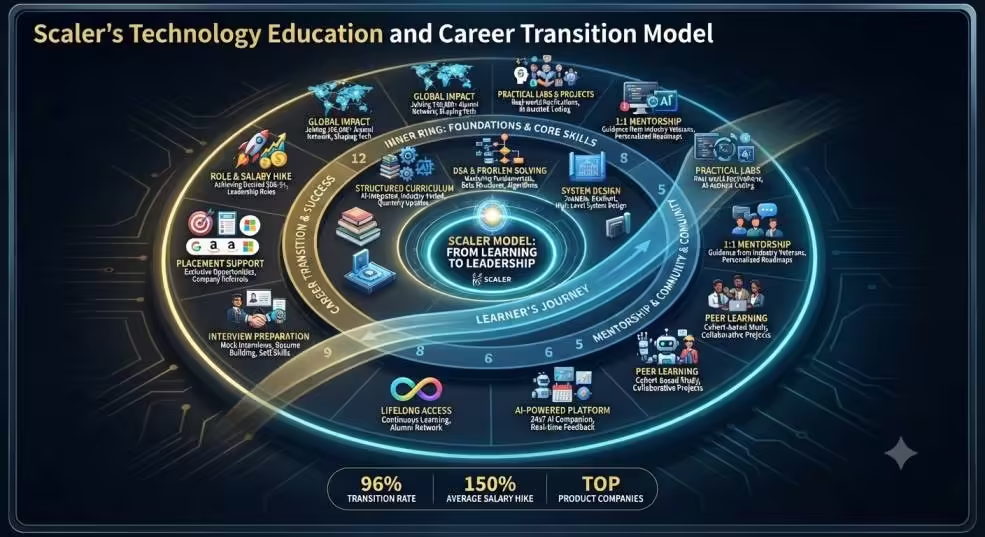
The learning model. According to Entrackr, which cites filings with the Registrar of Companies, Scaler offers courses through live classes, and sales of these courses were its sole source of revenue in FY25. In the SST announcement, co-founder Anshuman Singh described the Scaler approach as one in which every student gets a personal industry mentor who meets them monthly, supported by batch success managers responsible for ensuring no one is left behind. The company also stated that it works with more than 900 employer partners and has about 35,000 alumni in the global technology sector. These are company statements.
Product extension into undergraduate education. SST was announced as a four-year residential computer-science programme in Bengaluru with a first batch of 200 seats starting 18 July 2023. The company described three phases: 18 months of fundamentals, a one-year paid industry internship with one-to-one mentoring, and a final 18 months of specialisation. It stated an intention to provide a pre-placement offer to 50% of the batch within two and a half years of joining. Students were to be eligible for a BSc in Computer Science recognised by the UGC through a partner institute, plus a Master of Science from Woolf University, which the company described as licensed in the European Union. The company later announced a four-year undergraduate programme in AI and Business at SST, as published by Tribune India.
Brand campaign sequence. Public records document a sequence of films and content properties: a Money Heist–themed moment-marketing piece created with Monk Entertainment in December 2021; a pop-culture-inspired brand film in February 2022 [10]; a data-science and machine-learning film; a B2B campaign directed at employers on skill-based hiring; and the 2023 three-film “hungry techies” campaign created with The Womb. Scaler also stated that it produced two vernacular web series, B.E Rozgaar and 30 Weds 21.
Analysis: the architecture links three layers. The brand layer argues that skills matter. The product layer (mentored, live-taught programmes) delivers the skills. The extension layer (SST) moves the same promise earlier in the customer’s life, from mid-career transition to career entry.
Positioning & Consumer Insight
The February 2022 release placed the emphasis on practical exposure and industry relevance, and on “shifting the onus of ‘creating impact’” onto the techies themselves. Saxena stated that securing a good job is not the sole purpose of acquiring a skillset.
The 2023 campaign made selectivity explicit. Scaler’s release said its programmes are rigorous and demand “high hunger and drive” from learners, and described the campaign as “a hunger test” for techies, to be operationalised through a Hunger Test taken at a masterclass. The agency creative head, quoted in the release, framed the insight around people who daydream versus people who act.
Analysis: the documented messaging avoids a direct placement promise and instead sorts the audience by motivation. In a sector where unsubstantiated placement claims draw regulatory attention, this shifts part of the outcome narrative to the learner’s effort. It also converts a lead-generation mechanism (the masterclass) into a brand device.
One company claim deserves scrutiny. At the SST launch Saxena said Scaler had “delivered better results than any of the country’s current 4-year UG CS programs”. The comparison basis was not documented in the release, and no verified independent comparison is available.
Media & Channel Strategy
The February 2022 campaign was described as largely digital-led with a “push and pull” approach: the film was pushed through OTT, YouTube and social media, and supported by memes, engagement activities and content collaborations. The company named influencers including MBA Chaiwala, Soch by Mohak, RJ Abhinav and Dhruv Rathee, a regional web-series partnership with Chai Bisket, and a learner-run meme account. It reported a Discord community of over 96,000 members and a community-ambassador programme called Scaler Star. The company earmarked Rs 100 crore for marketing and branding in 2022.
The 2023 campaign was released on YouTube, Facebook, Instagram, Twitter and LinkedIn with influencer engagement. MediaNews4U reported that Scaler became an associate sponsor of the Asia Cup on Disney+ Hotstar to promote its data-science and machine-learning film.
Reported advertising and promotional expenses give the only verified spend series: Rs 92.1 crore in FY24, down 35.7% year on year [5]and Rs 64 crore in FY25, down 30%.
Business & Brand Outcomes
Financial figures below come from media reports of filings with the Registrar of Companies. Scaler is privately held and no company-published annual report was located. Reports do not uniformly state whether each figure is at entity or consolidated level.
Further disclosed detail: FY24 expenses were Rs 474.3 crore, with employee costs of Rs 230 crore. In FY25 total expenses fell 23% to Rs 365 crore, employee benefits fell 26.5% to Rs 169 crore (46% of expenses), training and recruitment fell 22.4% to Rs 38 crore, and Entrackr reported EBITDA of Rs 40 lakh. Other outlets report different FY25 EBITDA figures (for example Rs 5.5 crore by NewsBytes), so the figure should be treated as unsettled. Entrackr also reported FY25 cash and bank balances of Rs 13 crore, current assets of Rs 48 crore and current liabilities of Rs 330.5 crore.
Outcome claims. Scaler’s own website states learner outcomes (for example 11,000+ placements, 650+ companies and an average post-programme CTC of Rs 23 lakh). These are self-reported marketing figures and no independent audit has been located.
Brand outcomes. Scaler stated that its web series have “millions of views per episode”.
Strategic Implications
Growth and discipline are sequential, not simultaneous. The record shows revenue rising roughly fivefold in FY23 alongside a loss of Rs 330 crore, followed by restructuring in April 2024 and sharp expense cuts. Analysis: the model scaled on brand and sales intensity and was then rebalanced. The FY25 profit improvement was reported as driven by cost reduction, not revenue growth, since revenue declined.
Marketing efficiency is the model’s central variable. Layoffs were concentrated in marketing and sales, and advertising spend fell in both FY24 and FY25. Analysis: because course sales are the sole revenue source, the relationship between promotional spend and revenue is the key operating lever, yet no verified public data exists on acquisition efficiency.
Trust is the scarce asset. Sector regulators have repeatedly flagged unsubstantiated placement claims. Analysis: Scaler’s hunger-based positioning reduces reliance on a direct guarantee, but its self-reported outcome statistics and its SST comparison claim remain unaudited in the public record, which constrains how far the brand can credibly extend.
Vertical extension changes the risk profile. SST moves Scaler from short professional programmes to a four-year residential offering with fixed infrastructure and degree partnerships. Analysis: this broadens the addressable customer but lengthens the time to verifiable outcomes, and the first graduating cohort’s results are not yet publicly documented.
Balance-sheet signal. The reported gap between current liabilities and current assets in FY25 cannot be interpreted without knowing its composition, which is not public.
Discussion Questions
Scaler’s campaigns emphasise learner “hunger” and effort rather than guaranteed outcomes. Evaluate this positioning against the regulatory and reputational risks of outcome claims in Indian education advertising.
Revenue grew about 4.8x in FY23 with a Rs 330 crore loss, then losses fell 98% by FY25 as revenue declined. What does this sequence imply about the trade-off between growth and unit economics, and what data would you need to judge it?
Scaler extended from professional upskilling into a four-year undergraduate programme. Analyse the strategic logic and the risks, considering brand transfer, time-to-outcome and capital intensity.
Course sales are the sole reported revenue source. How should a firm with a single revenue stream sequence brand investment, performance marketing and community building?
Much of the public evidence on outcomes is company-reported. How should an investor, a prospective learner and a regulator each weigh such evidence, and what independent disclosure would most improve decision quality?
Source: www.markhub24.com