
Evanston Finance and Budget Committee members, looking to pare down the $348 million in spending in City Manager Luke Stowe’s 2027 proposed budget, may gain some insight from a staff report ranking capital projects.
Officials included the list in their Thursday, Oct. 29, presentation on the capital improvement projects budget, which covers more than 100 projects. Those include several large-scale facility projects, such as consulting for a new Police/Fire Headquarters, that currently lack a dedicated funding source.
Chris Sous, the city’s assistant city engineer, told committee members the list ranked projects according to set criteria. Committee members said they were seeing the list for the first time.
The criteria included the condition of the city asset in question, whether the project was “shovel ready” and whether it had an external funding source rather than relying solely on the city’s already strained bonding capacity, Sous said.
Some high-profile projects ranked at the lower end. Participatory Budgeting Improvements (with a $1 million budget) received a 35% priority score, sitting at the bottom.
Construction of Fountain Square North ($2 million budget), which would include restoration of the fountains, ranked just above, with a 36% priority score.
Also on the list were a vehicle charging station ($200,000 budget); charging infrastructure for the city’s vehicle fleet; $500,000); an exercise addition at Fire Station 4 ($15,000); design of an “oasis” on Custer Avenue between Main and Washington Streets ($100,000); a police outpost on Howard Street ($100,000); and a streetlight study for the Ashland Arts neighborhood ($100,000).

Committee member Therese McGuire, a professor of strategy at Northwestern University’s Kellogg School of Management, said she found the evaluation criteria “really useful and helpful” and asked how the information will be used. She also asked whether a similar list would be available for programs covered in the general budget.
Councilmember Matt Rodgers (8th Ward), who chairs the committee, said that the lower-scoring projects are still on the list, but that if the committee was looking “to rearrange and prioritize, that’s what this is doing.”
Committee members plan to discuss the list in more depth at a special meeting scheduled for Wednesday, Nov. 4.
Livingston: Decide what’s a ‘must-have’ and a ‘nice-to-have’
Committee member David Livingston said the city also needs to look at the “big significant” projects and determine “what level of higher GO [General Obligation] debt we would live with beyond the kind of self-imposed $150 million debt limit the city is now operating under.”
Municipalities often use GO bonds, a type of debt financing, to finance large projects. Evanston used them for the Robert Crown Community Center project, and the $3 million annual payments, including interest, stretch into the next decade.
“Because of our credit capacity, we need to be really firm about what is a must-have, what is a nice-to-have, and why,” Livingston said.
It would be easy for the city’s bond limit to expand to $400 or $500 million without controls, he said.
“That would be devastating,” he said. “So how do we do some long term planning and make sure that projects that everybody envisions are in any way affordable?”
Making up for a past buying spree
City Engineer Lara Biggs provided a mini-history, illustrating the challenge the city faces.
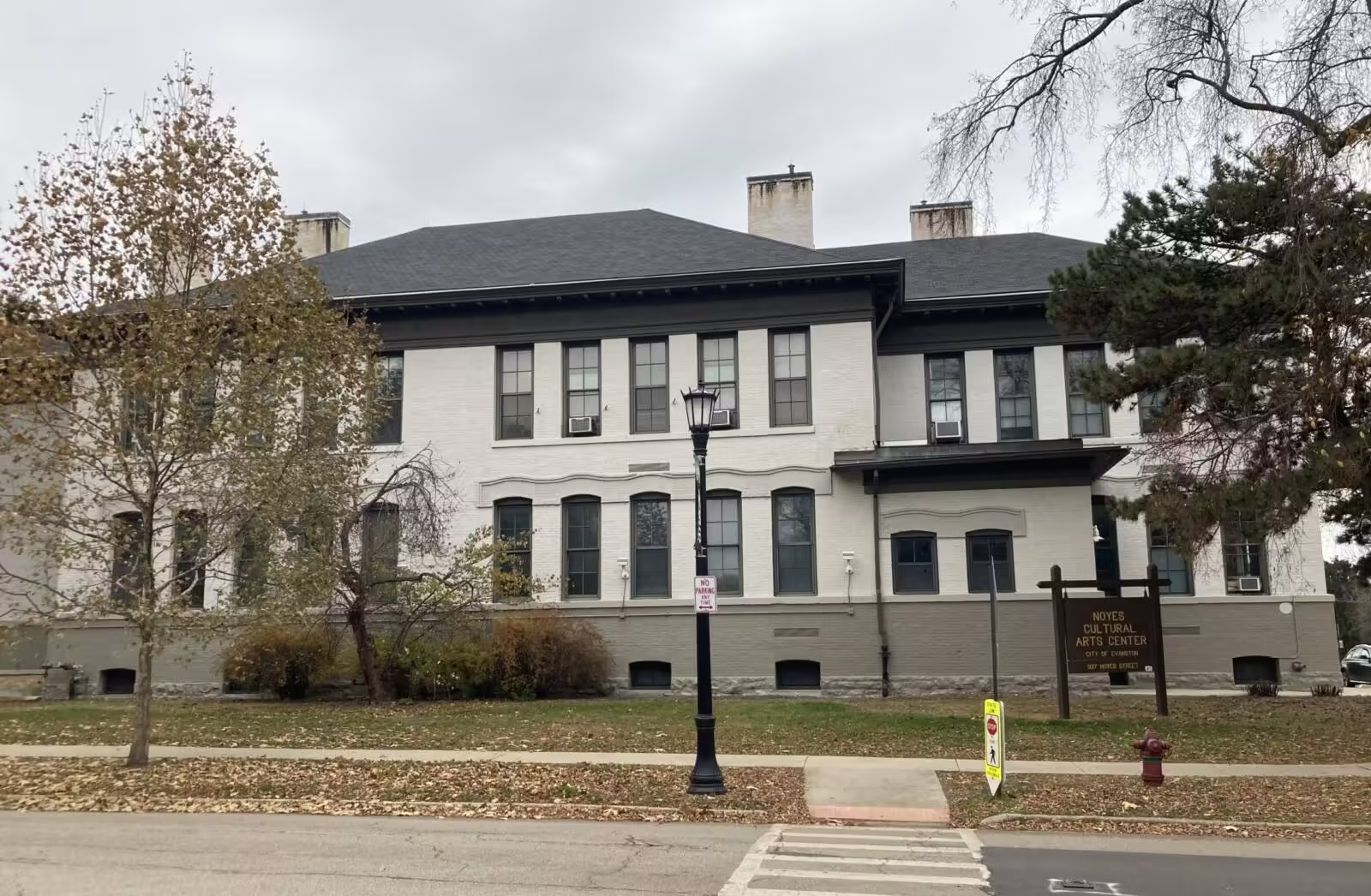
“In the 1970s and 1980s — I don’t want to describe this inappropriately — but we sort of went on a buying spree,” she told committee members. “We acquired some facilities, like the Noyes Cultural Arts Center, the police station. The Service Center [housing fleet services and public works] was built, but then we kind of coasted on investing in facilities. And now we have a series of buildings that haven’t had significant investment for quite some time. I mean the Police/Fire Headquarters and the Service Center are both very critical facilities that absolutely need that investment. I cannot stress that enough. But I understand there has to be a balance.”
At the meeting, city officials reviewed the rationale for some of the fee increases the city is seeking in the 2027 budget, similar to presentations at ward meetings over the past week.
In addition to an overall $5.1 million increase to the city’s property tax levy, Stowe’s budget includes a number of fee increases, including a 9% overall increase in trash collection rates to make up for lower property tax support, and a 25% increase in water rates to close a $6 million deficit in the Water Fund.
Rodgers also asked committee members what they would like to cut.
“We can ask all the questions we want about how things are counted and you know how things are tracked,” he said. “But the fundamental job here, if we want to spend less money, is look at that list and figure out what to cut.”
Committee member Candance Chow led off with the most extensive suggestions. Chow said she would support reducing the scope of participatory budgeting, especially “when it’s fairly clear that we have more projects than we can do.”
“This is my own personal observation,” she said. “I’ve seen a lot of charging stations in Evanston that aren’t utilized.”
She also questioned whether the city would be affected by the Putting Assets to Work initiative, a federal grant-supported program to find new uses and developments for underutilized city assests, including the Noyes Center, existing Police/Fire Headquarters and the Morton Civic Center at 2100 Ridge Ave.
She also asked whether a $600,000 investment from the program in the Chandler-Newberger Center would be “a good investment,” particularly “if it’s decided as a community that Evanston has too many facilities and Chandler may be one that could be repurposed or used in a different way.”
Councilmember Clare Kelly (1st Ward) spoke in support of participatory budgeting, suggesting there may be a misunderstanding about the group’s role.
City Council piloted the participatory budgeting process in 2022 with $3 million in federal American Rescue Plan Act funds. Under the process, community members develop ideas that can be funded through the city’s budget. Mental health first aid training, education support for marginalized students and an urban farm were included among the pilot’s winning projects.
“We asked them to prioritize it [community needs] through their public outreach,” Kelly said, “and I think that’s been really valuable.”
Biggs said the group is meant to have complete freedom in proposing projects.
“It may be something on our capital program. It may be something like a park that’s not scheduled to have a refresh for 10 years, but they think it needs now,” she said. “It could be something totally new. The purpose of participatory budgeting is that the city does not define the borders with which they work. They come to the city and say, ‘this is what the public wants,’ and then the city works to fund it.”
Councilmember Tom Suffredin (6th Ward) reminded officials of committee members’ interest in staffing, with some asking for more than the minimal cuts included in Stowe’s initial budget. More will be discussed at the committee’s Nov. 4 meeting, as well as during a special City Council meeting Monday, which will include discussions of the budget’s full ordinances as well as a “Truth in Taxation” hearing focused on property taxes.
Related Stories
Source: evanstonroundtable.com