
Overview
From October 30-November 16, NOAA Ocean Exploration will lead the 2026 Technology Demonstration aboard NOAA Ship Okeanos Explorer. Departing from Honolulu, Hawai‘i, the team will conduct initial field trials offshore the main Hawaiian Islands to ensure operational readiness before transiting to the remote waters of Johnston Atoll.
The primary purpose of the technology demonstration is to test the use and integration of autonomous underwater vehicles (AUVs) in routine operations aboard NOAA Ship Okeanos Explorerwith the ultimate goal of improving at-sea data collection abilities. A flexible payload means that AUVs can be adapted to support a range of data needs, including mapping at higher resolutions than achieved through ship-based bathymetry. The knowledge gained during the expedition will not only inform operations aboard NOAA Ship Okeanos Explorerbut also future operations aboard its eventual successor, NOAA Ship Discoverer. In addition, because the expedition will take place in areas of interest for marine critical minerals, data collected may increase our understanding of resources in the region, supporting responsible seabed resource management.
Technology
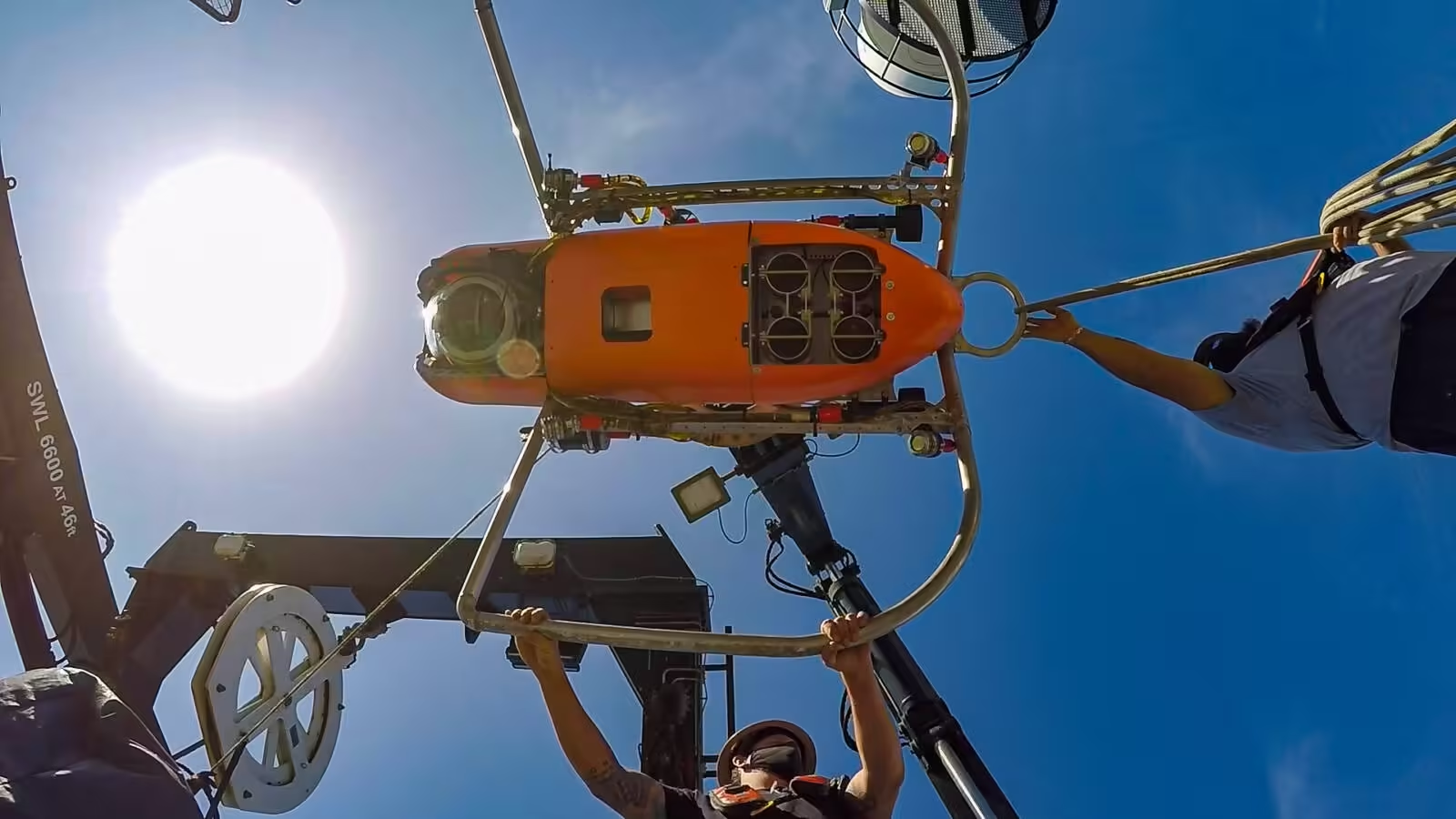
Two types of AUVs, funded via the NOAA Ocean Exploration Cooperative Institute (OECI), will be deployed on this expedition: a HUGIN 6000 and two Orpheus AUVs (built, owned, and operated by Orpheus Ocean). Both systems have flexible payloads, meaning that their onboard instrumentation can be adjusted to perform different tasks as needed.
The HUGIN 6000 is rated to a depth of 6,000 meters (3.7 miles) and can be deployed for up to 48 hours. Equipped with multibeam and synthetic aperture sonar (SAS)as well as a sub-bottom profiler, magnetometer, camera, and CTD sensor, it will be the largest AUV ever brought aboard Okeanos Explorer.
Also rated to a depth of 6,000 meters, a pair of compact and lightweight Orpheus AUVs will be equipped with cameras and pushcores for the expedition. The pushcores will be used to attempt the collection of sediment cores at a depth of 5,000 meters (3.1 miles), which will be the vehicles’ deepest pushcore sample collection to date. If successful, the sediment samples will be sent for analysis by scientists at the U.S. Geological Survey and NOAA’s National Centers for Coastal Ocean Science.
A HUGIN autonomous underwater vehicle is launched from Deep Clear in 2022. Image courtesy of NOAA Ocean Exploration, Investigation of a Historic Seabed Mining Equipment Test Site on the Blake Plateau. Download largest version (jpg, 4.8 MB).

Source: oceanexplorer.noaa.gov