

You’re reading a newsletter from The Indicator from Planet Money. Once a week, we curate our favorite stories and insights on business, finance, economics and why they matter. Subscribe here to get it in your inbox every Friday.
A TILE GAME is giving a boost to Chinese factories. Our very own Jennifer Pak reported that Chinese manufacturers have not had the easiest few years with U.S. tariffs and the war in Iran pushing up costs. Well, the aged game of Mahjong is giving them a surprising boost. That’s because it’s having a moment in the U.S. and some entrepreneurial citizens in China are enjoying the benefits. Mahjong sets can sell for like $300-$400 in the States … and want to know how much they cost to make? ~$30. One businessman said he used to make the game primarily for Chinese consumers. Now, every set is exported to the U.S.
People playing the centuries-old game Mahjong in San Francisco, California.
Justin Sullivan/Getty Images North America
hide caption
Justin Sullivan/Getty Images North America
Coming up:
- The risks to Anthropic’s (and AI’s) business
- Why we’re saying ‘buyout’ and not ‘layoff’
- How young people are doing with AI summaries
New’s We’re Watching
The two most interesting risks to Anthropic – U.S. Securities & Exchange Commission
What to Know: Anthropic gave the world 94 pages of risks to its business (slash the entire AI economy) in its IPO prospectus aka the S-1. It wouldn’t be Anthropic if they didn’t discuss the “existential risks” to humanity and society several times. And isn’t that an important risk to disclose? Another that stood out: the AI boom has a glaring point of failure. The majority of advanced semiconductor manufacturing is concentrated in one place, Taiwan, and if anything were to happen there, it could disrupt the entire AI economy. Think earthquake, Chinese military action, blockades. But I want to focus on a different risk, because it is FASCINATING!

Anthropic CEO Dario Amodei has persistently raised the safety concerns of AI.
Kevin Dietsch/Getty Images North America
hide caption
Kevin Dietsch/Getty Images North America
Committing to the past at a premium: Anthropic is worried about aging out of the tech that’s powering its AI, while paying the same prices. What does that mean?! AI companies have to lock into pricey contracts for all sorts of softwares, hardware, data center, and squadrons of GPUs. But technology is advancing quickly right now. New GPUs, for example, could come along that can do the same amount of work for way less money. Then Anthropic is stuck like CHUMPS in a contract paying a premium for old hardware, while some competitors may be doing more for less.
Why buyouts and not layoffs? – The Wall Street Journal
What To Know: Microsoft offered buyouts to 60,000 employees, roughly a quarter of its staff this week. And doesn’t that sound better than “Microsoft laid off 60,000 employees this week”?? Skydance ALSO offered a buyout to employees on Monday, though it’s not clear how many would be eligible. And here at NPR, we’ve been a fan of the term buyout too. So what’s the real difference in offering a buyout versus just laying off staffers?
The difference: Morale? Morale. There’s something about a “mega-layoff” that doesn’t inspire worker confidence. A “buyout” not so much. Really? Ok, I guess. The WSJ reported the focus in C-suite land is on the ratio of employees to AI agents inside companies. Companies have to find ways to pay for the ever-increasing costs of AI … and you know … actual human workers expect to be paid.
Andy Challenger, Chief Revenue Officer of Challenger, Gray & Christmas, a consulting firm, told the Journal that it can help staffers emotionally by making it a little easier to let go. It also tends to motivate older staffers to retire a little bit early, which may be the company’s goal.
Today’s Indicator
There are more bots than humans online. Here’s what that means
If you HAVEN’T listened: I never thought I’d yearn for the days when the internet felt wholesome. Where you could go to blogs and random sites and make friends across the world. Well, more than half of internet traffic now comes from non-humans, aka bots. They’re pouring into the digital veins of the World Wide Web, ignoring a lot of ads, generating all kinds of comments, nonsense and what have you. One interesting takeaway: this shift from human-to-bot traffic changes the business model of the internet. If humans let bots do their shopping for them, then ads suddenly become less useful. And if ads don’t pay out for websites, then who pays for them?
If you HAVE listened: Writer and researcher Erin Kissane says she believes Dead Internet Theory came out of a human impulse to “create speculative fiction versions” of real-life societal change that scares us. As a reminder, Dead Internet Theory is the idea that the internet becomes just bots talking to other bots.They’re pouring into the digital veins of the World Wide Web, ignoring a lot of ads, generating all kinds of comments, nonsense and what have you. One interesting takeaway: this shift from human-to-bot traffic changes the business model of the internet. If humans let bots do their shopping for them, then ads suddenly become less useful. And if ads don’t pay out for websites, then who pays for them?
Rest of the Week
How Meta plans to win the AI race with a “free” product
The case for (and against) abolishing MBAs
How Montana hopes to end corporate money in politics
Listener Mailbag
Listener Marjorie Wilkinson-Gruber sent in a comment from Marion, Iowa
Context: Marjorie wrote this message in response to Monday’s episode on a human-less internet! There’s a summary of the episode just above this segment.
Comment: After listening to today’s episode of The Indicator, I had to write y’all. I’m a substitute teacher for middle school students in a public school district. This district serves mostly upper middle class students. I recently had a class of 8th graders given a research assignment. Seems pretty easy (enter the topic in Google, read some websites) so I was surprised when students began complaining that “everything is blocked”. Turns out the school district had turned off/blocked AI summaries on the student computers. The students had become so reliant on the summaries that about half the class was stumped on what to do without them. They then complained loudly about having to read multiple websites to find the information they needed. “You expect me to actually read these pages?!?” Pretty disheartening and hard not to blame Google for forcing AI on all users/introducing the summaries in the first place!
In Our Spare Time
Producer Corey Bridges is playing through NPR’s gaming coverage
Just last week I completed the campaign for Gears of War: E-Day and I thought it was excellent. I’ve never been a huge Gears of War fan, but this game was absolutely gorgeous and super fun to play. Xbox has had it pretty rough in recent years, so it’s encouraging to see them churn out a game of the year quality product like this.
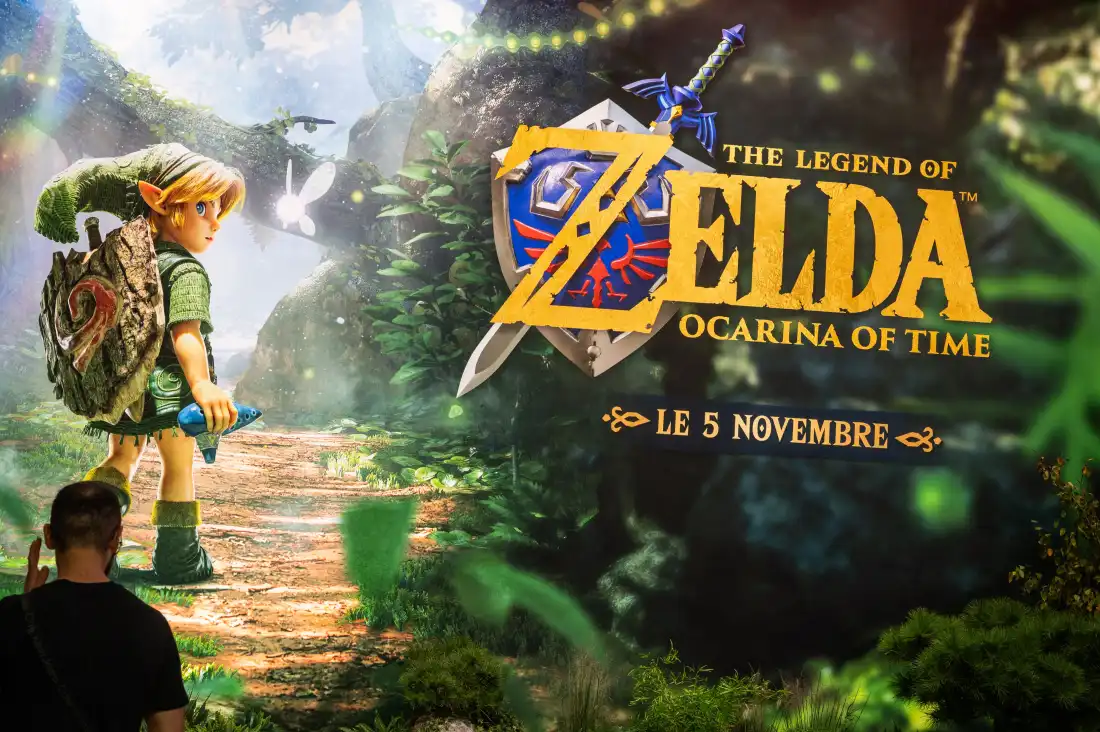
An Ocarina of Time ad at Paris Games Week PGW
RICCARDO MILANI/Hans Lucas/AFP via Getty Images/AFP
hide caption
RICCARDO MILANI/Hans Lucas/AFP via Getty Images/AFP
I’ve also been playing the new Nintendo Switch Sports Resort entry which I highly recommend to people who were fans of Wii Sports back in the day. And then finally, I’ve been preparing for the Legend of Zelda: Ocarina of Time remake by actually trying to progress in my year-old Breath of the Wild save. All I gotta say is, my backlog is looking more daunting than ever.
NPR put out its “Best Games of 2026” list. NPR is one of more than 150 outlets polled in The Game Awards, which has yet to be released.
Source: www.npr.org