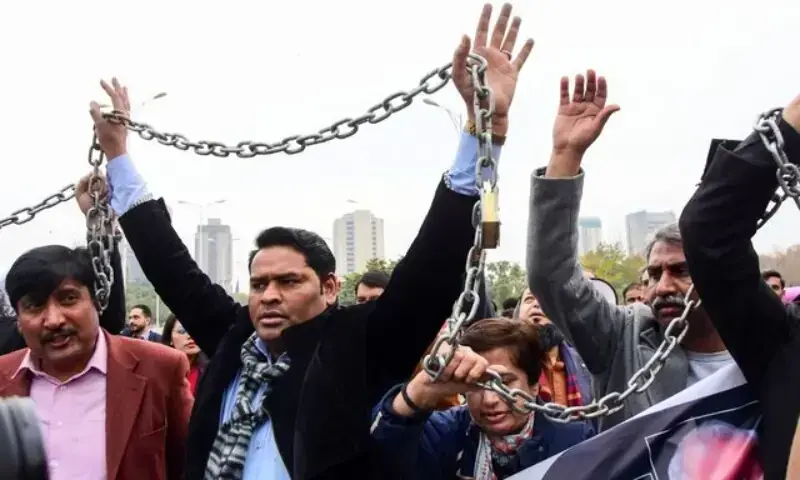

ISLAMABAD: Pakistan remained deeply hostile to journalism and its practitioners in 2025-26 despite a decline in documented violations against media workers, according to a new report issued by an Islamabad-based media watchdog.
“About 10 cases a month [against media personnel]their nationwide spread and severity in the period showed that fewer violations did not mean greater safety,” stated Freedom Network’s latest annual Impunity Report 2026, titled “From Violence to Lawfare: Process as Punishment for Journalists”.
Produced with technical assistance from International Media Support (IMS), the report was authored by journalist Adnan Rehmat and Freedom Network Executive Director Iqbal Khattak.
It finds that “impunity has evolved from a failure to punish violence into a broader system of coercion”.
Peca increasingly used to punish dissent, says Freedom Network report
The report was released on Thursday ahead of the International Day to End Impunity for Crimes against Journalists, observed worldwide, including in Pakistan, on Nov 2 each year.
“Despite the presence on the statute books of two laws to combat impunity for crimes against journalists, such a finding should be a matter of concern for those at the helm of affairs of the two safety commissions established under these laws,” Mr Khattak said.
Cases documented between October 2025 and August 2026 included one work-related killing, three attempted assassinations, 18 threats of murder or harm, 11 assaults, 13 legal actions and 32 threats of legal action.
Punjab recorded 49 cases, just over half the total, followed by Khyber Pakhtunkhwa, Islamabad and Balochistan. Digital and independent journalists were targeted most often. Victims or their families identified government authorities and officials as alleged instigators in nearly two-thirds of the cases.
The report identifies the controversial Prevention of Electronic Crimes Act (Peca) and its increasing use against journalists by the National Cyber Crime Investigation Agency (NCCIA) to punish dissent as “central to this legal siege” of online journalism in the country.
‘Recurring pattern’
A detailed analysis of representative Peca-related cases against journalists reveals a recurring pattern in which allegations of defamation, false information, harassment or reputational harm are channelled through cybercrime procedures, including in cases involving reporting on public expenditure, corruption or official conduct.
Even without a confirmed FIR or conviction, the process itself becomes “punitive” through summonses, device scrutiny, travel, legal costs, detention, repeated hearings, and reputational harm, the report says.
It adds that relief is commonly limited to bail or procedural protection rather than final vindication.
The report also provides guidelines for journalists and other media practitioners facing Peca-related cases to help minimise the harmful effects of legal action.
It expresses concern over the lack of institutional safeguards for media workers despite the establishment of two high-powered safety commissions, one at the federal level and the other in Sindh.
“The federal journalist protection mechanism is effectively dysfunctional, while the Sindh Commission, although more visible, has limited reach and demonstrated protection impact outside Karachi,” it says.
Published in Dawn, October 30th, 2026
Source: www.dawn.com