Born in London and spending his formative years in Nigeria, Osi Umenyiora had never even heard of American football until he moved to the U.S. as a teenager.
After moving to Auburn, Alabama, he took up the sport in high school and eventually earned an opportunity at Troy University. He was drafted by the New York Giants in 2003 and went on to win Super Bowls XLII and XLVI.
Umenyiora spent ten years with the Giants and two seasons with the Atlanta Falcons before retiring in 2015.
The rest, as they say, is history. Yet Umenyiora’s story was far from over.
“My whole story has just been one of pure fortune, and so I looked at it like, ‘Okay, I’ve been given this opportunity, and now I’m working with the NFL. How can I now give this opportunity to more people?’”
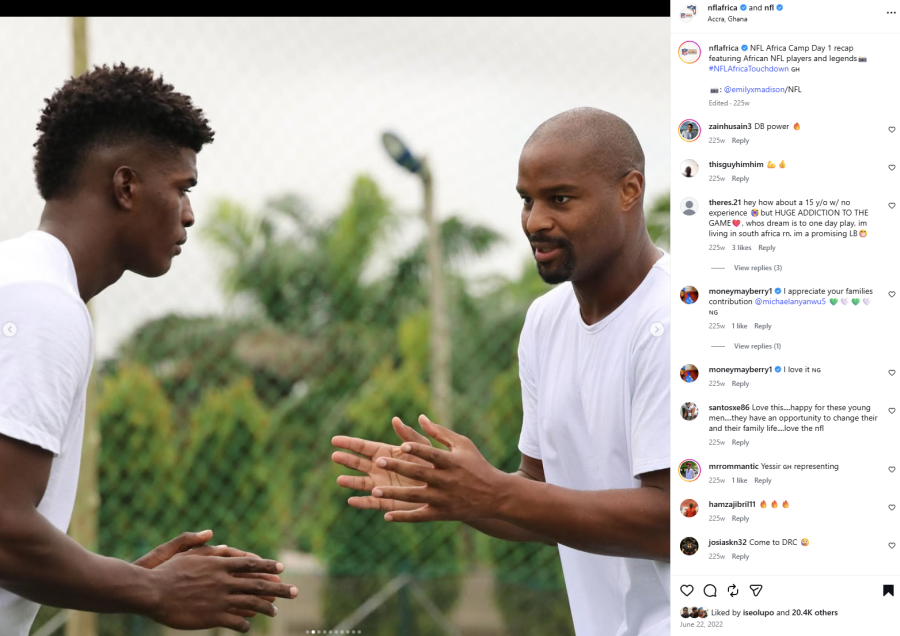
That’s where an e-mail to NFL Commissioner Roger Goodell snowballed into NFL Africa, the league’s initiative to grow the game on the continent and perhaps Umenyiora’s most impactful chapter yet.
In the conversation below, part of NBC Sports’ By Way of Africa series, Umenyiora reflects on his childhood in Nigeria, the story behind NFL Africa’s creation, and what the initiative’s growth means to him.
*This interview has been edited for length and clarity.
Mary Omatiga: Osi, you were born in London, but I read that you lived in Nigeria from age 7 to 14. What memories come to mind when you think of your childhood there?
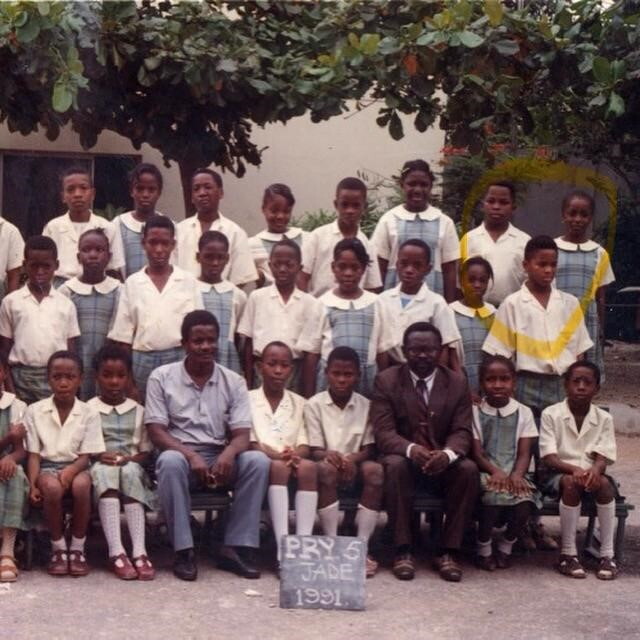
Osi Umenyiora: Nigeria to me is a very special place. It’s a place that I hope to one day return to and live. Growing up there meant so much to me. My family being there, coming back there. Because of the way we were raised — and we were raised in a very Nigerian way — when I got there, the only difference really was the climate. Other than that, it was basically the same things going on. But overall, it was just a really, really great experience and time in my life. It’s something that I’ll never forget and something that I cherish.
Courtesy of Osi Umenyiora
How did that time there shape you into who you are today?
Umenyiora: In a multitude of ways. The environment there teaches you how to survive first and foremost. It instills toughness. There are so many things that you see there that, whenever you leave that environment, the ability to thrive in those situations, you can carry them with you pretty much anywhere.
I know they say that if you can make it in New York, you can make it anywhere, but really, it’s if you can make it in Lagos, Nigeria, you can pretty much make it anywhere.
Courtesy of Osi Umenyiora
Names can carry so much weight in African culture. What’s your full Nigerian name and what does it translate to?
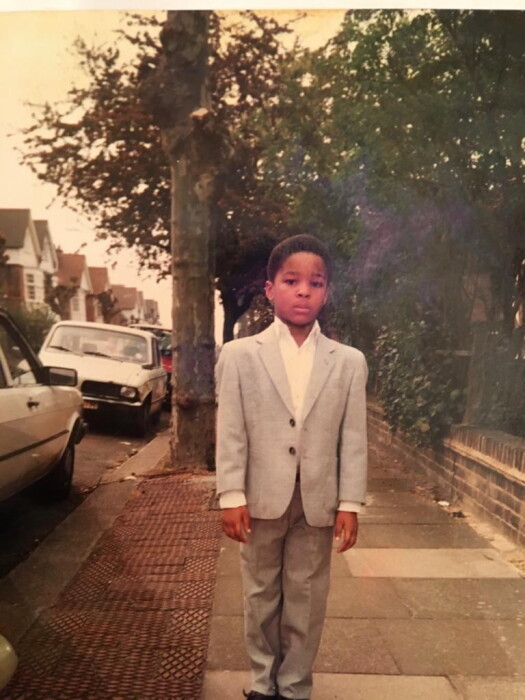
Umenyiora: Ogemdi Ositadinma Iloabuchi Umenyiora.
My father would actually name us after periods in his life. So Ogemdi means ‘My time is now’. Ositadinma means, ‘From today, things will be good’, and Iloabuchi basically means, ‘The heart of who is God’. So it’s three different names.
Then one of [my dad’s] friends went to him and was like, ‘You have four sons at this point, and none of them are named after you. Why don’t you name one of your sons after you?’
So he just started calling me Osi randomly when I was two years old and that’s how I got the name. But my first name is actually Ogemdi.
How do you think the meaning of your name has played out in your life?
Umenyiora: First and foremost, just understanding that my father would name all his children — and he had ten of them — after different periods of his life. I think it was a very special and sentimental thing for us because a lot of times you don’t really know the meaning of your names, or people just randomly call their children whatever.
But the fact that my father took the time to think about each one of his children and specifically name us after something that happened translates, and it just gives your name that much more pride and that much more meaning.
Also, the thing about Nigerian names is you can tell where somebody’s from within Nigeria just by hearing their name, which is kind of unique to a lot of people. So I can hear somebody’s name, and I’ll be like, ‘Okay, this guy is Fulani, or he’s Hausa, Yoruba, or Igbo, simply by hearing their name.
The name really is an identifier. It’s a marker of who you are, where you come from, and a lot of times it actually carries your whole family history with you.
Courtesy of Osi Umenyiora
You are Igbo. Can you talk about the values and traditions that come from your culture that have led to your success on and off the field?
Umenyiora: Being from the Igbo tribe, we’re very, very proud people. Obviously, there was a situation back in the ‘60s and ‘70s where Nigeria fought a war. Biafra was trying to secede from Nigeria. It didn’t work out well, but the Igbo people were the main people who were in that. So, just being a part of that tribe, I would say I find it interesting how I don’t really consider myself Igbo until I get to Nigeria.
Because outside of Nigeria, you’re just Nigerian. Everybody is cool. They’re family. You’re just one. But the minute you go back into Nigeria, that’s when you become either Igbo, Hausa, Yoruba, Fulani, Ijaw, Efik, Ibibio — one of those tribes.
To be honest, I wish that we would take more of the approach that we have outside of Nigeria into Nigeria, so we can be more cohesive and really move as one within the country. Because outside of the country, my best friends are Yoruba, Hausa, it doesn’t really matter until you go back in. I wish we would stop that.
You are a two-time Super Bowl champion, a New York Giants legend. So much of your journey was shaped by hard work and values, but your journey is also a testament to the power of having someone believe in you and take a chance on you.
How has that inspired this chapter of your life as the lead for NFL Africa?
Umenyiora: Oh, massively! A lot of times, people can look at things that they do and things that they accomplish and think that they’re the ones who did it. For me, I’ve never thought that way.
I always knew that I was very fortunate. I was lucky to have the parents that I did who were able to send me to America. I was lucky to be able to start playing the game of football, which gave me the opportunity to get a scholarship and then go on to the NFL.
My whole story has just been one of pure fortune, and so I looked at it like, ‘Okay, I’ve been given this opportunity, and now I’m working with the NFL. How can I now give this opportunity to more people?’
Because there are so many people, especially when I was growing up, who were more talented than me, had much more ability than me, but they just didn’t have the parents, or they didn’t have the [opportunities]. So now that I’m in a position to help, why would I not try to put those people in the exact same position that I’m in? As opposed to just going back there and doing the regular things.
‘Oh, we’re going to do a charity here. We’re going to do this and that.’
Cool. I get all that, but for me, it was about this: There are tremendous athletes there. There are people there with real ability, and all they need is just a pathway. All they need is just somebody to hold the door open for them, so they can come and make the best of their abilities.
For me, the idea that I had this opportunity to do something like that, given the fact that I was given that exact same opportunity, was monumental, and it’s something that I knew that I had to do.
It’s been brewing for 20 years. I know people see what’s going on now, but this is something that has been a long journey, a long process, and is just now starting to come to fruition.
Tell me about the e-mail you sent to Roger Goodell that started that long process.
Umenyiora: Roger is my guy. We spent quite a bit of time together, and so, just the understanding of the NFL trying to expand internationally, I’ve been in the UK, doing that work. But if you look at the actual rosters in the NFL, you hear a lot of African names. It wasn’t like that when I came in. There were just a couple, and now if you look, there are over a hundred.
You can’t have all these international games and try to expand into all these international markets, but the place where most of your players are coming from internationally, you don’t have a division, or you don’t have anything that you’re doing there. I think that wasn’t right, and so I had the conversation with him. I sent him the email, and in all fairness to him, he didn’t even hesitate.
As soon as I sent him the email, he saw the vision immediately and was like, ‘Hey, go do this. Let’s get this done.’
So kudos to him for that.
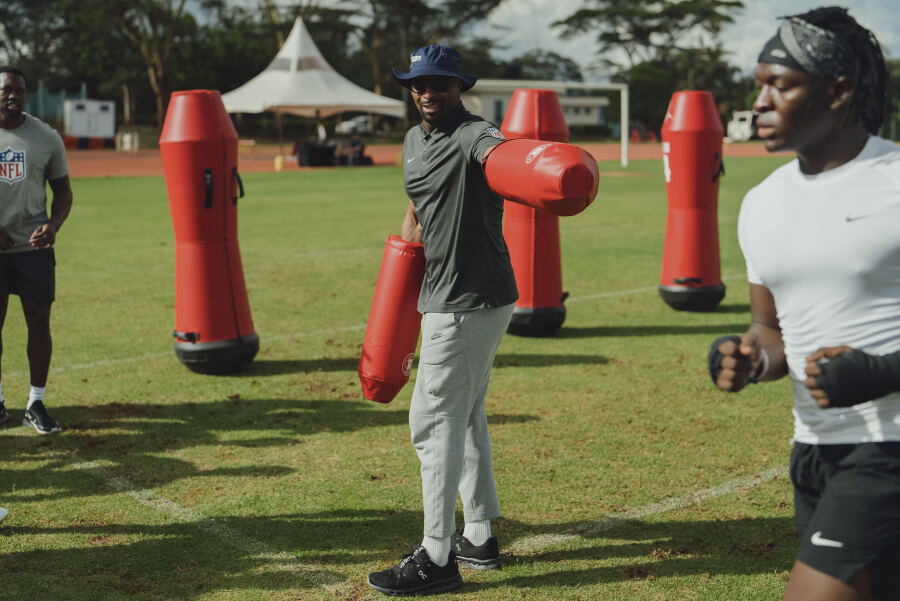
Since then, you’ve led camps in Kenya, Nigeria, Ghana, and Egypt. What does the growth of NFL Africa mean to you?
Umenyiora: It’s amazing. I think when I go there and I see how many people are playing the sport, especially flag football, they’re taking to it. It’s growing tremendously, and people understand the game. They’re adopting the culture. They love it. They know the players.
It’s really so crazy because when I left Nigeria, that wasn’t even a thought. I had never even heard of American football. There wasn’t even an inkling that something like this existed until I got to America.
So now, to go back there and see that people know the NFL, people know the players, they’re doing the dances — it’s really a testament to all the hard work that we’ve done and that we will continue to do. I’m really excited about it!
What are you most proud of?
Umenyiora: Well, I think what I’m going to be most proud of hasn’t happened yet. The scouts are sending you videos of a lot of these guys, and you see them, and they don’t have the body types. They’re big, but they’re not like American football big.
So you go there, you do the first camp. You see them. You train them. You talk to them. They’re excited. And then we come down there. We have the NFL Africa camp. Then, literally within like a couple of months, you see them in America, in college or in the NFL.
I can never get over that feeling because I know where I saw them first, and I know what’s going on on the ground there. I know the struggles that they’re enduring, and then literally within a couple of months you see them on NFL rosters or going to big-time colleges, and you’re like, ‘This is crazy.’
Just seeing that process repeat itself, and knowing that I had this idea — that this was possible because of something that I had done. Having the vision, and then all of a sudden seeing it come to reality is something that I wish everybody could experience.
I wish you could see some of the guys and the places that they’re training, and then the next thing you know, you see them at the NFL Africa camp, and then within a couple of months, you look up, they’re playing for the Baltimore Ravens.
It’s a really special thing to experience and I’m excited to keep it going.
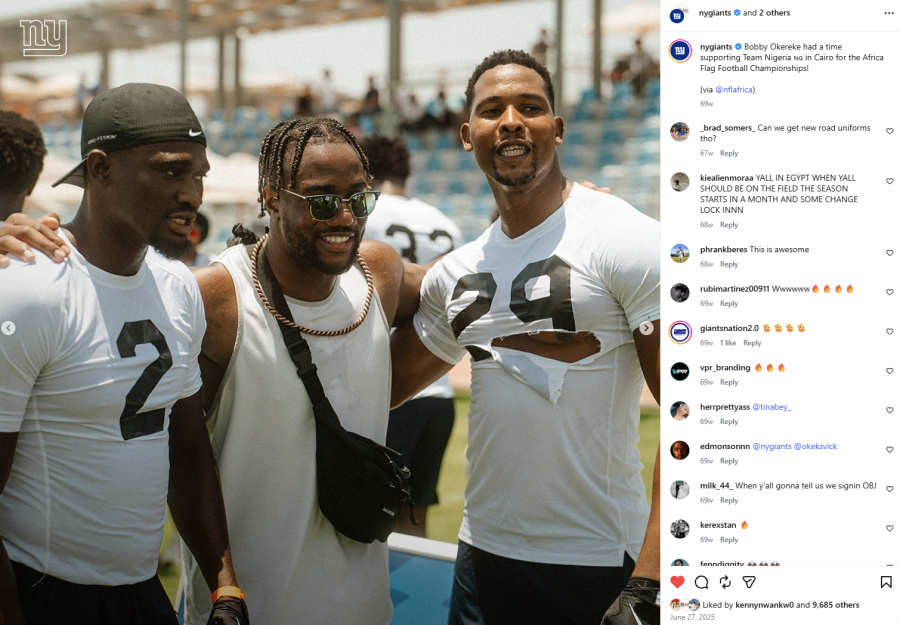
You’ve gone to these camps, and you’ve actually had the opportunity to bring NFL players with you. Some of them are actually experiencing Africa for the very first time.
What has that experience been like for you to see people experience the culture for the first time?
Umenyiora: Amazing! There’s really nothing like it. A lot will have African names because of their parents. They are first-generation, so they’ve never been. They’ve been raised in African households, so they’ve been hearing all the stories, getting a little understanding of it, and then to see them experience it for the first time and be like, ‘Wow, I’m really from here. My parents are from here.’
It’s mind-blowing, and they never forget it. It’s something that stays with them and lives with them. They want to give back. They want to keep going. And some of them, the minute that happens to them, there’s like a light bulb switch in their head, and they’re like, ‘Okay, what can I do now? How can I help? How can I be of service?’
It’s really cool to bring that experience to people who have never experienced it. Even some Americans have been there, and they see it, and it [resonates] with them because you just see a whole bunch of people who look exactly like you.
It’s just being in that environment and knowing that these are your roots. I think it’s something everybody really should experience.
Have there been any moments or reactions from players that have stayed with you?
Umenyiora: I think when we went to Ghana, and we went to Cape Coast Castle, that was crazy, to see their reactions and how they absorbed the reality of what their ancestors went through. That was a tough day, to be honest. So I would say that one stood out with me for sure.
NFL Africa shared on Instagram recently that this season there are 24 African countries represented in the league. Players are representing; they are coming to game day in their traditional attire. They are giving back to the continent, hosting camps and foundations.
What does it mean to you to see so many players representing with pride and giving back?
Umenyiora: It’s amazing, right? When you see it, you’re like, ‘Man, this is absolutely crazy.’ Because it wasn’t like that before. There was a time when you almost had to hide your identity in a way. So the fact that there are so many people who are so proud of where they come from and their heritage, I think it’s also a testament to Africa in general and some of the strides that Africa has made.
Now people want to be associated with something that they see as being good. It’s amazing to see them wear their colors with pride. If you look at the back of the NFL helmets, they’ll have the American flag, and then they’ll have whatever country they’re from.
But I think those things are tremendous, not only for Africa itself or the countries, but also for America to really be a unifier and bring people and cultures together so they can understand where they’re from.
You’ve witnessed the growth of NFL internationally, with games taking place all over the world. What do you think it would be like for people to actually experience an NFL game on the continent?
Umenyiora: I think that would be incredible. Baby steps, though. There are a couple of things that we need to get sorted out and make sure that we have our own houses in order to make sure we’re capable of hosting an NFL game on the African continent.
I think there are some countries there that are really making incredible strides, and they’re doing things with their stadiums, facilities, and with their infrastructure to make sure that something like that can happen. But I’m pretty sure at some point in the future it’s going to happen.
Before then, I think we need to build a league of our own on the continent. That’s really where my mind is. We need to focus on building something that captures the value on the continent itself, and actually develops people, trains them, and allows them to keep some of that talent there in Africa and provide entertainment for the people there.
That’s the next step, and I think that’s where we’re going to be next.
You’re also a flag football ambassador. The sport will make its Olympic debut at the 2028 Games in Los Angeles. What do you hope to see from African nations?
Umenyiora: There’s no question, in my mind anyway, that the African athlete is probably the best athlete in the world. They’re just untrained. So all we have to do is give them the opportunities, the tools, and all the training necessary, and I think this is a sport that they’re going to dominate.
I think we’re probably a little far behind in terms of the training and getting the players where they need to be in terms of their physical ability, their [knowledge of the game]. But in short order, I think it’s going to be African teams that are going to be among the best in the world.
Football is a gift. It’s given you so much, both on and off the field. What do you hope this sport will give to young African boys and girls?
Umenyiora: Exactly what it’s given me, and even more. I thank God for the sport. I know it takes a beating in a lot of instances, and maybe it’s deserved in some form or fashion, but from my vantage point, there’s really nothing like it.
The opportunities that this game provides to people, whether that’s to get an education. If you are African, the ability to get a scholarship… and then now they’re paying them in school. Then, on top of that, the opportunity to get to the NFL, which is a rare thing.
But overall, the values that it teaches — the discipline, the sacrifice, the hunger — there’s really no other sport like it to me. The teamwork, the camaraderie — I wish everybody could have those experiences. For me, it’s just a matter of trying to provide as much of that as possible to as many African people as possible.
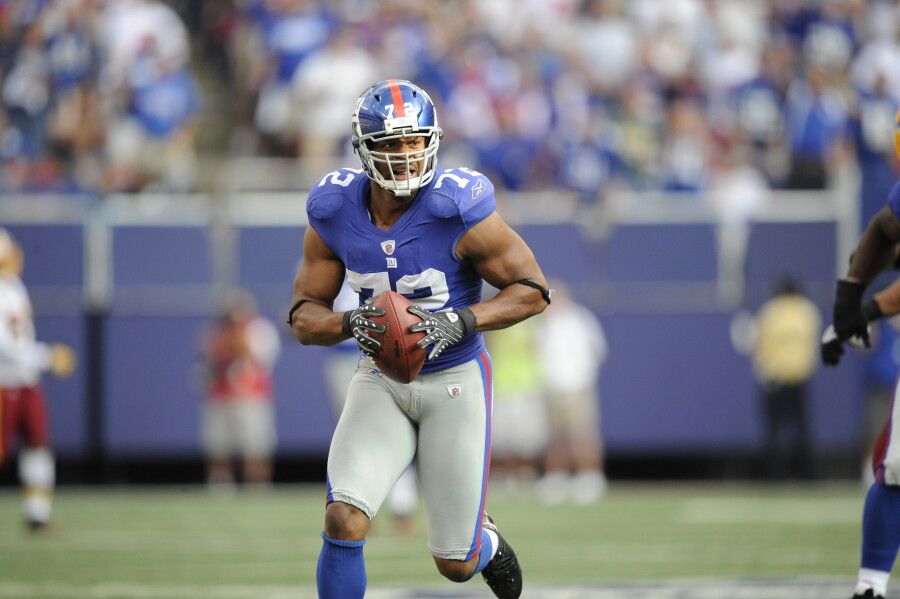
13 September 2009: New York Giants defensive end Osi Umenyiora (72) recovers a fumble for a touchdown during the Giants 23-17 win over the Redskins at Giants Stadium in East Rutherford, NJ
Icon Sportswire via Getty Images
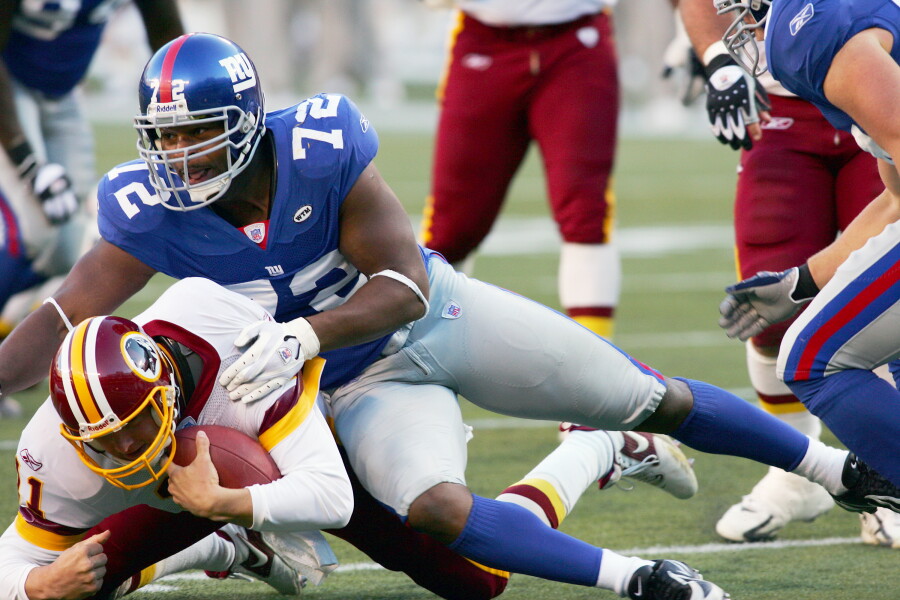
UNITED STATES – OCTOBER 30: New York Giants’ defensive end Osi Umenyiora sacks Washington Redskins’ quarterback Patrick Ramsey during the fourth quarter of the game at Giants Stadium. The Giants won, 36-0. (Photo by Corey Sipkin/NY Daily News Archive via Getty Images)
NY Daily News via Getty Images
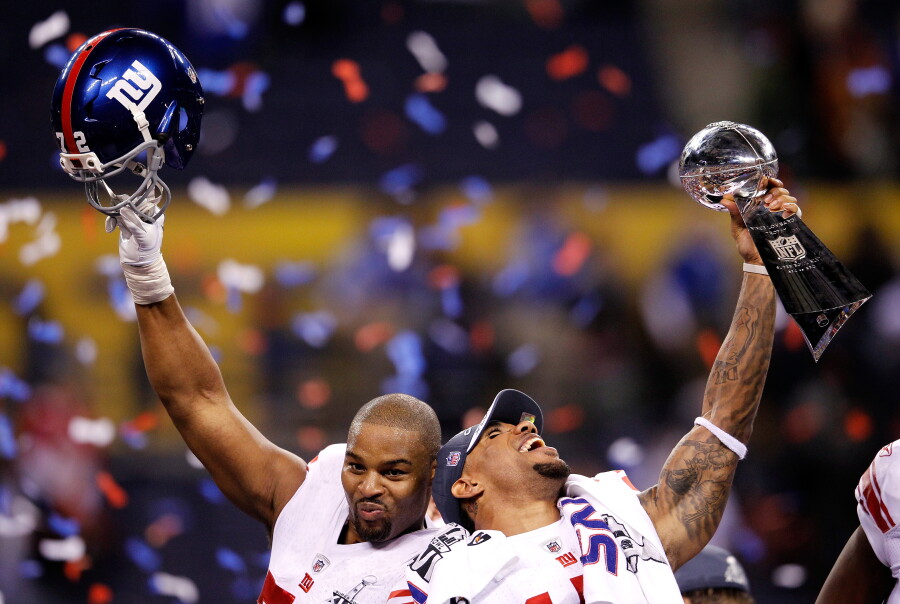
INDIANAPOLIS, IN – FEBRUARY 05: (L-R) Osi Umenyiora #72 and Devin Thomas #15 of the New York Giants celebrate with the Vince Lombardi trophy after the Giants won 21-17 against the New England Patriots during Super Bowl XLVI at Lucas Oil Stadium on February 5, 2012 in Indianapolis, Indiana. (Photo by Rob Carr/Getty Images)
Okay, to wrap up, I’ve got a quick game for us. This or That. Just go with your gut.
Start, bench, cut: Jollof Rice, rice and stew, pounded yam and egusi?
Umenyiora: Start plantain, bench fried yam, and I’m going to cut akara.
Puff puff or meat pie?
Umenyiora: Oooh, I’m sorry I can’t choose.
You have to pick.
Umenyiora: Meat pie! But puff puff, oh my gosh.
Afrobeats or Amapiano?
Umenyiora: Afrobeats
Name your top three Afrobeats artists?
Umenyiora: Wizkid, Asake, and Tems she’s incredible.
What Afrobeats song has been on repeat for you?
Umenyiora: “Money Constant” by DJ Maphorisa, DJ Tunez, Wizkid, and Mavo
Editor’s Note: By Way of Africa is a series committed to highlighting the talent and stories from the African continent and its diaspora. African stories are worth telling, and the culture—all of the languages, tribes, and traditions—is worth celebrating. Embedded in these narratives is a profound testament to the diligence, discipline, and work ethic deeply ingrained in African heritage. Whether born on the continent or dispersed across the globe, the contributions of these stories to society resound uniquely, by way of Africa.
Source: www.nbcsports.com