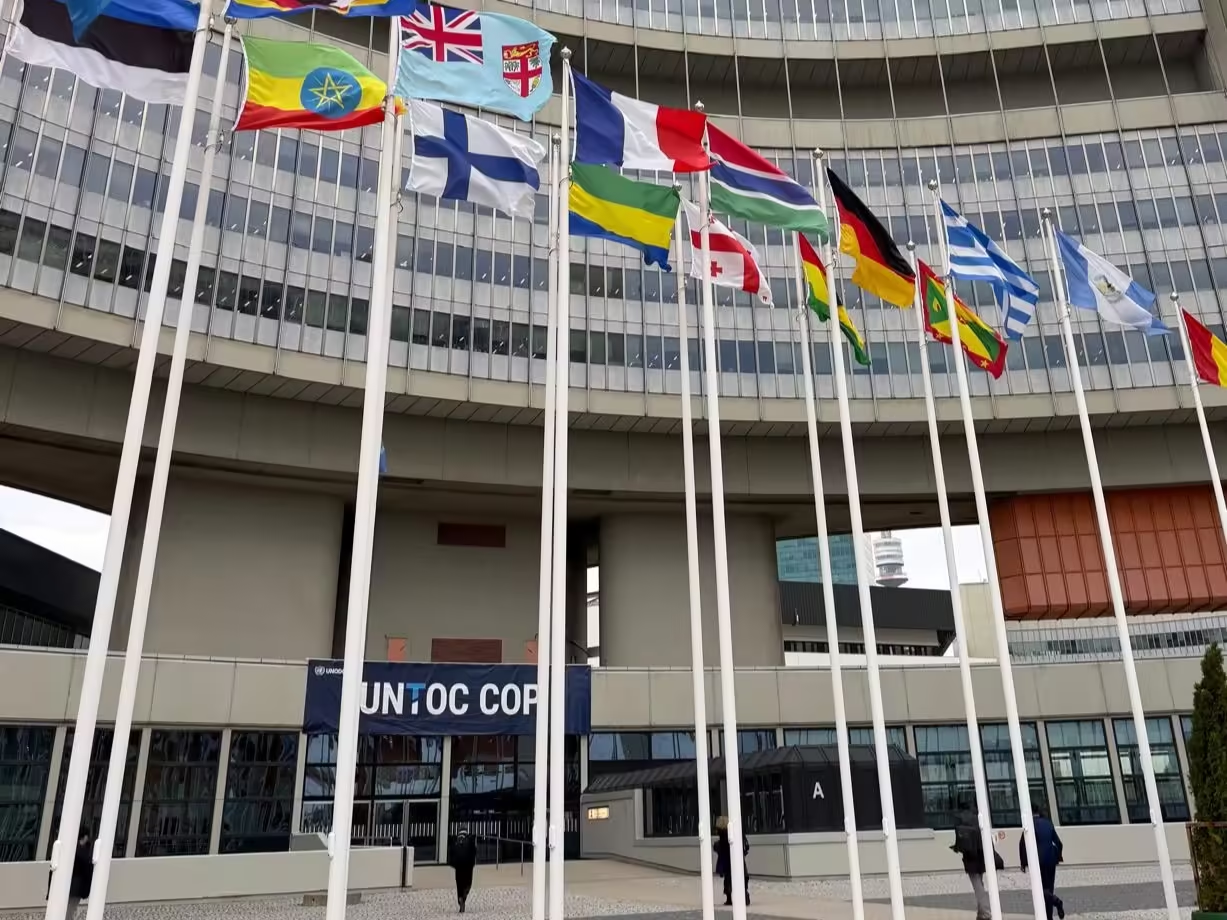

Vienna, Austria, 29 October 2026 — The International Union for Conservation of Nature (IUCN) welcomes the decision made on 23 October 2026 by the 13th session of the Conference of the Parties to the United Nations Convention against Transnational Organized Crime (UNTOC COP13) to begin negotiations on an additional protocol addressing crimes that affect the environment.
Adopted by a recorded vote of 83 in favour, 12 against and 27 abstentions, UNTOC’s resolution establishes an ad hoc committee to elaborate a protocol addressing illicit trafficking in wild fauna and flora, including timber and timber products; the illegal mining of and illicit trafficking in minerals and precious metals; and illicit trafficking in waste.
The decision marks an important step towards strengthening the international legal response to environmental crime. Such crimes are increasingly organised, transnational and profit-driven, contributing to biodiversity loss, ecosystem degradation and pollution, while undermining governance, depriving States of revenue and harming communities that depend on nature.
“This is a historic milestone in international efforts to address crimes that affect the environment. It recognises that these crimes transcend national borders and demand a coordinated international response. The negotiations provide a critical opportunity to strengthen international cooperation, bridge the gap between conservation and criminal justice, and establish a practical, science-informed protocol that helps protect nature, safeguard communities and hold perpetrators accountable,” said Sonia Peña Moreno, Director of the IUCN Centre for Policy and Law.
Preventing, investigating and prosecuting environmental offences
UNTOC, also known as the Palermo Convention, was adopted by the UN General Assembly in 2000 and entered into force on 29 September 2003. With 195 Parties, it provides a global legal framework for international cooperation against transnational organised crime. The Convention is supplemented by three protocols addressing trafficking in persons, the smuggling of migrants and illicit manufacturing of and trafficking in firearms.
A dedicated protocol on crimes that affect the environment could strengthen international cooperation to prevent, investigate and prosecute these offences, including through tools such as extradition, mutual legal assistance and the recovery of illicit proceeds. It also offers an opportunity to address gaps and differences between national legal frameworks that can complicate efforts to tackle transnational environmental crime.
The initiative builds on international efforts over more than a decade to strengthen the legal response to environmental crime, including calls for a dedicated international instrument. It also follows the work of the Open-ended Intergovernmental Expert Group on crimes that affect the environment, established in 2024, which met in 2025 and 2026 without reaching consensus on recommendations.
Connecting environmental protection and criminal justice
Multilateral environmental agreements and other instruments establish important conservation objectives and obligations. Strengthening their complementarity with criminal justice frameworks can help translate these commitments into more effective action and support a coordinated response to transnational environmental crime.
The new protocol offers an opportunity to bridge this gap by strengthening the criminal justice response to transnational environmental crime. Within its mandate, it can provide the fundamental tools of the UNTOC framework to support, among others, clearer definitions of offences, more effective investigation and prosecution, mutual legal assistance, information exchange and the recovery of illicit proceeds.
IUCN has a longstanding commitment to addressing environmental crimes, as reflected in its Resolutions and Recommendations. At the 2025 IUCN World Conservation Congress, IUCN Members adopted a set of relevant Resolutions, including Resolution 8.048 on crimes that affect the environment, Resolution 8.060 on recognising the crime of ecocide to protect nature, Resolution 8.057 on addressing wildlife trafficking and Resolution 8.033 on port State measures regarding illegal, unreported and unregulated fishing.
Building on its conservation mandate, IUCN encourages States to ensure that the protocol addresses the prevention of environmental crime, including its root causes and enabling conditions. Measures to tackle weak governance, corruption and harmful market incentives should complement criminal enforcement, alongside science-informed, community and rights-based approaches. The protocol should build on UNTOC’s tools and be guided by the principles of international law and sustainable development.
Conservation science, environmental forensics and community knowledge should inform prevention and enforcement efforts. The IUCN Red List of Threatened SpeciesTM, IUCN’s work on Key Biodiversity Areas and the expertise of IUCN Commissions can inform policy and enforcement responses. Environmental science and forensics can also help authorities and courts assess ecological harm beyond the market value of illegally traded goods.
IUCN encourages States to work towards a protocol that is effective, informed by the best available science and grounded in a human rights-based approach. The protocol should help strengthen the implementation of existing environmental agreements and commitments by reinforcing criminal justice responses to transnational environmental crime and enhancing international cooperation. It should also provide for appropriate liability of natural and legal persons, safeguard the rights of Indigenous Peoples, local communities, environmental defenders and whistleblowers, and promote access to justice and effective remedies, including restoration, remediation and reparation, as appropriate.
Next steps in the negotiations
The resolution establishes an ad hoc committee that will hold four sessions, with a view to submitting a draft protocol to the Conference of the Parties at its fourteenth session, in October 2028, if possible.
IUCN thanks Bolivia, Brazil, Colombia, Costa Rica, the Democratic Republic of the Congo, Ecuador, Mauritania, Panama, Peru, São Tomé and Príncipe and Uruguay for proposing the resolution. IUCN also recognises the leadership of Brazil, France and Peru for driving the intergovernmental momentum, as well as the important contributions of civil society organisations, Indigenous Peoples and other stakeholders in advancing efforts to address environmental crime.
The protocol will form part of a broader international response to crimes that affect the environment. Other harms to nature, including illegal, unreported and unregulated fishing and pollution, will continue to require effective national legislation and international cooperation, alongside efforts to strengthen the wider international legal and governance framework.
Related content:
Source: iucn.org