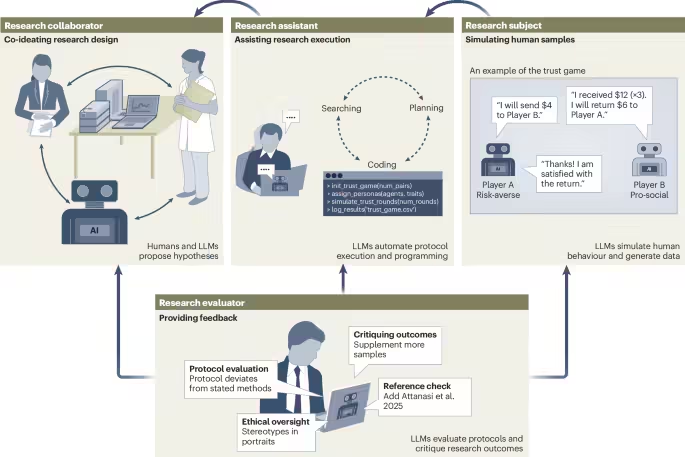

Lazer, D. et al. Computational social science. Science 323, 721–723 (2009).
Lazer, D. M. J. et al. Computational social science: obstacles and opportunities. Science 369, 1060–1062 (2020).
Vosoughi, S., Roy, D. & Aral, S. The spread of true and false news online. Science 359, 1146–1151 (2018).
Bail, C. A. et al. Exposure to opposing views on social media can increase political polarization. Proc. Natl Acad. Sci. USA 115, 9216–9221 (2018).
Kryvasheyeu, Y. et al. Rapid assessment of disaster damage using social media activity. Sci. Adv. 2, e1500779 (2016).
Einav, L. & Levin, J. Economics in the age of big data. Science 346, 1243089 (2014).
Ziems, C. et al. Can large language models transform computational social science? Comput. Linguist. 50, 237–291 (2024).
Gabriel, I., Keeling, G., Manzini, A. & Evans, J. We need a new ethics for a world of AI agents. Nature 644, 38–40 (2025).
Chen, L. et al. AI agent behavioral science. Humanit. Soc. Sci. Commun. 13, 1011 https://doi.org/10.1057/s41599-026-07316-7 (2026).
Brinkmann, L. et al. Machine culture. Nat. Hum. Behav. 7, 1855–1868 (2023).
Cheng, M., Piccardi, T. & Yang, D. CoMPosT: characterizing and evaluating caricature in LLM simulations. In Proceedings of the 2023 Conference on Empirical Methods in Natural Language Processing (eds Bouamor, H. et al.) 10853–10875 (Association for Computational Linguistics, 2023).
Xie, Y., Mei, Q., Yuan, W. & Jackson, M. O. Using large language models to categorize strategic situations and decipher motivations behind human behaviors. Proc. Natl Acad. Sci. USA 122, e2512075122 https://doi.org/10.1073/pnas.2512075122 (2025).
Zhou, H., Feng, Z., Zhu, Z., Qian, J. & Mao, K. UniBias: unveiling and mitigating LLM bias through internal attention and FFN manipulation. Adv. Neural Inf. Process. Syst. 37, 102173–102196 (2024).
Wang, A., Morgenstern, J. & Dickerson, J. P. Large language models that replace human participants can harmfully misportray and flatten identity groups. Nat. Mach. Intell. 7, 400–411 (2025).
Chowdhary, K. R. Natural language processing. In Fundamentals of Artificial Intelligence 603–649 https://doi.org/10.1007/978-81-322-3972-7_19 (Springer India, 2020).
Zoph, B. et al. Rethinking pre-training and self-training. Adv. Neural Inf. Process. Syst. 33, 3833–3845 (2020).
Howard, J. & Ruder, S. Universal language model fine-tuning for text classification. In Proceedings of the 56th Annual Meeting of the Association for Computational Linguistics (Volume 1: Long Papers) (eds Gurevych, I. & Miyao, Y.) 328–339 (Association for Computational Linguistics, 2018).
Bai, Y. et al. Training a helpful and harmless assistant with reinforcement learning from human feedback. Preprint at https://doi.org/10.48550/arXiv.2204.05862 (2022).
Rafailov, R. et al. Direct preference optimization: your language model is secretly a reward model. Adv. Neural Inf. Process. Syst. 36, 53728–53741 (2023).
Chen, R., Arditi, A., Sleight, H., Evans, O. & Lindsey, J. Persona vectors: monitoring and controlling character traits in language models. Preprint at https://doi.org/10.48550/arXiv.2507.21509 (2025).
Kim, J., Evans, J. & Schein, A. Linear representations of political perspective emerge in large language models. In Proceedings of the 13th International Conference on Learning Representations https://proceedings.iclr.cc/paper_files/paper/2025/hash/1557cc3e1a67f985dbdb162db9963dd0-Abstract-Conference.html (2025).
Wei, J. et al. Emergent abilities of large language models. Trans. Mach. Learn. Res. https://openreview.net/forum?id=yzkSU5zdwD (2022).
Nabavi, E. et al. On using large language models to support social research for climate action. npj Clim. Action 5, 52 https://doi.org/10.1038/s44168-026-00375-1 (2026).
GPT-5 https://openai.com/research/gpt-5 (OpenAI, 2025).
Gemini 2.5 Pro: A Thinking Model for Complex Tasks https://deepmind.google/models/gemini/pro/ (Google DeepMind, 2025).
Claude 3.7 Sonnet: A Hybrid Reasoning Model for Complex Tasks https://claude.ai/ (Anthropic, 2025).
Argyle, L. P. et al. Out of one, many: using language models to simulate human samples. Polit. Anal. 31, 337–351 (2023).
Demszky, D. et al. Using large language models in psychology. Nat. Rev. Psychol. 2, 688–701 (2023).
Horton, J. J., Filippas, A. & Manning, B. S. Large Language Models as Simulated Economic Agents: What Can We Learn from Homo silicus? Tech. Rep. 31122 https://doi.org/10.3386/w31122 (National Bureau of Economic Research, 2023).
Kim, J. & Lee, B. AI-augmented surveys: leveraging large language models and surveys for opinion prediction. Preprint at https://doi.org/10.48550/arXiv.2305.09620 (2023).
Kozlowski, A. C., Kwon, H. & Evans, J. A. In silico sociology: forecasting COVID-19 polarization with large language models. Preprint at https://doi.org/10.48550/arXiv.2407.11190 (2024).
Dillion, D., Tandon, N., Gu, Y. & Gray, K. Can AI language models replace human participants? Trends Cogn. Sci. 27, 597–600 (2023).
Wu, P. Y., Nagler, J., Tucker, J. A. & Messing, S. Large language models can be used to estimate the latent positions of politicians. Preprint at https://doi.org/10.48550/arXiv.2303.12057 (2023).
Mellon, J. et al. Do AIs know what the most important issue is? Using language models to code open-text social survey responses at scale. Res. Polit. 11, 20531680241231468 (2024).
Shanahan, M., McDonell, K. & Reynolds, L. Role play with large language models. Nature 623, 493–498 (2023).
Vezhnevets, A. S. et al. Generative agent-based modeling with actions grounded in physical, social, or digital space using Concordia. Preprint at https://doi.org/10.48550/arXiv.2312.03664 (2023).
Chen, N. et al. Large language models meet Harry Potter: a dataset for aligning dialogue agents with characters. In Findings of the Association for Computational Linguistics: EMNLP 2023 8506–8520 (Association for Computational Linguistics, 2023).
Zhou, J. et al. CharacterGLM: customizing social characters with large language models. In Proceedings of the 2024 Conference on Empirical Methods in Natural Language Processing: Industry Track (eds Dernoncourt, F. et al.) 1457–1476 (Association for Computational Linguistics, 2024).
Kozlowski, A. C. & Evans, J. Simulating subjects: the promise and peril of artificial intelligence stand-ins for social agents and interactions. Sociol. Methods Res. 54, 1017–1073 https://doi.org/10.1177/00491241251337316 (2025).
Anthis, J. R. et al. Position: LLM social simulations are a promising research method. In Proc. 42nd International Conference on Machine Learning (eds Singh, A. et al.) Vol. 267 of Proceedings of Machine Learning Research, 81005–81034 https://proceedings.mlr.press/v267/anthis25a.html (PMLR, 2025).
Sanders, N. E., Ulinich, A. & Schneier, B. Demonstrations of the potential of AI-based political issue polling. Harv. Data Sci. Rev. https://doi.org/10.1162/99608f92.1d3cf75d (2023).
Huang, M., Zhang, X., Soto, C. J. & Evans, J. Designing AI-agents with personalities: a psychometric approach. Pers. Sci. 7, 27000710251406471 (2026).
Hämäläinen, P., Tavast, M. & Kunnari, A. Evaluating large language models in generating synthetic HCI research data: a case study. In Proc. 2023 CHI Conference on Human Factors in Computing Systems 1–19 (Association for Computing Machinery, 2023).
Park, J. S. et al. Generative agent simulations of 1,000 people. Preprint at https://doi.org/10.48550/arXiv.2411.10109 (2024).
Abid, A., Farooqi, M. & Zou, J. Persistent anti-Muslim bias in large language models. In Proc. 2021 AAAI/ACM Conference on AI, Ethics, and Society 298–306 (Association for Computing Machinery, 2021).
Neumann, T., Lee, S., De-Arteaga, M., Fazelpour, S. & Lease, M. Diverse, but divisive: LLMs can exaggerate gender differences in opinion related to harms of misinformation. Preprint at https://doi.org/10.48550/arXiv.2401.16558 (2024).
Hagendorff, T., Fabi, S. & Kosinski, M. Human-like intuitive behavior and reasoning biases emerged in large language models but disappeared in ChatGPT. Nat. Comput. Sci. 3, 833–838 (2023).
Dominguez-Olmedo, R., Hardt, M. & Mendler-Dünner, C. Questioning the survey responses of large language models. In Advances in Neural Information Processing Systems 37 (eds Globerson, A. et al.) 45850–45878 (Curran Associates, 2024).
Zhang, Y. et al. LLMs capture urban science but oversimplify complexity. Preprint at https://doi.org/10.48550/arXiv.2505.13803 (2025).
Liu, X., Shang, H. & Jin, H. CoBRA: programming cognitive bias in social agents using classic social science experiments. In Proc. 2026 CHI Conference on Human Factors in Computing Systems 64 https://doi.org/10.1145/3772318.3790804 (Association for Computing Machinery, 2026).
Kolluri, A., Wu, S., Park, J. S. & Bernstein, M. S. Finetuning LLMs for human behavior prediction in social science experiments. In Proc. 2025 Conference on Empirical Methods in Natural Language Processing (eds Christodoulopoulos, C. et al.) 30096–30111 https://aclanthology.org/2025.emnlp-main.1530 (Association for Computational Linguistics, 2025).
Wang, L. et al. User behavior simulation with large language model-based agents. ACM Trans. Inf. Syst. 43, 55 (2025).
Park, J. S. et al. Generative agents: interactive simulacra of human behavior. In Proc. 36th Annual ACM Symposium on User Interface Software and Technology 1–22 (Association for Computing Machinery, 2023).
Sumers, T. R., Yao, S., Narasimhan, K. & Griffiths, T. L. Cognitive architectures for language agents. Trans. Mach. Learn. Res. https://openreview.net/forum?id=1i6ZCvflQJ (2024).
Yan, Y. et al. OpenCity: a scalable platform to simulate urban activities with massive LLM agents. Preprint at https://doi.org/10.48550/arXiv.2410.21286 (2024).
Macy, M. W. & Willer, R. From factors to actors: computational sociology and agent-based modeling. Annu. Rev. Sociol. 28, 143–166 (2002).
de Marchi, S. & Page, S. E. Agent-based models. Annu. Rev. Polit. Sci. 17, 1–20 (2014).
Cao, L., Pan, R. & Evans, J. Subjective perspectives within learned representations predict high-impact innovation. Preprint at https://doi.org/10.48550/arXiv.2506.04616 (2025).
Piao, J. et al. AgentSociety: large-scale simulation of LLM-driven generative agents advances understanding of human behaviors and society. Preprint at https://doi.org/10.48550/arXiv.2502.08691 (2025).
Ren, S., Cui, Z., Song, R., Wang, Z. & Hu, S. Emergence of social norms in generative agent societies: principles and architecture. In Proceedings of the Thirty-Third International Joint Conference on Artificial Intelligence (ed. Larson, K.) 7895–7903 (International Joint Conferences on Artificial Intelligence Organization, 2024).
Ashery, A. F., Aiello, L. M. & Baronchelli, A. Emergent social conventions and collective bias in LLM populations. Sci. Adv. 11, eadu9368 (2025).
Warnakulasuriya, K. et al. Evolution of cooperation in LLM-agent societies: a preliminary study using different punishment strategies. In Coordination, Organizations, Institutions, Norms, and Ethics for Governance of Multi-Agent Systems XVIII (eds Tzeng, S.-T. et al.) 115–133 (Springer, 2026).
Xie, C. et al. Can large language model agents simulate human trust behavior? Adv. Neural Inf. Process. Syst. 37, 15674–15729 (2024).
Jiang, G., Yang, S., Wang, Y. & Hui, P. When trust collides: exploring human-LLM cooperation intention through the prisoner’s dilemma. Int. J. Hum.-Comput. Stud. 209, 103740 (2026).
Zhang, J. et al. Exploring collaboration mechanisms for LLM agents: a social psychology view. In Proc. 62nd Annual Meeting of the Association for Computational Linguistics (Volume 1: Long Papers) (eds Ku, L.-W. et al.) 14544–14607 https://aclanthology.org/2024.acl-long.782 (Association for Computational Linguistics, 2024).
Wang, Z. et al. Unleashing the emergent cognitive synergy in large language models: a task-solving agent through multi-persona self-collaboration. In Proceedings of the 2024 Conference of the North American Chapter of the Association for Computational Linguistics: Human Language Technologies (Volume 1: Long Papers) (eds Duh, K. et al.) 257–279 (Association for Computational Linguistics, 2024).
Gao, C. et al. S3: social-network simulation system with large language model-empowered agents. Preprint at https://doi.org/10.48550/arXiv.2307.14984 (2023).
Yang, Z. et al. OASIS: open agent social interaction simulations with one million agents. Preprint at https://doi.org/10.48550/arXiv.2411.11581 (2024).
Agiza, A., Mostagir, M. & Reda, S. PoliTune: analyzing the impact of data selection and fine-tuning on economic and political biases in large language models. In Proc. AAAI/ACM Conference on AI, Ethics, and Society Vol. 7, 2–12 (AAAI Press, 2024).
Chu, E., Andreas, J., Ansolabehere, S. & Roy, D. Language models trained on media diets can predict public opinion. Preprint at https://doi.org/10.48550/arXiv.2303.16779 (2023).
Larooij, M. & Törnberg, P. Validation is the central challenge for generative social simulation: a critical review of LLMs in agent-based modeling. Artif. Intell. Rev. 59, 15 https://doi.org/10.1007/s10462-025-11412-6 (2026).
Sun, Y. et al. Comparing the performance of a large language model and naive human interviewers in interviewing children about a witnessed mock-event. PLoS ONE 20, e0316317 (2025).
Hanschmann, L., Mokelke, M. & Maedche, A. LadderChat: an LLM-based conversational agent for laddering interviews. In International Symposium on Chatbots and Human-Centered AI 48–65 (Springer, 2024).
Li, H. et al. LM-Interview: an easy-to-use smart interviewer system via knowledge-guided language model exploitation. In Proc. 2024 Conference on Empirical Methods in Natural Language Processing: System Demonstrations 520–528 (Association for Computational Linguistics, 2024).
Korn, A., Gorsch, S. & Vogelsang, A. LLMREI: automating requirements elicitation interviews with LLMs. In Proceedings of the 2025 IEEE 33rd International Requirements Engineering Conference (RE) 19–30 (IEEE, 2025).
Tuggener, D. et al. Role-playing LLMs in professional communication training: the case of investigative interviews with children. In Proc. 20th Conference on Natural Language Processing (KONVENS 2024) 249–263 (Association for Computational Linguistics, 2024).
H, M. K., Mahendrakar, D., V, A. K. V., Giri, A. & V, P. B. Exploring LLMs as a means for conducting bias-free technical interviews. In 2024 Intelligent Systems and Machine Learning Conference (ISML) 117–123 https://doi.org/10.1109/ISML60050.2024.11007345 (IEEE, 2024).
Wuttke, A. et al. AI conversational interviewing: transforming surveys with LLMs as adaptive interviewers. In Proceedings of the 9th Joint SIGHUM Workshop on Computational Linguistics for Cultural Heritage, Social Sciences, Humanities and Literature (LaTeCH-CLfL 2025) (eds Kazantseva, A. et al.) 179–204 (Association for Computational Linguistics, 2025).
Kaiyrbekov, K., Dobbins, N. J. & Mooney, S. D. Automated survey collection with LLM-based conversational agents. JAMIA Open 8, ooaf103 (2025).
Jin, Z. et al. CLadder: assessing causal reasoning in language models. Adv. Neural Inf. Process. Syst. 36, 31038–31065 (2023).
Velez, Y. R. & Liu, P. Confronting core issues: a critical assessment of attitude polarization using tailored experiments. Am. Polit. Sci. Rev. 119, 1036–1053 (2025).
Hackenburg, K. & Margetts, H. Evaluating the persuasive influence of political microtargeting with large language models. Proc. Natl Acad. Sci. USA 121, e2403116121 (2024).
Argyle, L. P. et al. Leveraging AI for democratic discourse: chat interventions can improve online political conversations at scale. Proc. Natl Acad. Sci. USA 120, e2311627120 (2023).
Shahid, F., Dittgen, M., Naaman, M. & Vashistha, A. Examining human-AI collaboration for co-writing constructive comments online. Proc. ACM Hum.-Comput. Interact. 9, 410 (2025).
Gilardi, F., Alizadeh, M. & Kubli, M. ChatGPT outperforms crowd workers for text-annotation tasks. Proc. Natl Acad. Sci. USA 120, e2305016120 (2023).
Törnberg, P. ChatGPT-4 outperforms experts and crowd workers in annotating political Twitter messages with zero-shot learning. Preprint at https://doi.org/10.48550/arXiv.2304.06588 (2023).
Wei, J. et al. Chain-of-thought prompting elicits reasoning in large language models. Adv. Neural Inf. Process. Syst. 35, 24824–24837 (2022).
Yao, S. et al. Tree of thoughts: deliberate problem solving with large language models. Adv. Neural Inf. Process. Syst. 36, 11809–11822 (2023).
Besta, M. et al. Graph of thoughts: solving elaborate problems with large language models. In Proc. AAAI Conference on Artificial Intelligence Vol. 38, 17682–17690 (AAAI Press, 2024).
Qin, C. et al. Is ChatGPT a general-purpose natural language processing task solver? In Proc. 2023 Conference on Empirical Methods in Natural Language Processing (eds Bouamor, H. et al.) 1339–1384 https://aclanthology.org/2023.emnlp-main.85 (Association for Computational Linguistics, 2023).
Glaser, B. & Strauss, A. Discovery of Grounded Theory: Strategies for Qualitative Research (Routledge, 2017).
Gale, N. K., Heath, G., Cameron, E., Rashid, S. & Redwood, S. Using the framework method for the analysis of qualitative data in multi-disciplinary health research. BMC Med. Res. Methodol. 13, 117 (2013).
Chew, R., Bollenbacher, J., Wenger, M., Speer, J. & Kim, A. LLM-assisted content analysis: using large language models to support deductive coding. Preprint at https://doi.org/10.48550/arXiv.2306.14924 (2023).
Zhang, H., Wu, C., Xie, J., Kim, C. & Carroll, J. M. QualiGPT: GPT as an easy-to-use tool for qualitative coding. Preprint at https://doi.org/10.48550/arXiv.2310.07061 (2023).
Parfenova, A., Marfurt, A., Pfeffer, J. & Denzler, A. Text annotation via inductive coding: comparing human experts to LLMs in qualitative data analysis. In Findings of the Association for Computational Linguistics: NAACL 2025 (eds Chiruzzo, L. et al.) 6471–6484 https://aclanthology.org/2025.findings-naacl.361 (Association for Computational Linguistics, 2025).
Evans, J. A. & Foster, J. G. Algorithmic abduction: robots for alien reading. Crit. Inq. 50, 375–401 (2024).
Fan, B. et al. Invisible walls in cities: designing LLM agent to predict urban segregation experience with social media content. In Proc. ACM Web Conference 2026 8916–8926 (Association for Computing Machinery, 2026).
Xiao, L. & Chen, X. Enhancing LLM with evolutionary fine tuning for news summary generation. Preprint at https://doi.org/10.48550/arXiv.2307.02839 (2023).
Goyal, T., Li, J. J. & Durrett, G. News summarization and evaluation in the era of GPT-3. Preprint at https://doi.org/10.48550/arXiv.2209.12356 (2022).
Pham, C. M., Hoyle, A., Sun, S., Resnik, P. & Iyyer, M. TopicGPT: a prompt-based topic modeling framework. In Proceedings of the 2024 Conference of the North American Chapter of the Association for Computational Linguistics: Human Language Technologies (Volume 1: Long Papers) (eds Duh, K. et al.) 2956–2984 (Association for Computational Linguistics, 2024).
Kajoluoto, R. Internet-Scale Topic Modeling Using Large Language Models. Master’s thesis, Aalto Univ. https://urn.fi/URN:NBN:fi:aalto-202405263735 (2024).
Jiang, Y., Qiu, R., Zhang, Y. & Zhang, P.-F. Balanced and explainable social media analysis for public health with large language models. In Australasian Database Conference 73–86 (Springer, 2023).
Vats, S. et al. LLMs—the good, the bad or the indispensable? A use case on legal statute prediction and legal judgment prediction on Indian court cases. In Findings of the Association for Computational Linguistics: EMNLP 2023 12451–12474 (Association for Computational Linguistics, 2023).
Xu, F. et al. Toward large reasoning models: a survey of reinforced reasoning with large language models. Patterns 6, 101370 (2025).
Kim, J., Lai, S., Scherrer, N., Agüera y Arcas, B. & Evans, J. Reasoning models generate societies of thought. Preprint at https://doi.org/10.48550/arXiv.2601.10825 (2026).
Turpin, M., Michael, J., Perez, E. & Bowman, S. Language models don’t always say what they think: unfaithful explanations in chain-of-thought prompting. Adv. Neural Inf. Process. Syst. 36, 74952–74965 (2023).
Feng, S. et al. What does the bot say? Opportunities and risks of large language models in social media bot detection. In Proceedings of the 62nd Annual Meeting of the Association for Computational Linguistics (Volume 1: Long Papers) (eds Ku, L.-W. et al.) 3580–3601 (Association for Computational Linguistics, 2024).
Luceri, L., Boniardi, E. & Ferrara, E. Leveraging large language models to detect influence campaigns on social media. In Companion Proceedings of the ACM Web Conference 2024 1459–1467 (ACM, 2024).
Yu, J. et al. Leveraging large language models for node generation in few-shot learning on text-attributed graphs. Proc. AAAI Conf. Artif. Intell. 39, 13087–13095 https://doi.org/10.1609/aaai.v39i12.33428 (2025).
Chen, L. et al. Large language model-driven meta-structure discovery in heterogeneous information network. In Proc. 30th ACM SIGKDD Conference on Knowledge Discovery and Data Mining 307–318 (Association for Computing Machinery, 2024).
Wang, H. et al. Can language models solve graph problems in natural language? Adv. Neural Inf. Process. Syst. 36, 30840–30861 (2023).
Guo, J. et al. GPT4Graph: can large language models understand graph structured data? An empirical evaluation and benchmarking. Preprint at https://doi.org/10.48550/arXiv.2305.15066 (2023).
Kaplan, J. et al. Scaling laws for neural language models. Preprint at https://doi.org/10.48550/arXiv.2001.08361 (2020).
Webb, T., Holyoak, K. J. & Lu, H. Emergent analogical reasoning in large language models. Nat. Hum. Behav. 7, 1526–1541 (2023).
Sun, J. et al. A survey of reasoning with foundation models: concepts, methodologies, and outlook. ACM Comput. Surv. 57, 278 (2025).
Joos, L., Keim, D. A. & Fischer, M. T. Cutting through the clutter: the potential of LLMs for efficient filtration in systematic literature reviews. In EuroVis Workshop on Visual Analytics (EuroVA) (eds Schulz, H.-J. & Vilanova, A.) https://doi.org/10.2312/eurova.20251105 (Eurographics Association, 2025).
Gehrmann, J., Quakulinski, L. & Beyan, O. Large language models for literature reviews—an exemplary comparison of LLM-based approaches with manual methods. In 2024 2nd International Conference on Foundation and Large Language Models (FLLM) 385–391 (IEEE, 2024).
Agarwal, S. et al. LitLLMs, LLMs for literature review: are we there yet? Trans. Mach. Learn. Res. https://openreview.net/forum?id=heeJqQXKg7 (2025).
Hsu, C.-C. et al. CHIME: LLM-assisted hierarchical organization of scientific studies for literature review support. In Findings of the Association for Computational Linguistics: ACL 2024 (eds Ku, L.-W. et al.) 118–132 (Association for Computational Linguistics, 2024).
Dennstädt, F., Zink, J., Putora, P. M., Hastings, J. & Cihoric, N. Title and abstract screening for literature reviews using large language models: an exploratory study in the biomedical domain. Syst. Rev. 13, 158 (2024).
Oami, T., Okada, Y. & Nakada, T.-a. Performance of a large language model in screening citations. JAMA Netw. Open 7, e2420496 https://doi.org/10.1001/jamanetworkopen.2024.20496 (2024).
Scherbakov, D., Hubig, N., Jansari, V., Bakumenko, A. & Lenert, L. A. The emergence of large language models as tools in literature reviews: a large language model-assisted systematic review. J. Am. Med. Inform. Assoc. 32, 1071–1086 (2025).
Hao, Q., Fan, J., Xu, F., Yuan, J. & Li, Y. HLM-Cite: hybrid language model workflow for text-based scientific citation prediction. Adv. Neural Inf. Process. Syst. 37, 48189–48223 (2024).
Lehr, S. A., Caliskan, A., Liyanage, S. & Banaji, M. R. ChatGPT as research scientist: probing GPT’s capabilities as a research librarian, research ethicist, data generator, and data predictor. Proc. Natl Acad. Sci. USA 121, e2404328121 https://doi.org/10.1073/pnas.2404328121 (2024).
Almaatouq, A. et al. Beyond playing 20 questions with nature: integrative experiment design in the social and behavioral sciences. Behav. Brain Sci. 47, e33 (2024).
Yang, Z. et al. Large language models for automated open-domain scientific hypotheses discovery. In Findings of the Association for Computational Linguistics: ACL 2024 (eds Ku, L.-W. et al.) 13545–13565 (Association for Computational Linguistics, 2024).
Si, C., Yang, D. & Hashimoto, T. Can LLMs generate novel research ideas? A large-scale human study with 100+ NLP researchers. In Proceedings of the 13th International Conference on Learning Representations https://proceedings.iclr.cc/paper_files/paper/2025/hash/ea94957d81b1c1caf87ef5319fa6b467-Abstract-Conference.html (2025).
Wang, Q., Downey, D., Ji, H. & Hope, T. SciMON: scientific inspiration machines optimized for novelty. In Proceedings of the 62nd Annual Meeting of the Association for Computational Linguistics (Volume 1: Long Papers) (eds Ku, L.-W. et al.) 279–299 (Association for Computational Linguistics, 2024).
Manning, B. S., Zhu, K. & Horton, J. J. Automated Social Science: Language Models as Scientist and Subjects Tech. Rep. (National Bureau of Economic Research, 2024).
Baek, J., Jauhar, S. K., Cucerzan, S. & Hwang, S. J. ResearchAgent: iterative research idea generation over scientific literature with large language models. In Proceedings of the 2025 Conference of the Nations of the Americas Chapter of the Association for Computational Linguistics: Human Language Technologies (Volume 1: Long Papers) (eds Chiruzzo, L. et al.) 6709–6738 (Association for Computational Linguistics, 2025).
Watkins, R. Guidance for researchers and peer-reviewers on the ethical use of large language models (LLMs) in scientific research workflows. AI Ethics 4, 969–974 (2024).
Zheng, L. et al. Judging LLM-as-a-judge with MT-bench and Chatbot Arena. Adv. Neural Inf. Process. Syst. 36, 46595–46623 (2023).
Lin, Y.-T. & Chen, Y.-N. LLM-Eval: unified multi-dimensional automatic evaluation for open-domain conversations with large language models. In Proc. 5th Workshop on NLP for Conversational AI (NLP4ConvAI 2023) 47–58 https://doi.org/10.18653/v1/2023.nlp4convai-1.5 (Association for Computational Linguistics, 2023).
Raju, R. S., Jain, S., Li, B., Li, J. L. & Thakker, U. Constructing domain-specific evaluation sets for LLM-as-a-judge. In Proc. 1st Workshop on Customizable NLP: Progress and Challenges in Customizing NLP for a Domain, Application, Group, or Individual (CustomNLP4U) 167–181 https://doi.org/10.18653/v1/2024.customnlp4u-1.14 (Association for Computational Linguistics, 2024).
Li, D. et al. From generation to judgment: opportunities and challenges of LLM-as-a-judge. In Proc. 2025 Conference on Empirical Methods in Natural Language Processing (eds Christodoulopoulos, C. et al.) 2757–2791 https://aclanthology.org/2025.emnlp-main.138 (Association for Computational Linguistics, 2025).
Street, W. LLM theory of mind and alignment: opportunities and risks. Preprint at https://doi.org/10.48550/arXiv.2405.08154 (2024).
Shankar, S., Zamfirescu-Pereira, J. D., Hartmann, B., Parameswaran, A. & Arawjo, I. Who validates the validators? Aligning LLM-assisted evaluation of LLM outputs with human preferences. In Proc. 37th Annual ACM Symposium on User Interface Software and Technology 1–14 (Association for Computing Machinery, 2024).
Wang, Y. et al. TrustJudge: inconsistencies of LLM-as-a-judge and how to alleviate them. In 14th International Conference on Learning Representations https://openreview.net/forum?id=4uPyOCeN6U (ICLR, 2026).
Pan, Q. et al. Human-centered design recommendations for LLM-as-a-judge. In Proc. 1st Human-Centered Large Language Modeling Workshop 16–29 https://doi.org/10.18653/v1/2024.hucllm-1.2 (Association for Computational Linguistics, 2024).
Wang, X., Kim, H., Rahman, S., Mitra, K. & Miao, Z. Human–LLM collaborative annotation through effective verification of LLM labels. In Proc. 2024 CHI Conference on Human Factors in Computing Systems 1–21 (Association for Computing Machinery, 2024).
Liang, W. et al. Can large language models provide useful feedback on research papers? A large-scale empirical analysis. NEJM AI 1, AIoa2400196 https://doi.org/10.1056/AIoa2400196 (2024).
Li, M., Lau, J. H. & Hovy, E. A sentiment consolidation framework for meta-review generation. In Proceedings of the 62nd Annual Meeting of the Association for Computational Linguistics (Volume 1: Long Papers) (eds Ku, L.-W. et al.) 10158–10177 (Association for Computational Linguistics, 2024).
D’Arcy, M., Hope, T., Birnbaum, L. & Downey, D. MARG: multi-agent review generation for scientific papers. Preprint at https://doi.org/10.48550/arXiv.2401.04259 (2024).
Ke, P. et al. CritiqueLLM: towards an informative critique generation model for evaluation of large language model generation. In Proceedings of the 62nd Annual Meeting of the Association for Computational Linguistics (Volume 1: Long Papers) (eds Ku, L.-W. et al.) 13034–13054 (Association for Computational Linguistics, 2024).
Peng, Q. et al. Review-LLM: harnessing large language models for personalized review generation. Preprint at https://doi.org/10.48550/arXiv.2407.07487 (2024).
Weber, R. The other reviewer: RoboReviewer. J. Assoc. Inf. Syst. 25, 85–97 (2024).
Tyser, K. et al. AI-driven review systems: evaluating LLMs in scalable and bias-aware academic reviews. Preprint at https://doi.org/10.48550/arXiv.2408.10365 (2024).
Du, J. et al. LLMs assist NLP researchers: critique paper (meta-)reviewing. In Proceedings of the 2024 Conference on Empirical Methods in Natural Language Processing (eds Al-Onaizan, Y. et al.) 5081–5099 (Association for Computational Linguistics, 2024).
Yu, S., Luo, M., Madasu, A., Lal, V. & Howard, P. Is your paper being reviewed by an LLM? Benchmarking AI text detection in peer review. In Proceedings of the 14th International Conference on Learning Representations https://proceedings.iclr.cc/paper_files/paper/2026/hash/64592277a1cbb02ed6e26b6e9e5f458c-Abstract-Conference.html (2026).
Zhou, R., Chen, L. & Yu, K. Is LLM a reliable reviewer? A comprehensive evaluation of LLM on automatic paper reviewing tasks. In Proc. 2024 Joint International Conference on Computational Linguistics, Language Resources and Evaluation (LREC-COLING 2024) (eds Calzolari, N. et al.) 9340–9351 https://aclanthology.org/2024.lrec-main.816 (ELRA and ICCL, 2024).
Du, S. TitleTrap: probing presentation bias in LLM-based scientific reviewing. In Proc. 5th Workshop on Evaluation and Comparison of NLP Systems (eds Akter, M. et al.) 119–125 https://aclanthology.org/2025.eval4nlp-1.10 (Association for Computational Linguistics, 2025).
Cioffi-Revilla, C. Introduction to Computational Social Science (Springer, 2014).
Giddens, A. & Griffiths, S. Sociology (Polity, 2006).
Yin, D., Bansal, H., Monajatipoor, M., Li, L. H. & Chang, K.-W. GeoMLAMA: geo-diverse commonsense probing on multilingual pre-trained language models. In Proc. 2022 Conference on Empirical Methods in Natural Language Processing 2039–2055 (Association for Computational Linguistics, 2022).
Acerbi, A. & Stubbersfield, J. M. Large language models show human-like content biases in transmission chain experiments. Proc. Natl Acad. Sci. USA 120, e2313790120 (2023).
Sharma, M. et al. Towards understanding sycophancy in language models. In Proceedings of the 12th International Conference on Learning Representations https://proceedings.iclr.cc/paper_files/paper/2024/hash/0105f7972202c1d4fb817da9f21a9663-Abstract-Conference.html (2024).
Aher, G. V., Arriaga, R. I. & Kalai, A. T. Using large language models to simulate multiple humans and replicate human subject studies. In International Conference on Machine Learning 337–371 (PMLR, 2023).
Suzuki, R. & Arita, T. An evolutionary model of personality traits related to cooperative behavior using a large language model. Sci. Rep. 14, 5989 (2024).
Hua, W. et al. War and peace (WarAgent): large language model-based multi-agent simulation of world wars. Preprint at https://doi.org/10.48550/arXiv.2311.17227 (2023).
Xu, Y. et al. Exploring large language models for communication games: an empirical study on Werewolf. Preprint at https://doi.org/10.48550/arXiv.2309.04658 (2023).
Golder, S. A. & Macy, M. W. Digital footprints: opportunities and challenges for online social research. Annu. Rev. Sociol. 40, 129–152 (2014).
Chang, Y.-Y., Wang, W.-Y. & Peng, W.-C. SeGA: Preference-aware self-contrastive learning with prompts for anomalous user detection on Twitter. In Proc. AAAI Conference on Artificial Intelligence Vol. 38, 30–37 (AAAI Press, 2024).
Fung, Y. R. et al. NORMSAGE: Multi-lingual multi-cultural norm discovery from conversations on-the-fly. In Proceedings of the 2023 Conference on Empirical Methods in Natural Language Processing (eds Bouamor, H. et al.) 15217–15230 (Association for Computational Linguistics, 2023).
Hua, Y. et al. SADAS: a dialogue assistant system towards remediating norm violations in bilingual socio-cultural conversations. Preprint at https://doi.org/10.48550/arXiv.2402.01736 (2024).
Hayes, A. S. ‘Conversing’ with qualitative data: enhancing qualitative research through large language models (LLMs). Int. J. Qual. Methods 24, 16094069251322346 (2025).
Goodin, R. E. The Oxford Handbook of Political Science (Oxford Univ. Press, 2009).
Piao, J. et al. Emergence of human-like polarization among large language model agents. Preprint at https://doi.org/10.48550/arXiv.2501.05171 (2025).
Potter, Y., Lai, S., Kim, J., Evans, J. & Song, D. Hidden persuaders: LLMs’ political leaning and their influence on voters. In Proceedings of the 2024 Conference on Empirical Methods in Natural Language Processing (eds Al-Onaizan, Y. et al.) 4244–4275 (Association for Computational Linguistics, 2024).
Burton, J. W. et al. How large language models can reshape collective intelligence. Nat. Hum. Behav. 8, 1643–1655 (2024).
Törnberg, P., Valeeva, D., Uitermark, J. & Bail, C. Simulating social media using large language models to evaluate alternative news feed algorithms. Preprint at https://doi.org/10.48550/arXiv.2310.05984 (2023).
Zheng, W. & Tang, X. Simulating public opinion propagation on social media using large language model-based agents. J. Syst. Sci. Syst. Eng. https://doi.org/10.1007/s11518-026-5726-8 (2026).
Argyle, L. P. et al. Testing theories of political persuasion using AI. Proc. Natl Acad. Sci. USA 122, e2412815122 https://doi.org/10.1073/pnas.2412815122 (2025).
Lan, X., Gao, C., Jin, D. & Li, Y. Stance detection with collaborative role-infused LLM-based agents. In Proc. International AAAI Conference on Web and Social Media Vol. 18, 891–903 (AAAI Press, 2024).
Lee, B., Aiyappa, R., Ahn, Y.-Y., Kwak, H. & An, J. A semantic embedding space based on large language models for modelling human beliefs. Nat. Hum. Behav. 9, 1928–1940 https://doi.org/10.1038/s41562-025-02228-z (2025).
Bai, H., Voelkel, J. G., Muldowney, S., Eichstaedt, J. C. & Willer, R. LLM-generated messages can persuade humans on policy issues. Nat. Commun. 16, 6037 (2025).
Tessler, M. H. et al. AI can help humans find common ground in democratic deliberation. Science 386, eadq2852 (2024).
Qu, Y. & Wang, J. Performance and biases of large language models in public opinion simulation. Humanit. Soc. Sci. Commun. 11, 1095 (2024).
Peng, T.-Q. et al. Beyond partisan leaning: a comparative analysis of political bias in large language models. J. Inf. Technol. Polit. https://doi.org/10.1080/19331681.2026.2646990 (2026).
James, W. Psychology (H. Holt, 1892).
Ke, L., Tong, S., Cheng, P. & Peng, K. Exploring the frontiers of LLMs in psychological applications: a comprehensive review. Artif. Intell. Rev. 58, 305 (2025).
Wang, J. Y. et al. A survey on human-centric LLMs. Preprint at https://doi.org/10.48550/arXiv.2411.14491 (2024).
Goldstein, A. et al. Temporal structure of natural language processing in the human brain corresponds to layered hierarchy of large language models. Nat. Commun. 16, 10529 (2025).
Jiang, H. et al. PersonaLLM: investigating the ability of large language models to express personality traits. In Findings of the Association for Computational Linguistics: NAACL 2024 (eds Duh, K. et al.) 3605–3627 (Association for Computational Linguistics, 2024).
Wang, J. et al. Towards a client-centered assessment of LLM therapists by client simulation. Preprint at https://doi.org/10.48550/arXiv.2406.12266 (2024).
Qiu, H. & Lan, Z. Interactive agents: simulating counselor–client psychological counseling via role-playing LLM-to-LLM interactions. In Proc. 15th Joint Conference on Lexical and Computational Semantics (*SEM 2026) (eds Mohammad, S. M. & Ousidhoum, N.) 410–427 https://aclanthology.org/2026.starsem-conference.29 (Association for Computational Linguistics, 2026).
Abdurahman, S. et al. Perils and opportunities in using large language models in psychological research. PNAS Nexus 3, pgae245 https://doi.org/10.1093/pnasnexus/pgae245 (2024).
Li, C. & Qi, Y. Toward accurate psychological simulations: investigating LLMs’ responses to personality and cultural variables. Comput. Hum. Behav. 170, 108687 https://doi.org/10.1016/j.chb.2025.108687 (2025).
Zhu, Y., Zhang, P., Haq, E.-U., Hui, P. & Tyson, G. Can ChatGPT reproduce human-generated labels? A study of social computing tasks. Preprint at https://doi.org/10.48550/arXiv.2304.10145 (2023).
Lissak, S. et al. The colorful future of LLMs: evaluating and improving LLMs as emotional supporters for queer youth. In Proceedings of the 2024 Conference of the North American Chapter of the Association for Computational Linguistics: Human Language Technologies (Volume 1: Long Papers) (eds Duh, K. et al.) 2040–2079 (Association for Computational Linguistics, 2024).
Meywirth, S. Designing a large language model-based coaching intervention for lifestyle behavior change. In International Conference on Design Science Research in Information Systems and Technology 81–94 (Springer, 2024).
Satake, Y. et al. Autonomous conversational agents for loneliness, social isolation, depression, and anxiety in older people without cognitive impairment: systematic review and meta-analysis. Psychol. Med. 56, e27 (2026).
Sha, S. et al. Efficacy of relational agents for loneliness across age groups: a systematic review and meta-analysis. BMC Public Health 24, 1802 https://doi.org/10.1186/s12889-024-19153-x (2024).
Sharma, A., Lin, I. W., Miner, A. S., Atkins, D. C. & Althoff, T. Human–AI collaboration enables more empathic conversations in text-based peer-to-peer mental health support. Nat. Mach. Intell. 5, 46–57 (2023).
Chen, B., Zheng, W., Zhao, L. & Ding, X. Leveraging large language models to assist philosophical counseling: prospective techniques, value, and challenges. Humanit. Soc. Sci. Commun. 12, 335 (2025).
Badawi, A. et al. When can we trust LLMs in mental health? Large-scale benchmarks for reliable LLM evaluation. In Proc. 19th Conference of the European Chapter of the Association for Computational Linguistics (Volume 1: Long Papers) 3873–3896 (Association for Computational Linguistics, 2026).
Tong, S., Mao, K., Huang, Z., Zhao, Y. & Peng, K. Automating psychological hypothesis generation with AI: when large language models meet causal graph. Humanit. Soc. Sci. Commun. 11, 896 (2024).
Hernandez, I. & Nie, W. The AI-IP: minimizing the guesswork of personality scale item development through artificial intelligence. Pers. Psychol. 76, 1011–1035 (2023).
Srinivasan, A., Berkowitz, J., Friedrich, N. A., Kivelson, S. & Tatonetti, N. P. Large language model analysis of reporting quality of randomized clinical trial articles: a systematic review. JAMA Netw. Open 8, e2529418 https://doi.org/10.1001/jamanetworkopen.2025.29418 (2025).
Stade, E. C. et al. Large language models could change the future of behavioral healthcare: a proposal for responsible development and evaluation. npj Ment. Health Res. 3, 12 (2024).
Tylor, E. B. Primitive Culture: Researches into the Development of Mythology, Philosophy, Religion, Art, and Custom Vol. 2 (J. Murray, 1871).
Zhao, W. et al. WorldValuesBench: a large-scale benchmark dataset for multi-cultural value awareness of language models. In Proceedings of the 2024 Joint International Conference on Computational Linguistics, Language Resources and Evaluation (LREC-COLING 2024) (eds Calzolari, N. et al.) 17696–17706 (ELRA and ICCL, 2024).
AlKhamissi, M., Xiao, Y., AlKhamissi, B. & Diab, M. T. Hire your anthropologist! Rethinking culture benchmarks through an anthropological lens. In Findings of the Association for Computational Linguistics: EACL 2026 1218–1235 (Association for Computational Linguistics, 2026).
Myung, J. et al. BLEnD: a benchmark for LLMs on everyday knowledge in diverse cultures and languages. Adv. Neural Inf. Process. Syst. 37, 78104–78146 (2024).
Hauser, J. et al. Large language models’ expert-level global history knowledge benchmark (HiST-LLM). Adv. Neural Inf. Process. Syst. 37, 32336–32369 (2024).
Altera.AL et al. Project Sid: many-agent simulations toward AI civilization. Preprint at https://doi.org/10.48550/arXiv.2411.00114 (2024).
Tao, Y., Viberg, O., Baker, R. S. & Kizilcec, R. F. Cultural bias and cultural alignment of large language models. PNAS Nexus 3, pgae346 https://doi.org/10.1093/pnasnexus/pgae346 (2024).
Varnum, M. E. W., Baumard, N., Atari, M. & Gray, K. Large language models based on historical text could offer informative tools for behavioral science. Proc. Natl Acad. Sci. USA 121, e2407639121 https://doi.org/10.1073/pnas.2407639121 (2024).
Zhao, X. et al. Enhancing participatory development research in South Asia through LLM agents system: an empirically-grounded methodological initiative from field evidence in Sri Lankan. In Proc. First Workshop on Natural Language Processing for Indo-Aryan and Dravidian Languages (eds Weerasinghe, R. et al.) 108–121 https://aclanthology.org/2025.indonlp-1.13 (Association for Computational Linguistics, 2025).
Dinh, N. V., Dang, T. C., Nguyen, L. T. & Nguyen, K. V. Multi-dialect Vietnamese: task, dataset, baseline models and challenges. In Proceedings of the 2024 Conference on Empirical Methods in Natural Language Processing (eds Al-Onaizan, Y. et al.) 7476–7498 (Association for Computational Linguistics, 2024).
Binz, M. et al. How should the advancement of large language models affect the practice of science? Proc. Natl Acad. Sci. USA 122, e2401227121 https://doi.org/10.1073/pnas.2401227121 (2025).
Laurito, W. et al. AI–AI bias: large language models favor communications generated by large language models. Proc. Natl Acad. Sci. USA 122, e2415697122 https://doi.org/10.1073/pnas.2415697122 (2025).
Abdurahman, S., Salkhordeh Ziabari, A., Moore, A. K., Bartels, D. M. & Dehghani, M. A primer for evaluating large language models in social-science research. Adv. Methods Pract. Psychol. Sci. 8, 25152459251325174 https://doi.org/10.1177/25152459251325174 (2025).
Lamoureaux, S., Castelle, M. & Weichselbraun, A. Language machines: toward a linguistic anthropology of large language models. J. Linguist. Anthropol. 36, e70033 (2026).
Marshall, A. Principles of Economics (Macmillan, 1890).
Li, N., Gao, C., Li, M., Li, Y. & Liao, Q. EconAgent: large language model-empowered agents for simulating macroeconomic activities. In Proceedings of the 62nd Annual Meeting of the Association for Computational Linguistics (Volume 1: Long Papers) (eds Ku, L.-W. et al.) 15523–15536 (Association for Computational Linguistics, 2024).
Zhang, X. et al. SocioVerse: a world model for social simulation powered by LLM agents and a pool of 10 million real-world users. Preprint at https://doi.org/10.48550/arXiv.2504.10157 (2025).
Lopez-Lira, A. Can large language models trade? Testing financial theories with LLM agents in market simulations. Preprint at https://doi.org/10.48550/arXiv.2504.10789 (2025).
Hashimoto, R., Takayanagi, T., Suzuki, M. & Izumi, K. LLM agents reveal how human bias shapes path-dependent market dynamics. J. Comput. Soc. Sci. 9, 32 https://doi.org/10.1007/s42001-026-00465-4 (2026).
Project Vend: Can Claude Run a Small Shop? (And Why Does That Matter?) https://www.anthropic.com/research/project-vend-1 (Anthropic, 2025).
Feng, Y., Lu, Y., Su, H., Tao, Y. & He, T. SimCity: multi-agent urban development simulation with rich interactions. Preprint at https://doi.org/10.48550/arXiv.2510.01297 (2025).
Karten, S. et al. LLM Economist: large population models and mechanism design in multi-agent generative simulacra. Preprint at https://doi.org/10.48550/arXiv.2507.15815 (2025).
Gueta, A., Feder, A., Gekhman, Z., Goldstein, A. & Reichart, R. Can LLMs learn macroeconomic narratives from social media? In Findings of the Association for Computational Linguistics: NAACL 2025 (eds Chiruzzo, L. et al.) 57–78 (Association for Computational Linguistics, 2025).
Yu, X. et al. Temporal data meets LLM—explainable financial time series forecasting. Preprint at https://doi.org/10.48550/arXiv.2306.11025 (2023).
Song, Z., Wu, S. & Zhou, Y. Code like an economist: analyzing LLMs’ code generation capabilities in economics and finance. Finance Res. Lett. 86, 108540 (2025).
Korinek, A. Generative AI for economic research: use cases and implications for economists. J. Econ. Lit. 61, 1281–1317 (2023).
Ludwig, J., Mullainathan, S. & Rambachan, A. Large Language Models: An Applied Econometric Framework Tech. Rep. (National Bureau of Economic Research, 2025).
Korinek, A. Language Models and Cognitive Automation for Economic Research Tech. Rep. (National Bureau of Economic Research, 2023).
Pataranutaporn, P., Powdthavee, N. & Maes, P. Can AI Solve the Peer Review Crisis? A Large-Scale Experiment on LLM’s Performance and Biases in Evaluating Economics Papers Tech. Rep. (IZA Discussion Papers, 2025).
Kong, H., Ahn, Y., Lee, S. & Maeng, Y. Gender bias in LLM-generated interview responses. Preprint at https://doi.org/10.48550/arXiv.2410.20739 (2024).
Broska, D., Howes, M. & van Loon, A. The mixed subjects design: treating large language models as potentially informative observations. Sociol. Methods Res. 54, 1074–1109 (2025).
Hofman, J. M. et al. Integrating explanation and prediction in computational social science. Nature 595, 181–188 (2021).
Wang, X., Fang, M., Zeng, Z. & Cheng, T. Where would I go next? Large language models as human mobility predictors. Preprint at https://doi.org/10.48550/arXiv.2308.15197 (2023).
Mo, B. et al. Large language models for travel behavior prediction. Transp. Res. Interdiscip. Perspect. 38, 102124 (2026).
Brandt, P. & Timmermans, S. Abductive logic of inquiry for quantitative research in the digital age. Sociol. Sci. 8, 191–210 (2021).
Duede, E. & Evans, J. The social abduction of science. Preprint at https://doi.org/10.48550/arXiv.2111.13251 (2021).
Zečević, M., Willig, M., Dhami, D. S. & Kersting, K. Causal parrots: large language models may talk causality but are not causal. Trans. Mach. Learn. Res. https://openreview.net/forum?id=tv46tCzs83 (2023).
Romanou, A. et al. CRAB: assessing the strength of causal relationships between real-world events. In Proceedings of the 2023 Conference on Empirical Methods in Natural Language Processing (eds Bouamor, H. et al.) 15198–15216 (Association for Computational Linguistics, 2023).
Swanson, K., Wu, W., Bulaong, N. L., Pak, J. E. & Zou, J. The Virtual Lab of AI agents designs new SARS-CoV-2 nanobodies. Nature 646, 716–723 (2025).
Pearl, J. & Mackenzie, D. The Book of Why: The New Science of Cause and Effect (Basic Books, 2018).
O’Neill, C. et al. Sparks of science: hypothesis generation using structured paper data. Preprint at https://doi.org/10.48550/arXiv.2504.12976 (2025).
Al Azher, I., Mokarrama, M. J., Guo, Z., Choudhury, S. R. & Alhoori, H. FutureGen: a RAG-based approach to generate the future work of scientific article. In 2025 IEEE International Conference on eScience (eScience) 427–438 https://doi.org/10.1109/eScience65000.2025.00087 (IEEE, 2025).
Zheng, T. et al. From automation to autonomy: a survey on large language models in scientific discovery. In Proc. 2025 Conference on Empirical Methods in Natural Language Processing (eds Christodoulopoulos, C. et al.) 17733–17750 https://aclanthology.org/2025.emnlp-main.895 (Association for Computational Linguistics, 2025).
Bran, A. M. et al. Augmenting large language models with chemistry tools. Nat. Mach. Intell. 6, 525–535 (2024).
Li, Y. et al. AgentExpt: automating AI experiment design with LLM-based resource retrieval agent. In Proceedings of the 43rd International Conference on Machine Learning (eds Zhang, T. et al.) 306, 67811–67828 (Proceedings of Machine Learning Research, 2026).
Sui, Y., Zhou, M., Zhou, M., Han, S. & Zhang, D. Table meets LLM: Can large language models understand structured table data? A benchmark and empirical study. In Proc. 17th ACM International Conference on Web Search and Data Mining 645–654 (Association for Computing Machinery, 2024).
Kusumegi, K. et al. Scientific production in the era of large language models. Science 390, 1240–1243 (2025).
McMahan, H. B., Moore, E., Ramage, D., Hampson, S. & Agüera y Arcas, B. Communication-efficient learning of deep networks from decentralized data. Preprint at https://doi.org/10.48550/arXiv.1602.05629 (2016).
Li, L., Fan, Y., Tse, M. & Lin, K.-Y. A review of applications in federated learning. Comput. Ind. Eng. 149, 106854 (2020).
Zhang, C. et al. A survey on federated learning. Knowl. Based Syst. 216, 106775 (2021).
D’Orazio, V., Honaker, J. & King, G. Differential privacy for social science inference. SSRN https://doi.org/10.2139/ssrn.2676160 (2015).
Oberski, D. L. & Kreuter, F. Differential privacy and social science: an urgent puzzle. Harv. Data Sci. Rev. 2, 1–21 (2020).
Bojic, L., Seychell, D. & Cabarkapa, M. Towards a societal AI alignment benchmark for evaluating human–machine value convergence. Humanit. Soc. Sci. Commun. 13, 883 (2026).
Santurkar, S. et al. Whose opinions do language models reflect? In International Conference on Machine Learning 29971–30004 (PMLR, 2023).
Kjell, O. N. E., Kjell, K. & Schwartz, H. A. Beyond rating scales: with targeted evaluation, large language models are poised for psychological assessment. Psychiatry Res. 333, 115667 (2024).
Berg, J., Dickhaut, J. & McCabe, K. Trust, reciprocity, and social history. Games Econ. Behav. 10, 122–142 (1995).
Vaswani, A. et al. Attention is all you need. Adv. Neural. Inf. Process. Syst. 30, 5998–6008 (2017).
Devlin, J., Chang, M.-W., Lee, K. & Toutanova, K. BERT: pre-training of deep bidirectional transformers for language understanding. In Proc. 2019 Conference of the North American Chapter of the Association for Computational Linguistics: Human Language Technologies, Volume 1 (Long and Short Papers) 4171–4186 https://aclanthology.org/N19-1423 (Association for Computational Linguistics, 2019).
Brown, T. B. et al. Language models are few-shot learners. Adv. Neural Inf. Process. Syst. 33, 1877–1901 (2020).
ChatGPT: Optimizing Language Models for Dialogue https://openai.com/blog/chatgpt (OpenAI, 2022).
Introducing OpenAI o1 https://openai.com/o1/ (OpenAI, 2024).
Guo, D. et al. DeepSeek-R1 incentivizes reasoning in LLMs through reinforcement learning. Nature 645, 633–638 https://doi.org/10.1038/s41586-025-09422-z (2025).
Source: www.nature.com