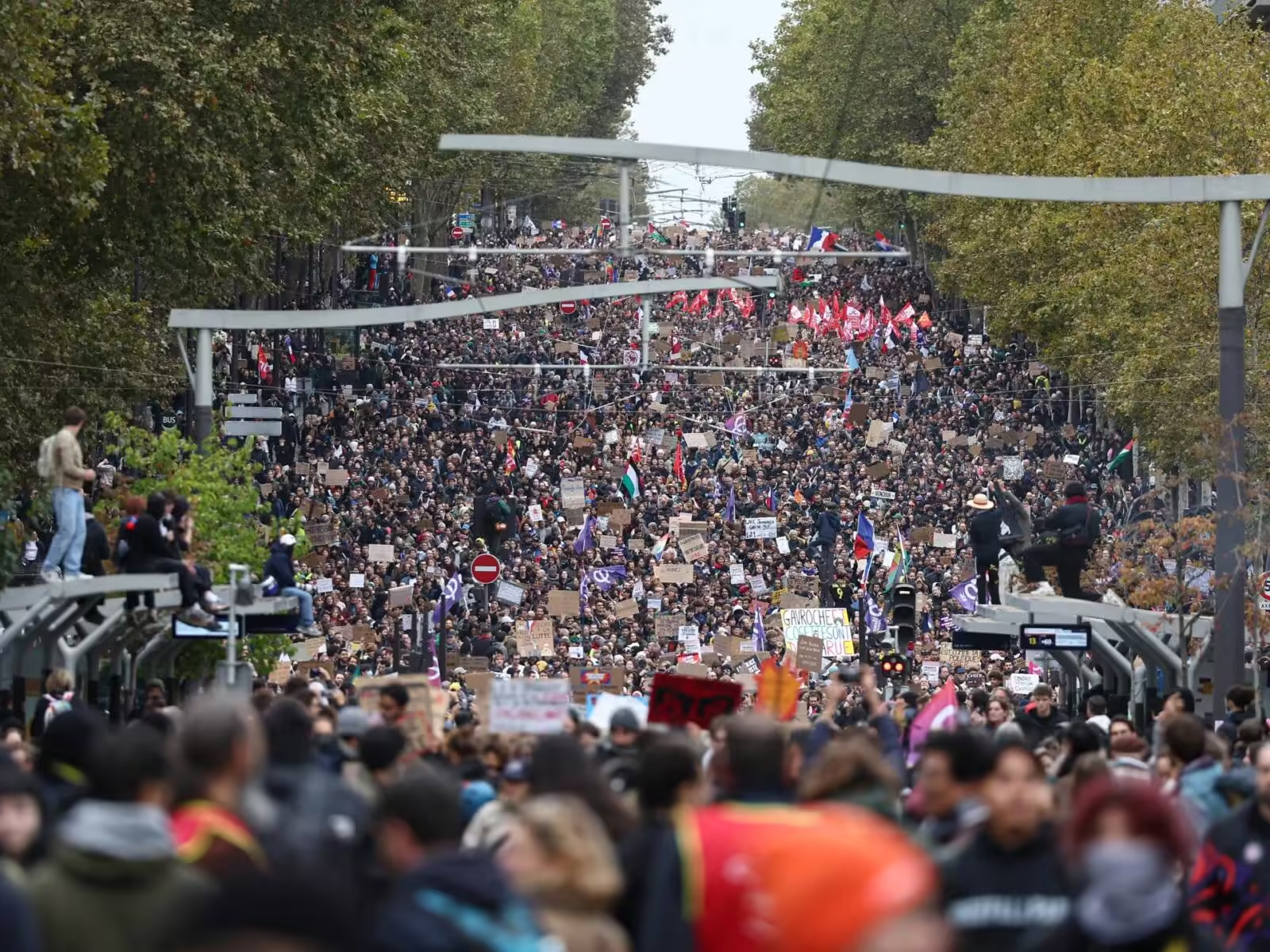

Paris, France – Thousands of people are marching peacefully in Paris as demonstrations kick off across France as part of a second wave of mass protests against deteriorating school conditions and the rising cost-of-living.
A cheerful demonstration started on Saturday in Porte d’Italie and is due to end at Porte de Vincennes, along the Boulevards des Marechaux.
Recommended Stories
list of 4 itemsend of list
Local authorities had indicated that this route on the edge of the city, on the southeastern rim, was the only one allowed after the originally negotiated central road between Place de la Bastille and Place de la Nation was banned.
Other protests organised by groups other than unions have been prohibited. The ban – and the push of the march to the city’s edge – triggered an uproar.
“This is a tactic by the government to try to run the movement out of steam – to try to discourage it,” said Emma, a protester and podcaster who did not give her last name.
“Changing a protest route at the last minute really gives the impression that the government wants to render the movement invisible,” said Monica, who is retired from the public education sector and also did not provide her last name.
Young students, teachers, ecologists as well as nurses and union representatives were marching and dancing amid witty slogans and calls for President Emmanuel Macron’s resignation: “Too many billionaires; We are preparing the revolution,” chanted a group. “We are all anti-fascists,” chanted a second one, echoing a familiar slogan of Italy’s anti-fascist movement.
In central Paris, businesses were shuttered and shop windows covered with protective panels, while some retailers hired private security. At least 24 metro stations were closed at the request of the police prefecture. Major cultural institutions, including the Louvre and the Musee d’Orsay, also closed for the day, while Art Basel Paris cancelled its weekend programme.
At least 135 arrested
The protest comes after authorities announced that more than 70,000 police officers and gendarmes were going to be deployed across the country, determined to prevent Saturday’s demonstrations from descending into the violence that erupted last weekend.
On October 17, protests that had been largely peaceful were marred by widespread looting, vandalism and clashes, with thousands of businesses damaged or ransacked. More than 2,000 people were taken into police custody, according to official figures.
To prevent a repeat, Interior Minister Laurent Nunez said 20 percent more officers would be deployed than during the previous weekend. The operation will also involve RAID, an elite police unit usually tasked with “counterterrorism” and other high-risk interventions. Nunez said its officers would not be directly involved in crowd control but would support other police operations.
Early on Saturday afternoon, the police said they had arrested at least 135 people across the country and seized a variety of weapons. But they also acknowledged that the situation was currently calm.
Meanwhile, the ‘Yellow Vest’ movement – remnants of the grassroots cost-of-living protests that shook France in 2018 – has announced it will hold a protest on October 31.
In several cities, including Montpellier, Rouen and Nice, protests were prohibited in their downtown areas on Saturday. In Marseille, a union-organised march has been authorised under strict conditions. And in Lyon, where demonstrations have been banned in the city centre, police fired tear gas to disperse some 150 people protesting.
On Friday, Macron met representatives of the student movement for the first time since the protests began. He promised more teachers and a deep overhaul of Parcoursup, the admission system to access universities. But the meeting failed to defuse tensions, with student representatives calling for further mobilisation until the government presents concrete actions.
Wider discontent
The protests began in mid-September, when high school students blockaded their schools over what they described as deteriorating conditions, including dilapidated buildings and teacher shortages, as well as what they see as an unfair system for accessing higher education.
The movement has since become a focal point for wider discontent over the cost of living, inequality and Macron’s presidency.
On October 17, more than half a million people took to the streets, following calls from student organisations and remnants of the Yellow Vests.
The unrest comes as France approaches a pivotal presidential election in six months. Macron, who is constitutionally barred from seeking a third consecutive term, will leave office in 2027.
The violence has also put a renewed focus on the far right, whose leading figure, Marine Le Pen, has long campaigned on a promise to restore law and order. Recent polls have placed her as the leading contender for the presidency by a wide margin.
There were tensions in Orleans, where thousands of people yelled anti-fascist slogans against Le Pen’s National Rally, which was holding its party congress on Saturday, marking the start of its presidential campaign.
Authorities expect between 20,000 and 30,000 people to join a counter-demonstration against the far-right party, prompting a major security operation.
Source: www.aljazeera.com