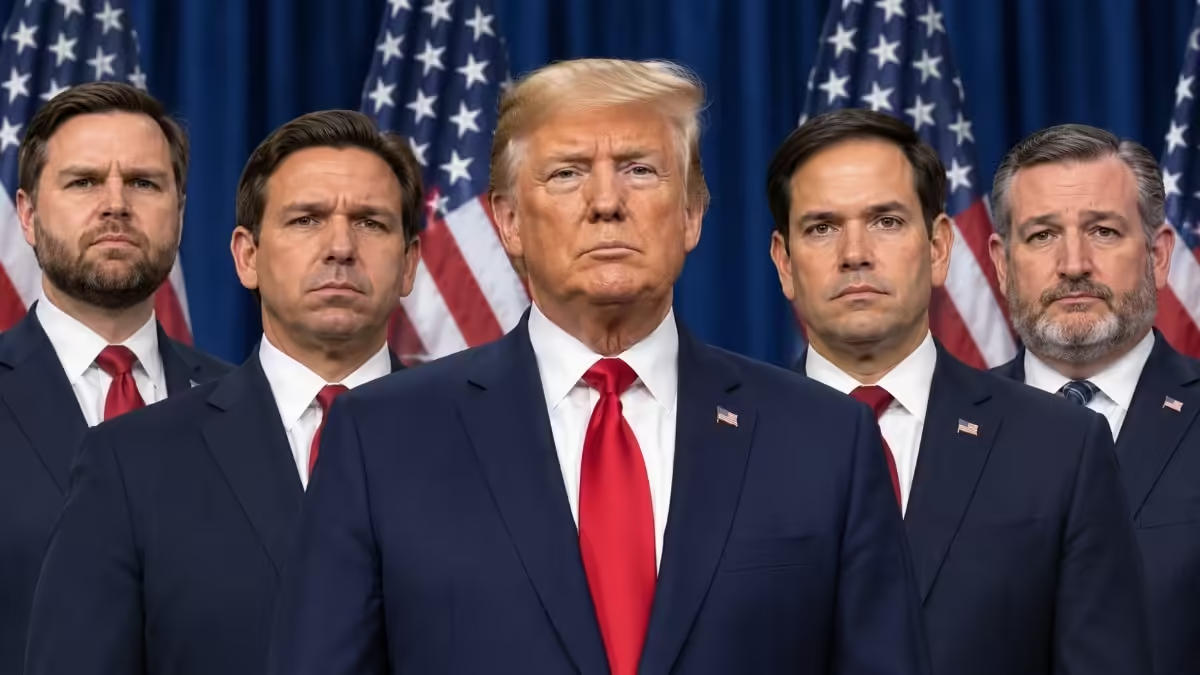

The 2026 midterm elections have dealt Donald Trump the biggest political setback of his second presidency, delivering a sweeping blue wave that has reshaped the balance of power in Washington. Democrats have wrested control of both the House and Senateflipping Republican strongholds in Texas, Kansas, South Carolina, Iowa, North Carolina and Ohio.
The Republican Party is now seemingly facing a dual challenge, of navigating minority status in Congress while contending with the rise of competing power centres within its ranks, as leaders and factions are reportedly beginning to position themselves for a post-Trump America.
The verdict was as much about Trump’s leadership as it was about voter discontent over his handling of the economy, the war in Iran, and governance. What Trump had sought to frame as a personal referendum has turned into a rejection of his presidency.
The knives are out for Trump within the Grand Old Partywith even Vice-President JD Vance and Senator Ted Cruz among those turning against him.
Trump, however, is not going anywhere just yet. He remains in the White House until January 2029 and is constitutionally barred from seeking a third term. But the midterm verdict could mark the beginning of the end of his largely unchecked political influence within the Republican Party.
With Democrats controlling both chambers of Congress, his legislative agenda and key appointments will face tougher scrutiny, while Republicans will have to contend with a party increasingly divided over its future leadership and direction. The battle over what comes after Trump has, in effect, already begun.
A CONGRESSIONAL CHECK ON EXECUTIVE POWER
Democrats flipped seven Senate seats and more than two dozen House seatsaccording to projections from the Associated Press, Reuters and major networks.
In Texas, state representative James Talarico defeated Attorney General Ken Paxton, ending a 38-year Republican Senate streak; Gina Hinojosa ousted three-term Governor Greg Abbott. In Kansas, Adam Hamilton became the first Democrat elected to the Senate since the Great Depression. Paediatrician Annie Andrews flipped South Carolina, the first Democratic Senate win there in nearly three decades. Similar upsets occurred in Iowa, North Carolina and Ohio.
House Minority Leader Hakeem Jeffries is positioned to become the first Black Speaker of the House when the new Congress convenes in January. Senate Minority Leader Chuck Schumer is set to reclaim the majority leader’s role. Jeffries told supporters the results showed Americans “have had enough of the extremism, enough of the corruption” and pledged a focus on affordability, healthcare and oversight. Schumer declared “relief is on the way”.
With majorities in both chambers, Democrats gain subpoena power, committee control and the ability to block or slow Trump’s nominees, including any Supreme Court vacancies and Cabinet appointments. Investigations into administration policies, the Iran war, and family business dealings are expected.
Trump retains the veto and the expansive tools of the executive branch, but the era of unified Republican government that began after the 2024 election ends in January 2027. The new dynamic echoes the latter half of his first term, when a Democratic House constrained him, (and impeached him two times), only now with Senate leverage as well.
Trump’s immediate response sought distance. On Truth Social, he wrote that he “wasn’t on the Ballot and if I was, we would have won IN A LANDSLIDE”, reversing earlier appeals for voters to treat the midterms as a proxy contest for him.
THE REPUBLICAN RECKONING AND INTERNAL POWER CENTRES
The losses extend beyond a simple minority status. They expose fractures and the rise of competing power centres inside the Republican Party that had been subordinated to Trump’s personal dominance for a decade.
Vice President JD Vance, long viewed as the leading heir apparent, campaigned aggressively as a surrogate and Republican National Committee (RNC) finance chair. His stock is now complicated by association with an unpopular presidency and the party’s historic setbacks.
Secretary of State Marco Rubio remains a potential rival with a more conventional profile. Other figures, including Florida’s Ron DeSantis and Texas Senator Ted Cruz, are already positioned in conversations about the post-Trump landscape.
Pre-election analysis from PBS and Reuters noted that a poor fight would force ambitious Republicans to begin distinguishing themselves from the president while still navigating his enduring hold on the base.
Ted Cruz, meanwhile, offered a stark assessment of the Republican defeat, describing the results as a “blue tsunami” and a “Watergate-level repudiation”.
In a lengthy post-election address, the Texas senator said Republicans had not lost because their supporters stayed home, but because voters who had backed the party previously had turned to Democrats. He identified the cost of living, corruption, the Iran war and tariffs among the issues that had fuelled voter discontent, citing Kansas exit polls in which affordability emerged as the biggest concern.
Cruz also called for a rebuilding of the Republican Party, admitting that it had alienated several of its traditional constituencies, including blue-collar workers, young voters, farmers, rural communities and Hispanics. At the same time, he warned that Democrats would use their congressional majority to pursue investigations, subpoenas and impeachment proceedings against Trump and members of his administration. He vowed to resist what he described as Democratic overreach, while calling on Republicans to return to their blue-collar roots and focus on economic concerns.
Republican strategists speaking before and after the results described a coming reckoning.
Some predicted a return to fiscal conservatism and a culling of candidates closely tied to the most polarising elements of Trump’s brand. Others warned that Trump’s personal grip would not dissolve easily; one former adviser likened him to a force that would continue to loom over the party.
The war in Iran, tariffs and economic discontent split elements of the coalition that delivered the 2024 victory. County-level data showed Democrats outperforming 2024 margins by substantial amounts even in Trump-won territory.
The minority status itself creates new centres of influence. The remaining Republican committee ranking members, the party’s governors who survived or were re-elected, and the donor networks that will decide how resources are allocated for 2028.
The most consequential challenge to Trump’s eventual departure might not come from a rival presidential candidate but from the political infrastructure being built around his movement.
Take for instance, the Rockbridge Network, founded by conservative strategist Chris Buskirk. The organisation seeks to bring together wealthy donors, political strategists, data analysts and grassroots activists into a coordinated ecosystem.
Its model goes beyond conventional election campaigning, combining voter databases, targeted outreach and grassroots mobilisation to build a durable support base. Its associated fundraising group, Turnout for America, reportedly spent $34.5 million on grassroots efforts during the 2024 presidential campaign, including door-to-door canvassing and voter outreach in battleground states. The ambition is to ensure that the political machinery powering MAGA survives even when Trump is no longer its face.
LOOKING TOWARD 2028 AND THE LIMITS OF THE PRESENT
The midterms accelerate the 2028 presidential contest.
Democrats will enter the next cycle with governing majorities and the ability to set an agenda on costs of living and institutional oversight.
Republicans must, therefore, decide whether to double down on the populist nationalism that defined the Trump years or to recalibrate toward broader electability.
There is also an ideological blueprint underpinning this transition.
Buskirk describes his political philosophy as “aristopopulism”, an attempt to combine the economic influence of wealthy entrepreneurs with the electoral strength of working-class voters.
It rests on the idea of a “productive elite” that uses capital, technology and innovation to strengthen American industry, rather than an extractive oligarchy that merely accumulates wealth. This vision could give post-Trump Republicans a framework to retain MAGA’s economic nationalism and populist appeal while shifting its leadership towards a network of business leaders, donors and political strategists.
In other words, the movement could outgrow the man who built it without necessarily abandoning the politics that made him powerful.
Neither path is guaranteed success for the party; the same voters who rejected Trump’s allies in deep-red states remain available to either party depending on conditions.
But Donald Trump will not fade quietly. He retains the bully pulpit, the capacity for executive action and a personal following that has repeatedly defied conventional political gravity.
The blue wave of 2026 has ended the period in which Trump’s presidency operated without meaningful congressional resistance and in which the Republican Party operated as an extension of one man’s will. For the remainder of his presidency, Donald will remain in the White House, but he will increasingly be a lame-duck.
– Ends
Source: www.indiatoday.in