
Eclipse Explorer
For a mobile-friendly or full-screen version of this interactive map, visit go.nasa.gov/EclipseExplorer.
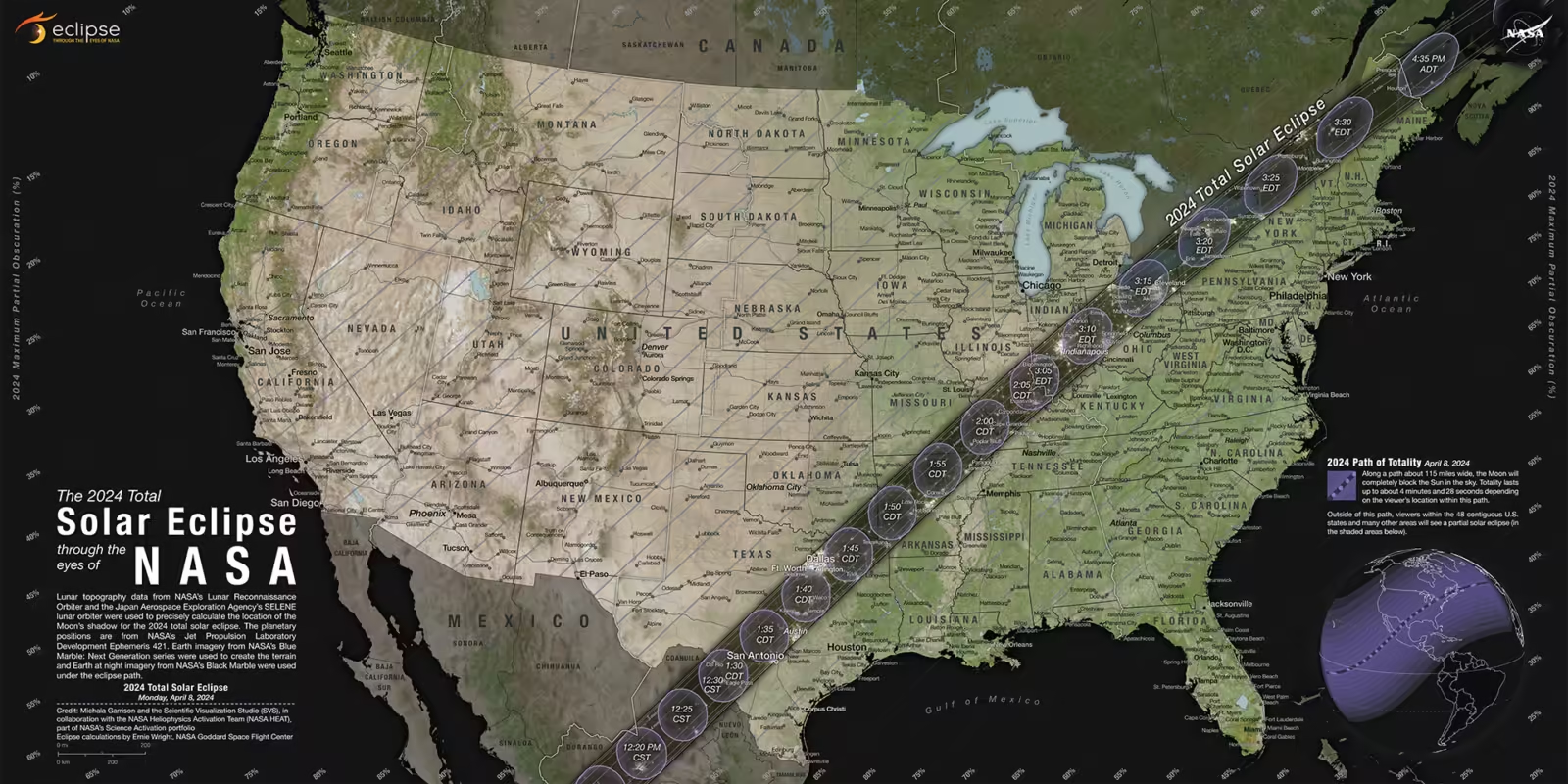
The Monday, April 8, 2024, total solar eclipse crossed North America, passing over Mexico, the United States, and Canada. The total solar eclipse began over the South Pacific Ocean. Weather permitting, the first location in continental North America that experienced totality is Mexico’s Pacific coast at around 11:07 a.m. PDT.
The path of the eclipse continued from Mexico, entering the United States in Texas, and traveled through Oklahoma, Arkansas, Missouri, Illinois, Kentucky, Indiana, Ohio, Pennsylvania, New York, Vermont, New Hampshire, and Maine. Small parts of Tennessee and Michigan also experienced the total solar eclipse. The eclipse entered Canada in Southern Ontario, and continued through Quebec, New Brunswick, Prince Edward Island, and Cape Breton. The eclipse exited continental North America on the Atlantic coast of Newfoundland, Canada, at 5:16 p.m. NDT.
This table provides the time that totality began in some U.S. cities in the path of totality. These areas also experienced a partial eclipse before and after these times.
| Location | Partial Begins | Totality Begins | Maximum | Totality Ends | Partial Ends |
|---|---|---|---|---|---|
| Dallas, Texas | 12:23 p.m. CDT | 1:40 p.m. CDT | 1:42 p.m. CDT | 1:44 p.m. CDT | 3:02 p.m. CDT |
| Idabel, Oklahoma | 12:28 p.m. CDT | 1:45 p.m. CDT | 1:47 p.m. CDT | 1:49 p.m. CDT | 3:06 p.m. CDT |
| Little Rock, Arkansas | 12:33 p.m. CDT | 1:51 p.m. CDT | 1:52 p.m. CDT | 1:54 p.m. CDT | 3:11 p.m. CDT |
| Poplar Bluff, Missouri | 12:39 p.m. CDT | 1:56 p.m. CDT | 1:56 p.m. CDT | 2:00 p.m. CDT | 3:15 p.m. CDT |
| Paducah, Kentucky | 12:42 p.m. CDT | 2:00 p.m. CDT | 2:01 p.m. CDT | 2:02 p.m. CDT | 3:18 p.m. CDT |
| Carbondale, Illinois | 12:42 p.m. CDT | 1:59 p.m. CDT | 2:01 p.m. CDT | 2:03 p.m. CDT | 3:18 p.m. CDT |
| Evansville, Indiana | 12:45 p.m. CDT | 2:02 p.m. CDT | 2:04 p.m. CDT | 2:05 p.m. CDT | 3:20 p.m. CDT |
| Cleveland, Ohio | 1:59 p.m. EDT | 3:13 p.m. EDT | 3:15 p.m. EDT | 3:17 p.m. EDT | 4:29 p.m. EDT |
| Erie, Pennsylvania | 2:02 p.m. EDT | 3:16 p.m. EDT | 3:18 p.m. EDT | 3:20 p.m. EDT | 4:30 p.m. EDT |
| Buffalo, New York | 2:04 p.m. EDT | 3:18 p.m. EDT | 3:20 p.m. EDT | 3:22 p.m. EDT | 4:32 p.m. EDT |
| Burlington, Vermont | 2:14 p.m. EDT | 3:26 p.m. EDT | 3:27 p.m. EDT | 3:29 p.m. EDT | 4:37 p.m. EDT |
| Lancaster, New Hampshire | 2:16 p.m. EDT | 3:27 p.m. EDT | 3:29 p.m. EDT | 3:30 p.m. EDT | 4:38 p.m. EDT |
| Caribou, Maine | 2:22 p.m. EDT | 3:32 p.m. EDT | 3:33 p.m. EDT | 3:34 p.m. EDT | 4:40 p.m. EDT |
Keep Exploring
Discover More Topics From NASA
Source: science.nasa.gov